
New realities taking shape in Eurasia
The 2025 Washington Declaration redefines Armenia–Azerbaijani relations, linking peace with Eurasian connectivity and trade under strategic American leadership.
The August 2025 Washington Joint Declaration on peace and connectivity, branded as the Trump Regional Integration and Peace Project (TRIPP) and signed by Armenia and Azerbaijan with the United States President Donald Trump as witness, is the most consequential advance in Armenian-Azerbaijani relations since independence. Alongside it, the foreign ministers initialed a draft peace agreement, setting the stage for eventual signing and ratification. The declaration creates a framework for practical cooperation, the establishment of a strategic trade corridor and signals a profound geopolitical realignment in the South Caucasus.
Signed in Washington, D.C., the deal marked the U.S.’s emergence as guarantor of peace in Eurasia. Russia, long the external gatekeeper of the South Caucasus, has been forced into strategic patience. Iran, weakened and constrained, lacks leverage to influence the process.
TRIPP, coupled with the initialed peace agreement, reflects more than Armenian-Azerbaijani accommodation: It ties peace to connectivity, elevates the U.S. role, affirms Armenia’s sovereignty, consolidates Azerbaijan and Turkiye’s hub and middle power status, reshapes the connectivity paradigm in Eurasia and creates space for the European Union to put its Global Gateway Initiative and 2025 Black Sea Strategy into action.
Why it is working: Converging factors
The Zangezur Corridor will result from the declaration as the first joint project between former adversaries to reshape the South Caucasus since the Soviet collapse. Its success will be measured less by construction timelines than by the endurance of cooperation under electoral, economic and geopolitical stress.
Russia’s overstretch in Ukraine created a rare opening. For decades, Moscow exploited frozen conflicts as leverage. Now distracted and weakened, it has been pushed into strategic patience, relying on a residual military and economic presence in Armenia, influence over Georgia’s leadership and the hope that Western engagement with Yerevan and Baku proves fleeting.
Facts & figures
Timeline of Armenia-Azerbaijan relations
1923: Establishment of the Nagorno-Karabakh Autonomous Oblast (with a 95% ethnic Armenian population) within the Azerbaijan Soviet Socialist Republic
1988: Nagorno-Karabakh’s legislature passes resolution requesting unification with Armenia
1988-1994: First Karabakh war (approximately 30,000 casualties)
1994: Ceasefire (Bishkek Protocol) brokered by Russia
1994-2020: Episodic clashes and de-facto Armenian control
Sept – Nov 2020: Second Karabakh war (over 7,000 casualties)
Nov 2020: Ceasefire brokered by Russia; Russian peacekeepers deployed to the region
2022: Armed clashes between Armenian and Azerbaijani forces
2023: Azerbaijani forces take full control of Nagorno-Karabakh, most ethnic Armenians flee the region
2024: Formal dissolution of the self-declared Republic of Nagorno-Karabakh, later disputed by its former leadership
Taking full ownership of strategic decisions marked a decisive shift for both Armenia and Azerbaijan. For the first time since independence from the Soviet Union in 1991, both countries pursued direct bilateral negotiations outside Russia’s mediation and the defunct Minsk Group. By taking the lead, they recast peace as a nationally driven strategy rooted in their own calculations of security and development.
Turkiye’s role was pivotal. Acting as a quiet co-guarantor, Ankara shielded the process from Russian interference and invested in its success. Its vision of linking the Turkic world through Nakhchivan (an exclave of Azerbaijan) into Anatolia embeds the corridor within a wider Eurasian network of energy, rail and digital ties. For Armenia, the prospect of normalized trade with Turkiye made peace not only a compromise with Azerbaijan but a gateway to new markets and growth.
Facts & figures
South Caucasus trade route bypassing Georgia
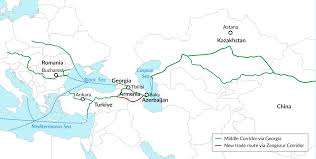
The Zangezur Corridor cuts transit times and offers a sanctions-compliant alternative from China to Europe bypassing Russia and Iran and complements rather than replaces the Middle Corridor passing through Georgia.
U.S. engagement under the Trump administration provided the guarantor. By anchoring TRIPP with memoranda of understanding for both Armenia and Azerbaijan, Washington bypassed Moscow and established a tangible regional footprint. For Armenia, Yerevan tied into Western systems through agreements on border and customs modernization, energy diversification (including civil nuclear) and high-tech development. For Azerbaijan, the agreements created new formats for cooperation, lifted arms restrictions and expanded ties beyond energy to political and security cooperation. Together, these steps reframed the U.S. from being a distant observer to an enduring actor, embedding reconciliation in an American-backed framework of security, investment and guarantees.
The international context has also aligned. Central Asian states, seeking to pivot from Russia’s orbit, have backed alternative westward routes. The EU, through its Global Gateway Initiative and 2025 Black Sea Strategy, began to treat the South Caucasus not only as a transit hub but as a geopolitical anchor. And against the backdrop of Georgia’s rapprochement with Russia, the breakthrough between Armenia and Azerbaijan has taken on even greater significance. Tehran, despite protests, was too constrained to block it.
Economics of the corridor
The Zangezur Corridor rests on solid economics. As part of east-west transport routes, it shortens cargo flows between China, Central Asia, the South Caucasus, Turkiye and Europe – cutting transit times compared to maritime routes and offering a sanctions-compliant alternative bypassing Russia and Iran. Once fully operational, it could move 15-20 million tons of goods annually, complementing rather than replacing the Middle Corridor passing through Georgia.
Facts & figures
The Zangezur Corridor explained
The Zangezur Corridor, also referred to as the Nakhchivan Corridor, is a transport route that will connect Azerbaijan with its Nakhchivan exclave, passing through the Armenian Syunijk Province. The corridor creates an overland transport route between Turkiye, the South Caucasus and Central Asia, economically connecting Europe, China and nations in between. Initially, Armenia opposed the project, citing sovereignty and national security concerns. The 2020 ceasefire agreement brokered by Russia, which ended the Second Nagorno-Karabakh War, includes an article calling for the corridor’s establishment. Construction has since begun and the corridor will provide an east-west transport route that avoids both Iran and Russian-influenced countries such as Georgia.
For China, whose Belt and Road corridors have been strained by sanctions and instability along northern routes, Zangezur offers another channel to Europe, strengthening the resilience of overland trade. Beyond transport, pipelines, power grids and fiber-optic links can be layered onto the same route, turning it into a multimodal platform that attracts investment and vests stakeholder interests. In short, the corridor is not only a geopolitical signal but an economically rational project placing the South Caucasus centrally into Eurasian and European trade flows.
Future scenarios hinge on three variables: Armenia’s internal vulnerabilities, the consistency of U.S. and EU engagement, and the trajectory of Russia’s war on Ukraine.
Armenia remains the most fragile link. Fractured politics, weak institutions and the legacy of defeat in Karabakh complicate any peace dividend. Moscow, adept at hybrid disruption, retains levers, such as its base in Gyumri, entrenched economic ties and media influence. Prime Minister Nikol Pashinyan casts the corridor as part of his vision of a “real Armenia”: sovereign, integrated in the West and anchored in development. Yet constitutional changes demanded by Azerbaijan as part of the peace agreement could become a flash point, especially if exploited by Moscow and domestic spoilers ahead of Armenia’s 2026 parliamentary elections. Timing is critical: The faster the framework is operationalized, the harder it becomes to dismantle.
Most likely: South Caucasus moves incrementally to peace and growth
The Washington memorandum of understanding (one year, renewable) is a trial of commitment. Each extension signals alignment while U.S. engagement deepens. Financing is not yet structured, early steps will shape legal and regulatory frameworks. Initial investment is expected from Azerbaijan and Turkiye, with possible EU and private participation. Tangible progress before Armenia’s 2026 elections, such as a pathway for logistics and infrastructure development, will be critical.
The governments in Yerevan and Baku are each likely to pursue bilateral tracks with Washington: Armenia embedding its memorandums of understanding on borders, energy and tech and Azerbaijan advancing cooperation formats, weapons-supply waivers and strategic partnership talks. Constitutional changes before 2026 are unlikely but possible if progress with the U.S., EU and Turkiye advances quickly.
Outcome: Implementation begins without delay, moving sequentially. The corridor becomes a phased yet still fragile architecture for peace, and increasingly difficult to reverse if early results become visible.
Somewhat likely: Russian subversion as the U.S. and EU dawdle
Here, peace holds but economic implementation falters. Russia accelerates hybrid disruption, exploiting Armenia’s Eurasian Economic Union membership to complicate customs and regulatory frameworks, while threatening existing trade benefits to undermine Yerevan’s future gains. Moscow intensifies interference ahead of Armenia’s 2026 elections, abusing media networks and mobilizing diaspora voters.
With operational progress slowed, no finalized peace treaty, Armenia-Turkiye normalization stalled and inconsistent Western engagement, momentum erodes. Prime Minister Pashinyan loses the 2026 elections, and a pro-Kremlin government redefines the process. The corridor may still open but under Russian supervision, with Moscow claiming an integral role.
Outcome: The peace process survives in name but is redefined on Russian terms. Avoiding this path requires consistent U.S. and EU engagement to sustain Armenia’s commitment.
Less likely: A disruptive Russian reentry after the war on Ukraine
This scenario depends on the war in Ukraine ending in a way that frees Russian bandwidth. Moscow would then seek to disrupt the U.S.- and EU-backed framework around TRIPP. Two subsequent pathways then emerge:
Sub-scenario A: Military provocation
Russia could use its base in Gyumri and residual security presence to engineer instability, pressuring Armenia’s leadership – even without a pro-Kremlin coup – to invite Russian “peacekeepers” back. This would restore Moscow as arbiter and reverse Western gains. Turkiye’s deterrence alone would not suffice, only sustained U.S. and EU engagement can deter such a move.
Sub-scenario B: The Abkhazian railway gambit
Moscow pressures Georgia to reopen the Soviet-era railway through Abkhazia, creating an alternative east-west link attractive to Armenia and reasserting Russia as a connectivity player. Yet this remains unlikely; reopening carries huge political costs in Georgia, where the link is deeply unpopular and past attempts have failed.
Outcome: Both sub-scenarios are low-probability but high-impact, not restoring Russian primacy, but disrupting momentum, complicating Western frameworks and reminding all actors of Moscow’s enduring capacity to spoil.