Prof. Der Mugrdechian Speaks to Osher Institute Class on Armenian Culture
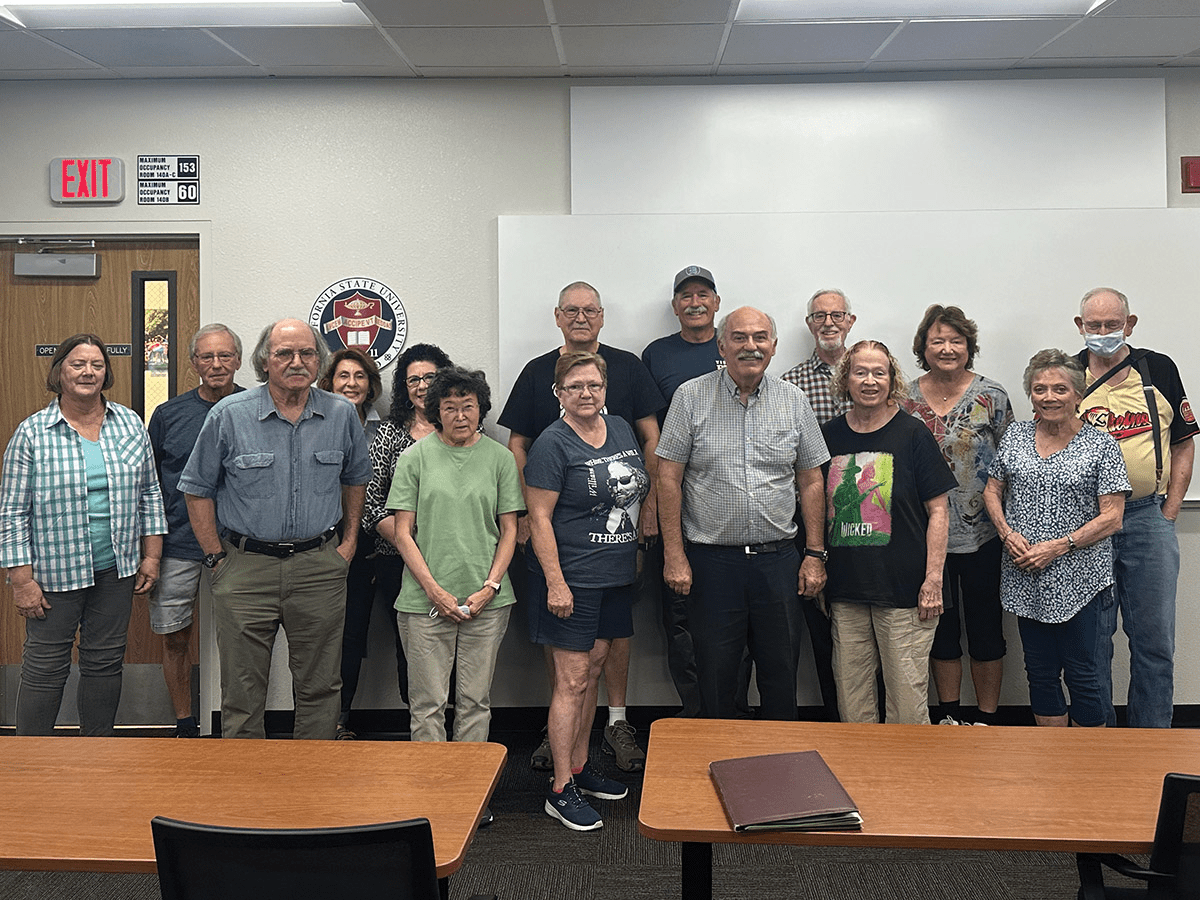
The Osher Life Long Learning Institute (OLLI), a program at Fresno State designed for adults ages 50 and up who want to keep learning simply for the joy of it, invited Prof. Barlow Der Mugrdechian to teach a class, “Armenian Church: Culture and Language,” on two consecutive Mondays, October 6 and October 13. The course covered the origins of Christianity in Armenia and the role of the Armenian Apostolic Church in shaping Armenian identity and culture. The first session of the course centered on how Armenia became the first nation to adopt Christianity as a state religion and how that decision continues to influence Armenian life, art, and tradition today.
Prof. Der Mugrdechian began by situating Armenia’s conversion within the broader context of early Christianity’s spread through the Mediterranean world. While no country was officially Christian in the early fourth century, Armenia’s King Trdat the Great converted to Christianity in 301 AD, making Armenia the world’s first Christian nation.
Christianity quickly became central to Armenian identity, and church building flourished.
The Holy Etchmiadzin Cathedral, constructed in 303 AD, became the headquarters of the Armenian Church. Made from volcanic tufa stone and crowned with a dome, Etchmiadzin established the architectural style that defines Armenian churches worldwide. It remains one of the four main religious centers of the Armenian Church, together with the Catholicosate of the Great House of Cilicia in Antelias, Lebanon; the Armenian Patriarchate of Jerusalem, and the Armenian Patriarchate of Constantinople.
Prof. Der Mugrdechian also explained the Church’s hierarchy, headed by the Catholicos of All Armenians, currently His Holiness Karekin II. The office of Catholicos has shifted locations throughout history as the church adapted to political upheavals, including the fall of Armenian kingdoms and the Armenian Genocide that forced the Catholicosate of Cilicia to relocate from Sis (in present-day Turkey) to Antelias, Lebanon. Despite these challenges, the Church preserved unity through its structure and democratic election of leaders, reflecting both its religious authority and national character.
The Armenian Apostolic Church belongs to the Oriental Orthodox communion and does not accept the Council of Chalcedon (451 CE), which distinguished between Christ’s divine and human natures. Instead, the Armenian Church affirms the oneness of Christ’s nature, aligning it with the Syrian, Coptic, and Ethiopian Orthodox Churches. Its liturgy, known as the Badarak, has been preserved in Classical Armenian since the fifth century. Chanted hymns (sharakans) and the Eucharist form the heart of the service, connecting worshippers to centuries of unbroken tradition.
“Even here in Fresno, the Divine Liturgy is celebrated in classical Armenian,” noted Prof. Der Mugrdechian. “It hasn’t changed in 1,500 years. The language gives an air of mystery to the Liturgy.”
Christianity profoundly influenced Armenian art, architecture, music, and literature. Prof. Der Mugrdechian illustrated this through illuminated manuscripts like the Queen Mlke Gospel and the works of the 13th-century painter Toros Roslin. St. Gregory of Narek, the tenth-century mystic poet, embodied the spiritual depth of Armenian Christianity in his Book of Lamentations, a collection of meditative prayers still revered today. Prof. Der Mugrdechian also played hymns such as “Soorp Soorp” and “Hayr Mer,” noting that “Armenian music is really embodied in the Armenian Church music, and it was all inspired by Christianity.”
In concluding the first class, Prof. Der Mugrdechian emphasized that the Armenian Church remains a unifying force for Armenians worldwide. From Etchmiadzin to Fresno, the same liturgy, prayers, and rituals connect communities across continents. The Church’s influence extends beyond spirituality, it serves as a cultural and social anchor for diaspora Armenians, preserving language, tradition, and identity. As
“It is the one institution that still ties Armenians, no matter where you live in the world,” stated Prof. Der Mugrdechian. “I can go to France and attend an Armenian Church, and it is exactly the same service as in Fresno.”
Through this presentation, it became clear that Christianity in Armenia is not just a religion but a foundation of national identity. The lasting impact of the Armenian Apostolic Church continues to illuminate the past and unite Armenians in faith and heritage today.
The Osher class continued on Monday, October 13.
The Armenian language and alphabet occupy a central place in Armenian cultural identity, historical continuity, and literary tradition. Rooted in an ancient civilization between Europe and Asia, Armenian culture has evolved through eras of political change, linguistic development, and intellectual achievement.
On Monday, October 13, Prof. Barlow Der Mugrdechian of the Armenian Studies Program, continued his two-part special lecture series with the Osher Life Long Learning Institute, focusing on the Armenian alphabet and language, which provided general information on Armenia’s cultural history and literary development. He opened his presentation by teaching those in attendance simple phrases in Armenian: Ինչպէս? ես: (How are you?) and Ես լաւ եմ: (I am fine).
Armenia is one of the world’s oldest continuous civilizations, with archaeological evidence such as a 5,000-year-old leather shoe and the world’s oldest known winery discovered in the Areni- 1 Cave complex. Ancient maps, including the World Map of Eratosthenes (3rd century before Christ), position Armenia near the center of the ancient world, dating back to 95 before Christ. The term “Armenia” emerged in the 6th century before Christ in Greek and Persian sources, while Armenians traditionally refer to themselves as Hay and their homeland as Hayastan. The republic’s ongoing cultural roots are present in the development of the modern-day capital of Yerevan and art installations like the 2008 statue of famous Armenian author William Saroyan.
The Armenian alphabet was created in 406 AD by the priest and scholar St. Mesrop Mashtots, though the spoken language had been present for at least 4,000 years prior. The original alphabet contained 36 letters, with two additional letters (Օ, Ֆ) added in the 12th century. The alphabet was designed not only for communication, but also to support the translation of religious texts, which helped solidify Christian identity in Armenia after its adoption of Christianity in 301 AD.
According to Prof. Der Mugrdechian, the creation of the alphabet initiated the 5th-century Golden Age, a period of remarkable intellectual and cultural production.
Major achievements of the era included the translation of the Bible from Hebrew and Greek. Notable historians and authors of the era were Agathangelos, Ghazar Parpetsi, Movses Khor-enatsi, and Yeghishe. These works played a crucial role in preserving Armenian national memory and religious identity.
Over centuries, geographic separation and foreign influence created distinct dialects. The ancient language, referred to as classical Armenian (krapar), is now only used in the Armenian Apostolic church. By the 19th century, two standardized written branches emerged: modern Eastern Armenian and modern Western Armenian. Modern Eastern Armenian was developed in Eastern Armenia under the Russian Empire and is based on the dialect of Tiflis (Tbilisi). It is spoken today in the Republic of Armenia, Iran, Georgia, Russia, and newer diaspora communities.
On the other hand, Modern Western Armenian was developed in Western Armenia under Ottoman rule, and is based on the Constantinople (Istanbul) dialect. It is largely spoken in the Middle East, Europe, and the Americas.
Armenians developed manuscript illuminations that are preserved today in Armenia’s Matenadaran (manuscript library). Notable manuscripts are the King Gagik Gospels and the Mughni Gospels from the 11th century. As Armenian literature evolved, the shift from manuscript to print further transformed intellectual life.
The first Armenian printed book was published in Venice in 1512, followed by the first printed Armenian Bible in Amsterdam in 1666.
During this time, modern Armenian prose and poetry emerged in both the Eastern and Western branches of the language. In Eastern Armenian literature, figures such as Khachatur Abovian, author of Wounds of Armenia, the first modern Armenian novel, and Hovhannes Tumanyan, author of Akhtamar and Anoush, played pivotal roles. Western Armenian literature produced equally influential figures, including the romantic poet Bedros Tourian and the symbolist poet Daniel Varoujan, as well as the writer Krikor Zohrab; both Varoujan and Zohrab were killed during the Armenian Genocide.
Ultimately, the Armenian alphabet and language are far more than systems of writing and speech-they are enduring pillars of Armenian identity and cultural resilience.
From their ancient Indo-European origins, to the Golden Age of translation and the emergence of modern dialects, Armenian linguistic traditions reveal centuries of adaptation, creativity, and survival.
Prof. Der Mugrdechian concluded the presentation by teaching more phrases to the attendees, giving them a chance to see, listen, and even repeat a language that dates back thousands of years.