How Armenia Opened the Door to Putin’s Weaponized Orthodox Christianity
In the decades since the fall of the Soviet Union, Vladimir Putin has reemphasized the role of the Russian state not only in the realm of material security but also in spiritual warfare. The Kremlin’s domestic and foreign policy alike now rest on an ideology that fuses Orthodox Christianity, nationalism, and nostalgia into a doctrine of civilizational preservation. In this worldview, Moscow is not merely a political capital but a “Third Rome,” the last guardian of Christian faith against moral decay.
Besides in Ukraine, nowhere has this “holy geopolitics” been more visible than in the South Caucasus. Once the southern edge of the tsarist and later Soviet empire, the region remains central to Moscow’s claim of spiritual stewardship over Eastern Orthodox civilization. But in Armenia, the world’s first Christian nation and historically one of Russia’s closest religious allies, that theology is meeting unexpected resistance.
For two centuries, Russia positioned itself as the protector of Eastern Christians, a role inherited from Byzantium. During the tsarist period, Moscow’s expansion into the Caucasus was justified as a crusade to defend Orthodoxy against the spread of Islam. The 19th-century wars against Persia and the Ottoman Empire were shrouded in sacred language, with phrases such as “liberating the faithful” rather than annexing territory.
That narrative persisted even through the Soviet era, paradoxically repurposed under an atheistic guise as “liberating the working peoples” from imperial oppression. When the USSR collapsed, Russia’s new rulers rediscovered religion as both domestic glue and foreign currency. The Russian Orthodox Church (ROC), once persecuted, has become the central pillar of Russian soft power, funding cultural centers, restoring monasteries, and mediating conflicts across the post-Soviet space.
By the mid-2000s, the fusion of Kremlin policy and clerical mission, sometimes referred to as “Orthodox geopolitics,” had become a defining feature of Putinism. While NATO deploys bases, Russia deploys bishops.
The South Caucasus occupies a unique position in Russia’s imperial imagination, representing the crossroads of Orthodoxy, Islam, and ancient Christianity. Georgia, predominantly Orthodox, remains Russia’s estranged sibling; Armenia, with its Apostolic Orthodox Church, is historically close yet theologically distinct; Azerbaijan, a Muslim and Turkic nation, lies beyond Orthodoxy’s reach but within Moscow’s geopolitical periphery.
For Russia, maintaining influence here requires not only military presence but spiritual leverage. After the 2020 Nagorno-Karabakh (Artsakh) war, Russian peacekeepers and clergy were deployed together; the military to enforce order, the Church to enforce narrative. The Russian Orthodox Church’s Department for External Church Relations (DECR) held joint liturgies in occupied Armenian churches, projecting Russia as the “true guardian” of Christian heritage. It was a subtle but powerful gesture, implying that Moscow, not Yerevan, was the rightful custodian of Christianity in the Caucasus.
When Armenian Prime Minister Nikol Pashinyan’s government began its campaign to marginalize the Armenian Apostolic Church, defrocking priests, defaming bishops, and jailing archbishops, the Kremlin saw opportunity. Russian media quickly reframed Armenia’s internal crisis as proof of “Western moral decay infiltrating the East.” State broadcasters like Russia Today and Sputnik Armenia ran segments portraying the Apostolic Church as “under attack by liberal forces backed by the West.” In this narrative, Putin becomes the protector of faith not only in Russia but in neighboring lands where “Western secularism” threatens spiritual order. Moscow’s message is clear: while Yerevan abandons its Church, Russia defends its own.
This moral asymmetry carries strategic implications. By aligning itself with Orthodoxy, Moscow positions Russia as a civilizational alternative to both Western secularism/liberalism and Turkic Islamism. Armenia’s government, by contrast, appears spiritually adrift, a nation-state unmoored from its cultural roots, seeking Western approval at the cost of its own identity. To many observers across the region, the optics are damning: Armenia, the disciple of European democracy, looks less moral than the dictator of Moscow.
Within Russia’s foreign policy apparatus, the Patriarchate functions almost as a shadow ministry of diplomacy. Patriarch Kirill I regularly meets foreign clergy and heads of state, advancing narratives aligned with Kremlin policy. Through entities like the Russkiy Mir Foundation, Moscow funds religious schools, translation projects, and restoration of Orthodox sites abroad, often in strategically sensitive regions.
As Western sanctions constrict Russia’s economy, soft power becomes its most resilient export. Faith is immune to embargoes. Pilgrimages, inter-church dialogues, and “peace missions” cost little but yield legitimacy. In the global South — from Syria to Serbia — Russia’s religious diplomacy provides symbolic parity with the West’s human rights discourse.
In this light, the Caucasus becomes a proving ground for what one Russian analyst calls “sanction-proof sovereignty.” While the U.S. lectures about democracy, Russia baptizes its influence in Orthodox iconography.
This strategy resonates not only with believers but with secular elites disillusioned by Western double standards. The narrative of “spiritual authenticity versus liberal hypocrisy” has gained traction even among non-religious Armenians frustrated by what they perceive as Western indifference during the Karabakh crisis.
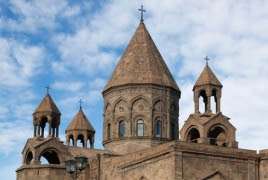
For the Kremlin, bringing Armenia under its spiritual umbrella would symbolize the restoration of imperial unity. For Armenia’s faithful, however, such absorption would mean cultural extinction. The Apostolic Church, born in the first century and shaped by martyrdom, predates both Moscow and Constantinople (also known as Byzantium). Its survival through millennia of empire testifies to its refusal to submit.
This theological independence is therefore a form of geopolitical resistance, and precisely why both Moscow and Yerevan’s secular elites seek to weaken it. The first for domination; the second for convenience.
The contest between Russia and the West in Armenia is no longer fought in the language of ideology, but in that of sacred imagery. The Kremlin brands itself as the guardian of faith, while the West brands itself as the guardian of freedom. Armenia, caught in between, risks losing both.
In Yerevan, protesters carry crosses and national flags side by side, symbols of a unity the state refuses to acknowledge. In Moscow, Patriarch Kirill blesses icons of Russian soldiers “defending Christian civilization.”
For Armenia, the lesson is clear: spiritual independence is a matter of national security. Rejecting Russian control does not mean abandoning Christianity; it means reclaiming ownership of faith from all empires, Western, Eastern, or domestic.
The Armenian Apostolic Church remains one of the few institutions that commands respect from both East and West, from Moscow to Rome, as well as from the diaspora and the homeland. Leveraging that soft power could restore Armenia’s diplomatic balance, positioning it as a bridge between civilizations rather than a pawn among them.