Christian Solidarity International Meets with Karekin II, Jailed Archbishop
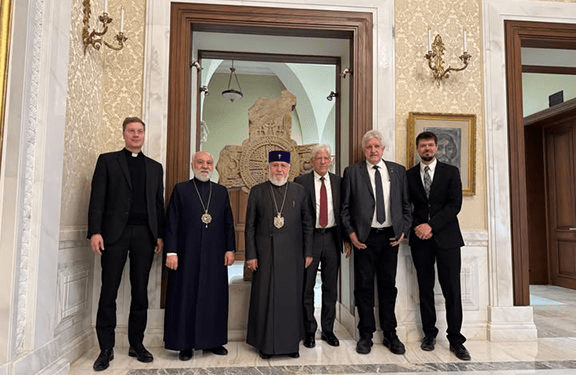
The CSI delegation meets with Catholicos Karekin II in Etchmiadzin on Feb. 3
A delegation of Christian Solidarity International on Tuesday met with His Holiness Karekin II, Catholicos of All Armenians at Holy Etchmiadzin and Archbishop Bagrat Galstanyan who was jailed following the government’s crackdown of the Armenian Church and opposition activists last June.
“The Armenian Apostolic Church has been steadfast in defending the rights of the 150,000 Armenian Christians ethnically cleansed from their homeland in Nagorno Karabakh/Artsakh,” CSI said in announcing its delegation’s visit with the Catholicos.
The delegation included CSI President John Eibner.
“As a result, the Church is now under attack by Turkey, Azerbaijan, and the Armenian government itself,” CSI said in its social media post.
“CSI stands in solidarity with the Armenian church in the face of this persecution,” added the post.
Eibner and his colleagues are in Yerevan to report on their conclusion after attending a prayer breakfast there last year organized by a pro-government group. During the breakfast and that time, Eibner called out the Armenian government for is persecution of the Armenian Church.
The CSI delegation also visited Archbishop Galstanyan, who has been in custody since June. The jailed cleric handed a letter to the delegation, which was read during the CSI’s press conference, jointly held by the Armenia-based Armenian Center for Political Rights. Galstanyan’s letter was addressed to the International Religious Freedom letter that kicked off in Washington on Tuesday.
“I am incarcerated today for a simple reason,” Galstanyan told the International Religious Freedom Summit in the letter from prison published Tuesday and read at the Yerevan press conference by Eibner. “My offense is to speak an unwelcome truth – that the Christian Armenian nation faces an existential threat.”
Earlier in the day, a CSI delegation joined by Erich Vontobel, a member of the Swiss parliament, visited Archbishop Bagrat in prison in Yerevan.
The prison visit came as religious freedom experts, advocates and NGOs are gathered in Washington, DC for the International Religious Freedom Summit, and ahead of a planned visit by U.S. Vice President JD Vance to Armenia and Azerbaijan this month. The Archbishop also wrote a letter to Vice President Vance.
Archbishop Galstanyan is one of four bishops who have been detained by the Armenian government in the last eight months. Dozens of others have also been detained, including church workers, lawyers for the detained clergy, family members of the clergy, and public supporters of the church.
The prime minister has publicly pledged to remove the head of the worldwide Armenian Apostolic Church, Catholicos Karekin II, from his position, and replace him with a figure chosen by a state-appointed committee.
Over the weekend, the government charged six bishops with “obstructing a judicial act” and banned them from leaving the country ahead of an Episcopal Assembly planned to be held in Austria on February 16-19. The decision by the Church to hold the Assembly outside Armenia was meant to foster an environment free from state interference.
“This is another escalation in the government’s campaign against the church,” said Eibner at the press conference. “These attacks are designed to render the church incapable of being a voice for Armenia’s national interests.”
According to Archbishop Bagrat’s letter, the government’s campaign against the church is part of a larger effort by Turkey and Azerbaijan to “turn Armenian into a vassal state.” “A crucial part of this project is to rob the Armenian Apostolic Church of its ability to speak with an independent voice in society,” he said.
In September 2023, Azerbaijan attacked Artsakh and ethnically cleansed it of its 120,000 Armenian Christian inhabitants. The Armenian Church has publicly supported the right of these Armenians to return to their homeland, which has led senior Azerbaijani officials to call the Church “an obstacle to peace.”
Rafael Ishkhanyan, the president of the Armenian Center for Political Rights, pointed to an international conference held in Bern, Switzerland, in May 2025, where the Catholicos, the head of the Armenian church, called for the repatriation of Armenians to Nagorno Karabakh and freedom for the Armenian hostages held by Azerbaijan.
“This was the trigger” for the government’s anti-church campaign, he argued. “We are now in the third phase of this campaign – where it is starting to affect the rights of individual believers.”
The ACPR published a comprehensive report on the anti-church campaign in December 2025.
Erich Vontobel, a member of Switzerland’s National Council, introduced a motion mandating the Swiss government to hold a peace forum between Azerbaijan and representatives of the displaced people of Artsakh, to facilitate their safe return. The motion was approved by the parliament in March 2025.
“In Armenia, one hears at the highest level, that the case of Nagorno Karabakh is closed,” Vontobel said, referring to statements from Armenia’s prime minister, Nikol Pashinyan. “We see it differently.”
The Swiss lawmaker shared with the press conference that when he spoke with the Archbishop about the Nagorno Karabakh issue during the prison visit, the archbishop urged him: “Continue!”
“I promise you here and now,” he said, “I and we will do what we can. The case of Nagorno Karabakh is not closed yet. As long as the displaced people have not returned to their homes, the case cannot and must not be closed.”
Father Peter Fuchs, the CEO of CSI-Germany, who also participated in the prison visit, shared a message of solidarity from Christians in Germany to the Armenian Church. He noted that when Pope Leo XIV visited the Armenian Patriarchate in Istanbul two months ago, he expressly sent greetings to Catholicos Karekin II – recognizing him as the rightful head of the Armenian church.
“This solidarity is more important than ever,” he concluded.