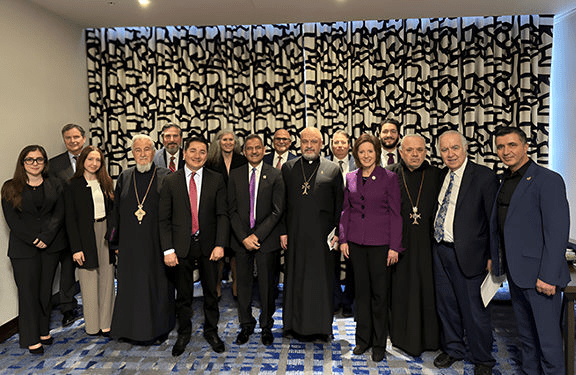
Harut Sassounian’s prepared remarks at the International Religious Forum in Los Angeles on Feb. 19, 2026
I will start by presenting the first of my three short topics:
It is a well-documented fact that Armenian churches, graveyards, and sacred symbols have been wholesale desecrated and destroyed in Azerbaijan and Turkey.
What else can one expect from the Turkish government that committed mass murder and genocide in 1915? Do you think that they are going to value buildings more than the people they massacred? Removing the religious heritage of Armenians, Assyrians, and Greeks is the next illegal act after eliminating the indigenous people. Destroying their heritage is intended to cover up the massacres. Eliminating their houses of worship and cemeteries is a sinister way to wipe out the last traces of those who lived on these lands for millennia, as if they never existed.
During the 2020 Nagorno Karabagh War, Azeri soldiers brutally decapitated Armenian soldiers they captured in violation of the Geneva Conventions and constituting a war crime. They also raped and mutilated captured Armenian female soldiers.
Since the 2020 war and the occupation of the entire region of Nagorno Karabagh in 2023, Azerbaijani forces have desecrated and destroyed hundreds of Armenian churches, cemeteries and sacred sites. They commit these crimes openly, by videotaping their illegal actions and proudly displaying their evil deeds to the world.
Regrettably, the destruction of Armenian churches did not start in 2020. For over a century, the government of Azerbaijan has destroyed hundreds of Armenian churches and houses of worship. Such destruction took place not only on the territory of Nagorno Karabagh, but throughout Azerbaijan. We should not forget the mass destruction of thousands of sacred Khachkars or carved cross stones.
The British newspaper The Guardian described it as the “attempted erasure by Azerbaijan of its Armenian cultural heritage, including the destruction of thousands of UNESCO-protected ancient stone carvings.” This is “the 21st century’s most extensive campaign of cultural cleansing.” It took place in Djulfa, located in the Azerbaijan enclave of Nakhichevan, a historic Armenian region. There used to be around 10,000 Khachkars, the earliest dating back to the 6th century. After much destruction and plunder, around 3,000 Khachkars remained. In the year 2,000, UNESCO declared them to be a world cultural heritage site.
On Dec. 15, 2005, a large group of Azeri soldiers descended on the cemetery and methodically destroyed all 3,000 Khachkars. They loaded the debris onto trucks and dumped it into the Araxes River. Satellite images prove this destruction. Not surprisingly, Azerbaijan has denied that Armenians ever lived there. This was the final act to eliminate all traces of Armenians living in Nakhichevan for centuries.
I urge this panel to issue a statement in defense and preservation of Armenian Christian sites in the Republic of Azerbaijan from further destruction.
My next topic is the war unleashed by Armenia’s Prime Minister Nikol Pashinyan against over 1,700 year old Armenian Apostolic Church, its leadership, and clergy in Etchmiadzin, the Church’s worldwide headquarters.
It all started last May when Pashinyan called for the resignation of the Catholicos of All Armenians, Karekin the First, the Supreme head of the Armenian Apostolic Church, by accusing him of violating his vow of celibacy and escalating the charge to an accusation of being the agent of foreign powers, meaning Russia.
In the meantime, the Armenian government ordered the arrest and imprisonment of four high-ranking Armenian clergymen on dubious charges, many of them unfounded. Most recently, the government banned the travel of six other bishops and the Catholicos Karekin the First by accusing them of defrocking a disobedient Bishop. The aim was to disrupt the gathering of Armenian bishops this week in Austria.
I must say that the Armenian government’s actions have nothing to do with religion, the church or legalities. They are purely a political prosecution aiming to eliminate all those who criticize the Prime Minister before the upcoming parliamentary elections in June.
By these actions, the Armenian government is violating the Armenian Constitution’s provision on the separation of Church and State. It is also a violation of the European Convention on Human Rights that Armenia has pledged adherence as a member of the Council of Europe.
Furthermore, the Prime Minister in recent months has criticized the content of sermons delivered in Armenian churches, has decided who should be Catholicos, and which member of the clergy can be defrocked. The constitution bars the government from meddling in the internal affairs of the Church, which has its own long-established canonical rules for handling such matters.
Regrettably, I don’t see many expressions of outrage by the international community. I urge this panel to make a public statement condemning the unwarranted and illegal interference of the Armenian government in the internal affairs of the Church.
The third and last issue I would like to cover is the situation of Armenians in Jerusalem which is under Israeli rule.
For several decades, some Hasidic Jews have been disgracefully spitting on the walls of the Armenian Patriarchate in Jerusalem and attacking physically Armenian Clergymen in the streets of Jerusalem for wearing a cross.
When the Israeli police are called, they either do not show up or show up too late to apprehend the Jewish violators.
A further issue in Jerusalem is the signing of a 98-year lease by the Armenian Patriarch to a Jewish businessman by handing over large chunks of the property of the Patriarchate to build a five-star hotel.