ANC-UK Submits Report to Parliament Inquiry Panel on Artsakh
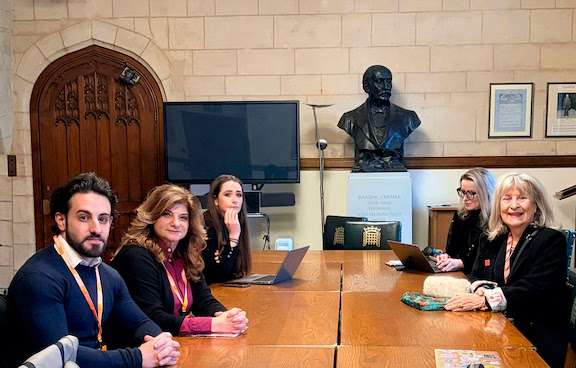
The Armenian National Committee of the United Kingdom on Friday submitted a report to a panel convened in the British Parliament to conduct inquiry into the various injustices against the Armenians of Artsakh by Azerbaijan, including the state-sponsored destruction of cultural and religious sites there.
The UK Parliament Inquiry on Artsakh kicked off on Monday with a presentation examining the destruction of Armenian heritage in Artsakh in 2023 and exploring pathways to justice and accountability.
The Inquiry is conducted by the International Bar Association’s Human Rights Institute (IBAHRI), together with the APPG on International Law, Justice and Accountability and the APPG on Armenia. The cross-party panel is chaired by members of parliament Brendan O’Hara, John Whittingdale, Jessica Morden, and includes the participation Baroness Helena Kennedy, Lord McInnes, Lord Alton and Baroness Hooper.
“The UK Government’s position on the South Caucasus is clear and unchanged: we recognize Azerbaijan’s sovereignty and territorial integrity, and we support the ongoing normalization of relations between Azerbaijan and Armenia as the path to a lasting and peaceful settlement”.
The ANC-UK report presented to the inquiry on Friday set out the legal and historical foundations of the Inquiry, detailing the protections afforded to cultural heritage under the 1907 and 1954 Hague Conventions, the Geneva Conventions, the Rome Statute of the International Criminal Court and UN Security Council Resolution 2347. It further examined the relevance of the Genocide Convention and international jurisprudence recognizing that the intentional destruction of cultural heritage can serve as evidence of genocidal intent.
The report was presented by ANC-UK chair Annette Moskofian and board member, Andre Vartanian. They also fielded questions from the inquiry’s principals and called for:
- Pledge greater aid to the forcibly displaced population of Nagorno-Karabakh;
- Acknowledge that Azerbaijan’s military offensive in Nagorno-Karabakh, viewed through the lens of the blockade and violations of humanitarian law, constituted ethnic cleansing;
- Apply targeted sanctions against members of the Azerbaijani regime responsible for the ethnic cleansing.
- Publicly support the right of return of the population of Nagorno-Karabakh to their homeland pursuant to the terms of the ICJ interim measure, Article 13 of the Universal Declaration of Human Right 1948, Article 12 of The International Covenant on Civil and Political Rights, and United Nations General Assembly Resolution 194 (III);
- Publicly support the facilitation of that return with the installment of multinational or UN peacekeeping force to ensure atrocities cannot be committed against the Armenian people again, along with self-governing rights bestowed to the local population;
- More vigorously lobby for the protection of the cultural and religious heritage of Armenians by international organizations such as UNESCO;
- Curtail Azerbaijan from further claims on the sovereign territory of Armenia and insist on their withdrawal from Armenian territory occupied from 2020 to present.
The panel’s main objective is is to consider the issue of the destruction of cultural heritage of the Armenian people in the Nagorno-Karabakh since 2023, the legal responses taken and those that could be taken to address it, as a matter of urgent international concern. It is also to provide a platform to victims/survivors and civil society organizations working with them to ensure that they shape the recommendations for the UK Government.
“Acts of intentional destruction to cultural heritage are increasingly prevalent during or in the aftermath of armed conflict. Cultural heritage constitutes a unique and important testimony of the culture and identities of people. The degradation and destruction of cultural heritage — whether tangible or intangible — constitutes a loss to the affected communities, as well as to the international community as a whole,” the inquiry said in a statement on its website.
The aims of the Inquiry are to:
- Consider the scale and nature of destruction of cultural heritage in Nagorno-Karabakh since the escalation of the conflict in 2023, and the attempt to erase the traces of the presence of Armenians in the Nagorno-Karabakh, focusing on recent occurrences, and mapping developing trends.
- Explore the legal responses taken to date, with a particular focus on good practices, failed responses, and identifying gaps requiring attention.
- Identify justice and accountability avenues for legal recourse that could be taken.
- Engage the UK Government and international actors with recommendations on assistance to the community.
In its statement issued on Friday, the Embassy said it “does not speak on behalf of the British Parliament, which is a separate and independent arm of power in the constitutional system of Great Britain…. Parliament operates independently from the Government and its hearings, discussions and investigations reflect the positions of individual deputies or parliamentary committees, not the official policies of His Majesty King Charles III’s Government.”