New Children’s Book Depicts Courageous and Hopeful True Story of Genocide Survival
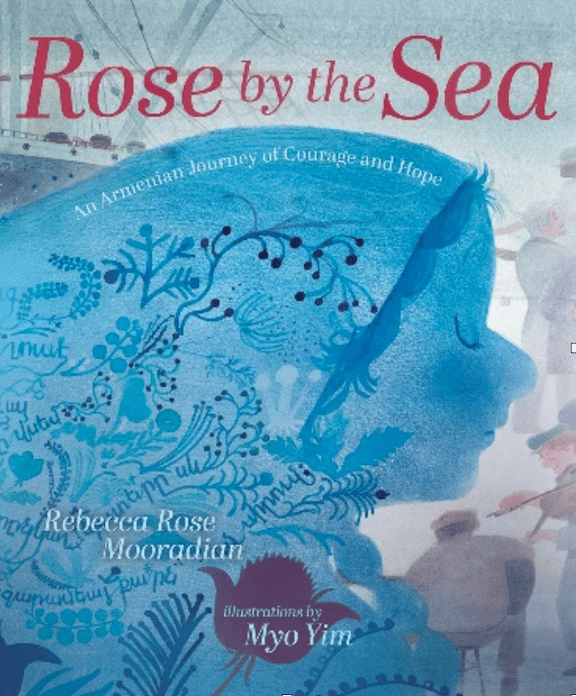
Sharing stories of the Armenian genocide have usually been horrific, but Rebecca Rose Mooradian, whose great-grandparents survived the genocide and came to America, writes a story of hope in a recently released picture book, “Rose by the Sea,” published by Atheneum Books for Young Readers, based on her great-grandmother’s experience.
Rebecca said that growing up, her father told her stories of his grandmother and her escape from Turkish soldiers. She would picture her crossing the desert, young and brave. Though only shadows of the story were passed down to her as a child, she felt that if Dzovinar could overcome so much, then she must certainly possess great strength, too. She felt she owed her existence to Dzovinar’s bravery and refusal to give up, even in the face of unspeakable tragedy.
She continued, “As an adult, I read more about Dzovinar’s story in the memoir “The Repatriate: Love, Basketball, and the KGB,” written by my great-uncle Tom Mooradian, who learned more details from Dzovinar’s sister, Ardemis.
“My great-grandmother was born on the banks of the Euphrates River, the last of her mother’s children. Hername comes from ‘Dzov,’ meaning lake or ocean, and ‘na,’ meaning flower or rose. When Dzovinar was about nine years old, the Turkish army came and burned down her village of Ileja while she was out playing in the fields with her sisters, Miram and Ardemis. Though her surviving family believed her to be dead, Dzovinar was taken in and hidden by a Turkish family until missionaries secured her safety. At the age of fifteen, she sailed across the ocean to Kitchener, Canada, where she married my great-grandfather. They eventually settled in Delray—an immigrant community in Detroit, Michigan, where they raised three sons and a daughter. In America, Dzovinar was able to reconnect with her brother, Garabed, and send news of her survival back to Ardemis, who had fled to Greece.”
With familial pride Rebecca relayed that as a mother and grandmother, Dzovinar was said to be generous and loving, and she never spoke of the events of the genocide. It was as if she desired to protect her children fromever knowing the depth of the sorrow she carried.
She emphasized, “I do not tell her story to remember the pain and violence that exists in the world, that has existed since the dawn of time. Instead, I remember her as one who would not be broken. Hers is the story of the Armenian people: forced from her home by tragedy, with her family scattered to the winds, she survived and grew stronger. She took root in a new land. She blooms.