Turkey caught in the vortex of a widening Iran war

After months of trying to head off a US-Israeli war with Iran, Turkey now finds itself caught in the middle of it — and deeply concerned that a prolonged, regionalized conflict could pose serious security, economic, and political risks. Last week’s developments showed that Ankara’s fears are already becoming a reality.
On March 4, North Atlantic Treaty Organization (NATO) air and missile defense systems intercepted an Iranian ballistic missile headed toward Turkey, reportedly aimed at the Incirlik airbase in the country’s south. According to Turkey’s Ministry of Defense, the missile was launched from Iran and, after passing through Iraqi and Syrian airspace, was detected en route to Turkish territory. NATO assets deployed in the Eastern Mediterranean intercepted and destroyed it before it could cross into Turkey. Debris that fell in the southern Turkish border town of Hatay was identified as part of the interceptor missile used to neutralize the threat.
On March 9, NATO air defense intercepted a second Iranian ballistic missile after it entered Turkey’s airspace. Turkish Foreign Minister Hakan Fidan conveyed Ankara’s protest to his Iranian counterpart after the first incident and warned him that “next time, Turkey will respond in kind,” according to a Turkish official. Iran’s military denied that Tehran had fired missiles at Turkey and insisted the Islamic Republic respects its sovereignty.
But political dynamics inside Iran make such assurances difficult to rely on. The US and Israeli strikes that began on February 28 have killed a number of senior military and political figures, including Islamic Revolutionary Guard Corps (IRGC) chief Mohammad Pakpour and Supreme Leader Ayatollah Ali Khamenei, who previously had the final say on all matters of state. With its leadership badly weakened, Iran has activated its so-called mosaic defense strategy, designed to empower local IRGC commanders in wartime. The IRGC’s decentralized command-and-control structure gives lower-ranking commanders greater authority to respond to the ongoing US-Israeli air campaign. The move enables Iran to continue its attacks even if its military leadership is eliminated but also increases the risk of uncoordinated drone and missile launches that could trigger unintended escalation. The only clear guiding strategy appears to be one agreed upon before the war: expand the conflict across the Middle East and increase the cost for US President Donald Trump, especially by disrupting regional trade and energy flows.
All of that raises serious security risks for Turkey, a country that sits at the crossroads of some of the world’s most critical energy and trade routes. One particularly vulnerable asset is the Baku-Tbilisi-Ceyhan (BTC) oil pipeline. Running from Azerbaijan through Georgia to the Turkish Mediterranean port of Ceyhan, the pipeline supplies oil to European markets and also accounts for roughly one-third of Israel’s imports. Iran has signaled it could target the BTC pipeline. Azerbaijan has already said it foiled several “terrorist” sabotage plots linked to Iran’s IRGC, including an attempt to attack the pipeline. An attack on the BTC would be more than a security incident. Any disruption to the pipeline would have a significant impact on global energy prices, delivering yet another blow to Turkey’s struggling economy.
A prolonged war — especially if tanker traffic through the Strait of Hormuz is disrupted further— could push oil prices, already trading above $100 a barrel, up even higher. Due to Turkey’s dependence on imported energy, higher oil prices would immediately drive up its import bill. According to economists, for every $10 increase in the price of oil, Turkey’s current account deficit is expected to increase by $7 billion, adding new inflationary pressure across the economy. Turkish officials the author spoke to say Iran and its allies still possess tens of thousands of drones, missiles, and rockets — enough to sustain the conflict for four to five months. For Turkish President Recep Tayyip Erdoğan, that would be a nightmare scenario at a time when he had been hoping to stabilize the economy ahead of possible early elections in 2027.
Another major concern for Turkey is the possibility that the US or Israel could arm Iranian Kurdish groups linked to the Kurdistan Workers’ Party (PKK), a Kurdish militant organization that has waged a war against the Turkish state for decades. Ankara views this as a serious security threat given its large Kurdish population — and the timing could not be worse domestically. Turkey has been negotiating with the PKK’s imprisoned leader, Abdullah Öcalan, to end the group’s decades-long insurgency. The talks are part of Erdoğan’s broader political strategy to secure the support of the pro-Kurdish party in parliament so he can run for another term in the next elections, a move that would require amending the constitution. Early last year, Ocalan called on the PKK to lay down its arms and dissolve, and the group announced it would. But the process has stalled, partly due to disputes over integrating the PKK’s Syrian affiliate into Syria’s military.
Meanwhile, the PKK’s Iranian branch, the Kurdistan Free Life Party (PJAK), rejected Öcalan’s call. Shortly before the Iran war began, PJAK and several other Iranian Kurdish groups formed an umbrella organization — an apparent effort to present a united front against Tehran ahead of the February strikes on the regime. After the war began, Trump publicly encouraged Iranian Kurds to take up arms against Iran, saying, “I think it’s wonderful that they would want to do that. I’d be all for it.” His comments followed reports that the CIA was considering arming Kurdish forces to help spark an uprising inside Iran.
Although Trump later walked back his earlier remarks, saying he did not want Kurdish fighters from Iraq to join the war against Iran, Ankara fears that mobilizing Kurdish groups remains part of Israel’s broader strategy. Turkish officials are worried that empowering these groups would not only pose a direct security risk to Turkey but could also derail its fragile disarmament talks with the PKK. One Turkish official who spoke with the author said, “If anything on the Iranian Kurdish front threatens our security, we will respond with force.”
Another troubling consequence of the Iran war for Turkey is unfolding in the Eastern Mediterranean, where Ankara is already locked in disputes with Greece and Cyprus over energy and security. Following a drone strike believed to have been carried out by Iran or its proxies on a British military base in Cyprus, which is a key hub for Western aerial operations in the Middle East, Greece dispatched two frigates and four F-16 fighter jets to Cyprus.
In another move that worries Ankara, Athens deployed Patriot air-defense missiles to the island of Karpathos in the Dodecanese, near Turkey’s western coast, saying the step was meant to strengthen protection against ballistic missile threats. Turkey argues that placing long-range Patriot systems on Karpathos violates the demilitarized status of the Dodecanese islands. Turkish officials fear that the growing military buildup in the Eastern Mediterranean could further tilt the regional balance against Turkey. In response, Ankara deployed fighter jets to ensure the security of the Turkish Republic of Northern Cyprus, the Ankara-backed de facto state that covers the northern third of the island, established in 1974.
The war is still in its early days, but it has already created serious economic and security challenges for Turkey. President Trump and Israeli officials say the conflict could last for weeks, raising the risk that other regional countries targeted by Iran may be drawn in. Turkish officials, however, believe the Iranian regime is far from collapsing and could sustain the fight for months — a scenario Ankara is desperate to avoid.
That is why Turkey has been at the forefront of efforts to de-escalate and bring the war to an end. But many in Ankara believe they have little leverage over its course, arguing that it was Israeli Prime Minister Benjamin Netanyahu who ultimately persuaded Trump to launch the war. As one Turkish official put it, “When push comes to shove, Trump listens to Netanyahu — no one else.”
Gönül Tol is a Senior Fellow at the Middle East Institute
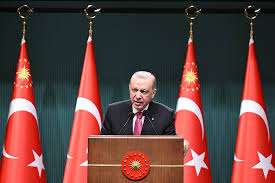
Photo by Mehmet Ali Ozcan/Anadolu via Getty Images