Why Peace Failed: Hrair Balian’s Anatomy of the Nagorno-Karabakh Conflict
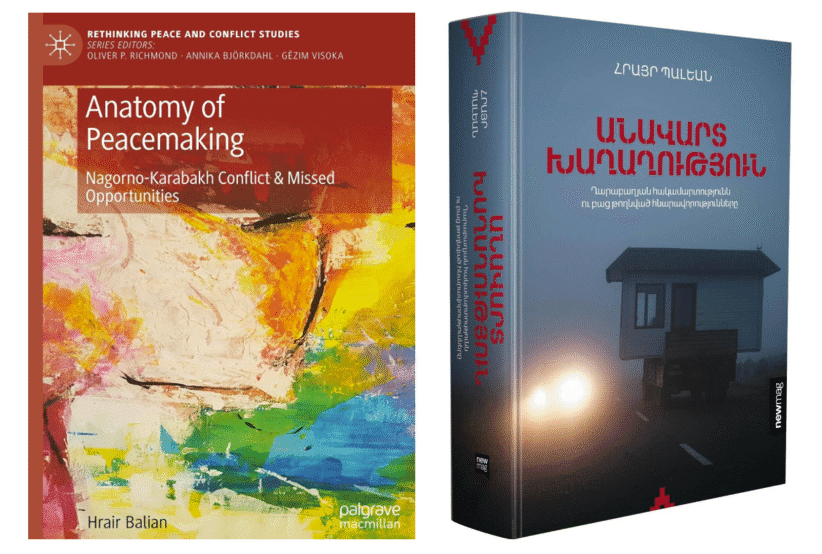
Palgrave Macmillan has published Hrair Balian’s substantial volume Anatomy of Peacemaking: Nagorno-Karabakh Conflict and Missed Opportunities. Newmag is expected to release the Armenian edition of the book soon.
Balian brings decades of experience in conflict resolution across various regions of the world, and in this work he successfully combines his practical knowledge with academic methodology through meticulous source comparison, comparative reconstruction of different phases of negotiations, and parallel reading of legal and political arguments within international frameworks.
The book presents the Nagorno-Karabakh conflict not only within its own historical and political context, but also alongside other international conflicts, revealing both structural similarities and distinctive characteristics.

The study is heavily document-based and often resembles a diplomatic chronicle, examining negotiations that lasted more than three decades. It is perhaps the first work to consolidate nearly the entire accessible documentary record of the Nagorno-Karabakh conflict. Yet Balian does not limit himself to presenting archival material or retelling familiar political episodes. He places them within a broader framework of comparative conflict analysis, international law, and the interaction of major powers’ political calculations.
A particularly notable aspect of the book is its use of negotiation theory, especially the concept of BATNA (Best Alternative to a Negotiated Agreement). This provides a useful lens for understanding how the conflicting sides assessed their options beyond the negotiating table.
The author shows that for a long time, both the Armenian and Azerbaijani sides operated under the assumption that they had more advantageous alternatives outside negotiations—whether due to time, military recovery, or expectations of changes in the international environment. It was precisely this perception that repeatedly reduced political willingness for compromise and contributed to the prolongation of the negotiation process. From this perspective, Balian explains why even relatively advanced understandings failed to evolve into final agreements.
Azerbaijan had more room for costly mistakes, whereas each mistake for Armenia carried incomparably heavier strategic and political consequences. “Structural asymmetry of power often condemns negotiations to failure from the outset. When one side significantly surpasses the other in military, economic, or political strength, it is usually less inclined toward difficult concessions, because it has a more advantageous alternative outside negotiations—the use of force,” the author writes.
One of Balian’s most important contributions is that he presents not only the various settlement proposals but also their internal logic: why one proposal replaced another, why certain formulations changed, and what role disagreements among mediators played. In that sense, the book is not simply a collection of documents, but an anatomy of negotiating architecture.
Balian’s work also draws on his personal interviews with former presidents, foreign ministers, officials involved in negotiations, international mediators, and other actors. This gives the study not only documentary depth but also an opportunity to reconstruct internal political logic, showing how decisions were shaped through closed discussions, mutual distrust, and at times personal political calculations.
One of the strongest sections of the book is its discussion of the relationship between the principles of self-determination and territorial integrity, especially in the context of the International Court of Justice’s advisory opinion on Kosovo.
The author does not attribute the failure of peace to a single actor or decision, but treats it as a cumulative process in which regional power calculations, domestic political constraints, and societies’ lack of readiness for compromise were interconnected. Balian avoids reproducing exclusively Armenian or Azerbaijani narratives.
Libaridian–Guluzade channel
The book devotes special attention to the secret negotiations of 1995–96 conducted by presidential advisers Gerard Libaridian and Vafa Guluzade.
According to the author, these contacts outside formal mediation frameworks were important because they marked one of the first attempts to discuss mutually acceptable general principles before broader international formats had fully consolidated.
At the same time, Balian shows that the process suffered from structural weaknesses from the very beginning: the talks depended heavily on political trust between the two individuals. They lacked sufficient institutional durability, broad domestic support, or public preparation. As a result, even when certain understandings emerged, they did not develop into a stable political process.
In the author’s view, another limitation of these early contacts was that they unfolded amid rapidly shifting power balances and mutual distrust. In this sense, he presents the Guluzade–Libaridian dialogue not as a ready-made missed solution, but as an early experiment whose structural fragility would later reappear in subsequent phases of negotiation.
The 1999 land-swap proposal
The 1999 “land swap” remains one of the most discussed yet least fully documented episodes in the history of the Nagorno-Karabakh settlement process. Over the years, public and political discourse has often described it as an agreed or nearly agreed formula whereby Armenia would cede the Meghri region, or part of it, in exchange for Nagorno-Karabakh, thus providing a direct land connection between Azerbaijan and its exclave of Nakhichevan. Balian warns that such simplified perceptions do not correspond to the full documentary record.
He avoids reproducing hardened interpretations and shows that declassified materials from the United States Department of State offer only a partial picture of the negotiations. Balian concludes that assumptions suggesting presidents Robert Kocharyan and Heydar Aliyev had effectively reached a “Meghri for Karabakh” agreement do not directly follow from those documents. At most, he argues, they leave important questions unanswered but do not permit conclusions about a final deal.
This unfinished negotiating logic of 1999 was later reformulated and became more clearly defined during the 2001 Key West negotiations, where Heydar Aliyev gave preliminary consent — only to withdraw it shortly afterward — to Nagorno-Karabakh joining Armenia in exchange for a sovereign-use corridor across southern Armenia toward Nakhichevan, without severing Armenia’s land connection to Iran.
In Balian’s account, Key West emerges as a rare moment when negotiations moved beyond general principles and approached the threshold of political decision.
1997 plan vs 2007 Madrid principles
Balian closely examines the various proposals presented by the OSCE Minsk Group and pays particular attention to a topic still frequently debated today: the similarities and differences between the 1997 step-by-step proposal and the 2007 Madrid Principles.
He argues that although the Madrid Principles were formally a package proposal, structurally they were close to the 1997 phased approach. The principal difference lay in the language concerning final status, while the phased logic of settlement remained intact.
The 1997 proposal deferred the question of final status to later negotiations and established no final mechanism, yet it also envisaged international legal and political stabilization of Nagorno-Karabakh’s already existing de facto separate status. According to the document, the security regime around Nagorno-Karabakh would be fixed through an international agreement, with the United Nations Security Council serving as guarantor.
In that sense, the author emphasizes, the 1997 proposal did not guarantee de jure independence, but it nevertheless created a de facto internationally guaranteed status politically close to the interim status logic discussed in later proposals.
However, Balian underlines that it was in the Madrid Principles that, for the first time, the issue of Nagorno-Karabakh’s final legal status was explicitly linked to a legally binding expression of will. Here, the future political process was not merely acknowledged as necessary; a concrete mechanism was proposed, based on referendum logic, whereby the result would express the free will of Nagorno-Karabakh’s population.
The Madrid Principles also articulated the concept of interim status: until final status was determined, Nagorno-Karabakh would operate under its own elected authorities, institutional governance structures, and certain autonomous functions.
Thus, while both documents indeed emerged from phased logic, the main difference was that by 2007 the principle of self-determination had already been materialized in a clearer political structure—through interim status, a mechanism of expression of will, and transitional institutional arrangements.
The author convincingly argues that, even though the 2007 proposal offered more explicit political and legal mechanisms favorable to the Armenian side, the 1997 phased settlement was ultimately more attainable because Armenia and Nagorno-Karabakh were then in stronger positions, the external environment was less polarized, and Heydar Aliyev—unlike his son—was more inclined toward settlement.
Clumsy rhetoric after the 2018 revolution
Despite structural limits in the peace process, the author rightly stresses the importance of individual decisions and the presence—or absence—of political will.
One chapter addresses the negotiating behavior of Armenia’s new government after the 2018 “Velvet Revolution.” Balian shows that after the change of power, sufficient institutional memory regarding foreign policy and the negotiating legacy did not emerge, while the existing negotiating structure was often replaced by political declarations of starting from zero.
He critically examines the notion that negotiations needed to begin on entirely new foundations, disregarding the documentary and political layers accumulated over the previous two decades. In his view, such an approach failed to reflect the real structure of negotiations and reduced predictability for mediators.
The author offers especially sharp criticism of formulations that later became symbolic of an entire political period: “new war, new territories” [statement by Armenia’s defense minister], “I am starting negotiations from my own point” and “Artsakh is Armenia, period” [statements by Armenian Prime Minister Nikol Pashinyan].
According to Balian, these statements not only departed from the cautious logic of diplomatic language but were also perceived as political signals that Yerevan was abandoning even the formal balance of previous negotiations.
He emphasizes that “Artsakh is Armenia, period” was perceived in Azerbaijan as a rejection of the entire negotiation framework. As he writes: “For Azerbaijan, Pashinyan’s statement effectively eliminated even the theoretical possibility of negotiations and dashed hopes that he would be more prudent and flexible than his predecessors.”
This assessment is presented not merely as a description of political reaction, but as an identification of a turning point at which public rhetoric began directly contributing to the collapse of the negotiating environment.
Within the same logic, Balian also examines the thesis that “Artsakh must return to the negotiating table,” which Armenia’s new authorities presented as a principled revision of the process. He shows that, while politically understandable to a domestic audience, the demand did not align with the already-established mediation structure. According to his analysis, the format developed over the years by the Minsk Group co-chairs was built around direct negotiations between Armenia and Azerbaijan, while separate participation by Nagorno-Karabakh lacked internationally agreed foundations sufficient to reorganize the process without jeopardizing the entire mechanism. For that reason, this demand became not an expansion of the agenda, but an additional burden on the process.
The final nail in Karabakh’s coffin
In the conclusion, Balian stresses that while the Minsk Group mediation process had fundamental flaws that contributed to the failure of peacemaking, the greatest responsibility for that failure lies with the conflicting sides themselves.
Armenia and Azerbaijan spent most of the process in maximalist positions, only rarely attempting to move beyond binary thinking and search for creative alternatives. Balian notes that Armenia missed valuable opportunities, while Pashinyan, instead of strengthening weak negotiating positions through deeper alliances, mitigating military asymmetry, and exercising extreme caution, displayed arrogance, erratic, and provocative behavior, and drove the final nail into Nagorno-Karabakh’s coffin.
Translator’s notes
The Armenian and English editions of the book are being published almost simultaneously. While working on the Armenian translation, I was in daily—if not round-the-clock—contact with the author for several months, sharing my observations and editorial suggestions, many of which were also incorporated into the English edition.
The author showed particular meticulousness regarding Armenian and insisted that the text remain as free as possible of foreign vocabulary. I accommodated many of his suggestions and tried, as much as possible, to avoid foreign-derived terminology and vocabulary—at times even against my own preference.
The author and the translator, unlike the conflicting sides described in the book, succeeded in finding mutually acceptable terms.
The Armenian edition of the book will be available in bookstores across Armenia starting in April.