Congress can boost US trade and strike a blow to Iran with Azerbaijan’s help
On March 5, Iranian drones attacked Azerbaijan. Radio Free Europe reported that one damaged a building in the Nakhchivan airport, while another landed near a school. Azerbaijani President Ilham Aliyev declared that Iran had carried out a “groundless act of terror and aggression,” and announced that he had mobilized Azerbaijani forces, saying the soldiers “must be ready to carry out any operation.” Iranian authorities denied that the drones were theirs, arguing that Israel had launched a false flag operation.
The next day, the Azerbaijani security service arrested several operatives of Iran’s Islamic Revolutionary Guard Corps for alleged terrorism and foiled their plots. The targets included the strategic Baku-Tbilisi-Ceyhan oil pipeline, Israel’s embassy in Azerbaijan and Jewish sites.
Today’s open hostility between Azerbaijan and Iran is the latest development in their complex relationship. Iran has long criticized Baku’s ongoing relationship with Jerusalem. An Al Jazeera reporter said Iran has accused Azerbaijan of becoming an “Israeli spy base,” for years. Since 2021, the Revolutionary Guard has been massing troops and heavy equipment along the border to threaten Baku over the issue.
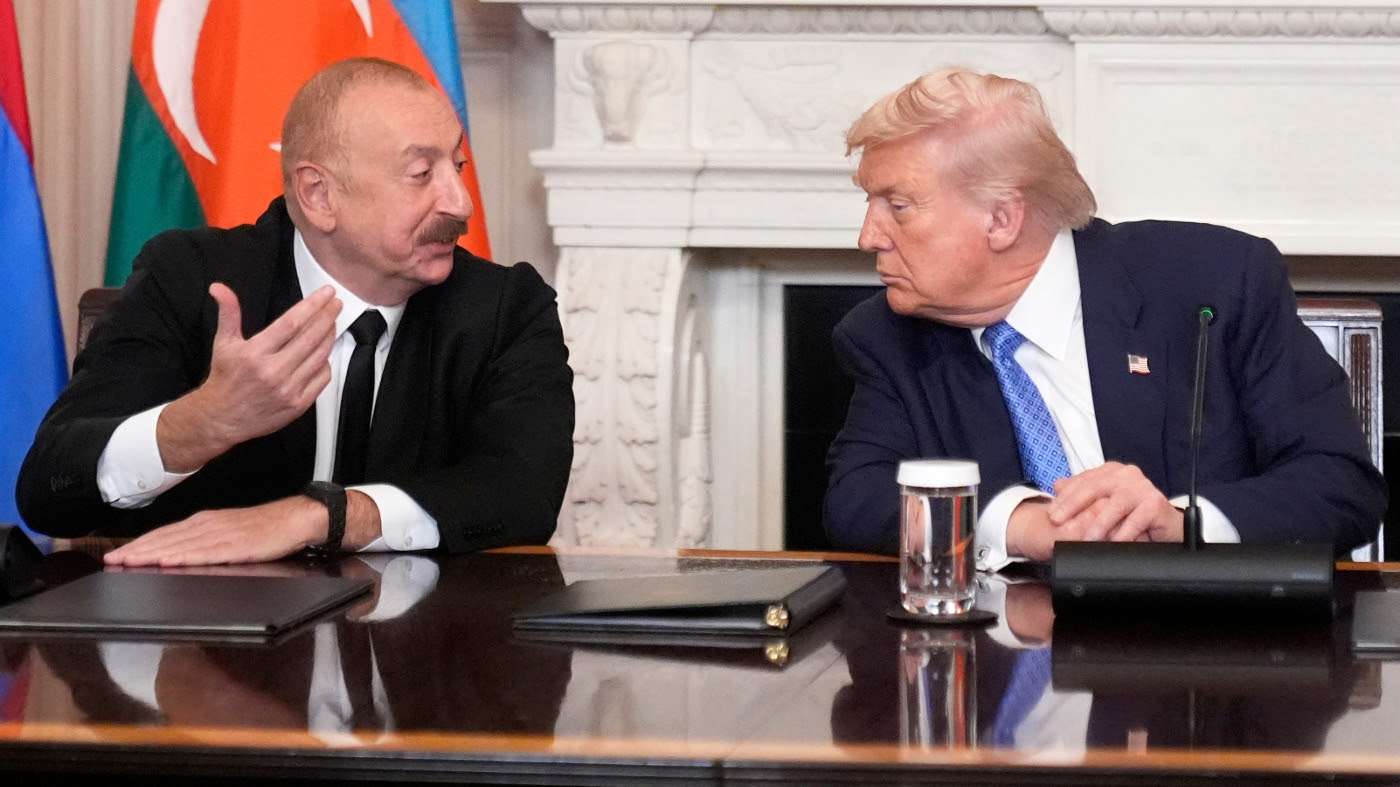
Iranian interests in the Caucasus are nothing new. Azerbaijan’s mere existence as a secular Shi’a state is a rebuke to Tehran’s theocratic pretensions. Moreover, Tehran is openly opposed to the development of the Trump Route for International Peace and Prosperity, announced in August, when U.S. President Donald Trump, President Aliyev and Armenia’s Prime Minister Nikol Pashinyan met in Washington, D.C. to discuss an end to the Karabakh conflict.
The trade route, exclusively leased to the U.S. for 99 years, will cut through Armenian territory to link Azerbaijan with its Nakhchivan exclave and open the way to Turkey and onward to Europe, bypassing Iran and Russia. Tehran fears that this corridor will strengthen the West and Turkey’s position in the region while cutting off Iran’s access to Armenia.
The announcement of the route also upset Moscow. Since the collapse of the Soviet Union in 1991, Russia has viewed the former Soviet republics of the Caucasus as part of its sphere of influence.
Throughout the Karabakh conflict, the Russians served as bad-faith mediators between Armenia and Azerbaijan. The deployment of hundreds of soldiers, ostensibly for peacekeeping, in reality froze the conflict on Russian terms. Moscow’s role was uncertain after Azerbaijan launched a military offensive in Karabakh in 2023 and Russian peacekeepers failed to intervene. Busy in Ukraine, in April 2024, the Kremlin announced its withdrawal from Karabakh. Russia’s status as a security guarantor was degraded as it was unable to assist Armenia, much to Iran’s consternation.
Now, as Azerbaijan’s relationship begins to strain with Iran and Russia, this could be an opportunity for Baku and Washington to strengthen their defense, energy and trade relations. One method would be to repeal Section 907, a statute prohibiting U.S. aid to Azerbaijan unless the president reports to Congress that Baku “is taking demonstrable steps to cease all blockades and other offensive uses of force against Armenia and Karabakh.”
When the Soviet Union collapsed, 15 countries became newly independent across Eastern Europe, the Caucasus and Central Asia. At the time, elected officials and policymakers in the United States debated how the U.S. would engage politically, militarily, economically and in energy relations with these “new independent states.”
This led to the FREEDOM Support Act, aimed at promoting capitalism and democracy across Eastern Europe and Eurasia. Section 907 was included because Armenia and Azerbaijan were fighting the first Karabakh conflict since gaining independence from the Soviet Union. An amendment to the act was passed in 2001, allowing U.S. presidents to waive Section 907 as they deemed necessary.
Since then, three presidents have waived Section 907. President George W. Bush issued a waiver during the global war on terror, as Azerbaijan opened its airspace and territory as a transit route for NATO supply lines to Afghanistan. President Joe Biden waived the measure again, indicating that the Azerbaijanis were aiding American efforts against international terror. Most recently, President Trump waived Section 907 following the U.S.-Armenia-Azerbaijan meeting in August.
These repeated waivers by Democratic and Republican presidents raise the question of why Section 907 has not been repealed in its entirety. It is now outdated and irrelevant, and it interferes with U.S. foreign policy and national interests.
Reassessing restrictions on U.S. aid to Azerbaijan is also timely. The U.S.-Azerbaijan Strategic Partnership Charter announced in February “envisions expanded U.S. arms sales and collaboration in cybersecurity, counterterrorism, and mine clearance.”
While Russia is providing Iran with intelligence to target U.S. forces and China mulls the merits of intervention, the U.S. stands to gain from expanding its partnerships in the South Caucasus. This would also further strengthen Azerbaijan’s economic ties with the U.S. and the West as it seeks to distance itself from Iran and Russia.
A stronger partnership with the U.S. would boost Azerbaijan’s economy through profits from Trump’s planned trade corridor. Meanwhile, closer U.S.-Azerbaijan relations would weaken Iranian and Russian positions in the region, reducing their threats to U.S. national security. Therefore, repealing Section 907 would be mutually beneficial. It is time for Congress to act.
Mark Temnycky is a nonresident fellow at the Atlantic Council’s Eurasia Center and a freelance journalist covering Eurasian affairs.