Vahe Boghosian Preserves Sudanese-Armenian Community History, Boosts Sudanese Image
YEREVAN — Vahe Boghosian is the founder of the first multimedia project on Sudanese-Armenian history, called sudanahye (Armenian for Sudanese Armenian), which documents and preserves the unique history and rich culture of the Sudanese-Armenian community. He has been touring various countries, giving lectures and organizing exhibitions of the archival materials, starting last year in London, Amsterdam and Berlin, and this year in the US at New Haven (Yale University), Boston (Harvard University and several other venues), and New York City.
 Vahe Boghosian (photo Aram Arkun)
“I don‘t think I have a particular skill. I only have love – love for my family, my culture and our history,” Boghosian said in Western Armenian, whilst sitting on the steps of the Matenadaran in Yerevan, the largest center of Armenian manuscripts in existence.Born and raised in London, Boghosian got his his bachelor’s degree in history and his MSc. in security studies. On his mother’s side he is Sudanese-Armenian.

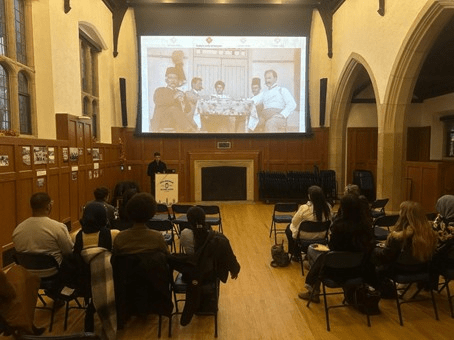
Presentation and panel discussion with Bayan Abubakr and Ameen Mekki titled “Sudanese-Armenian History and the Colonial Legacy in Sudan” organized by Sudanahye and Sudan Solidarity Collective at Barzakh Café in NYC on March 10, 2026 (photo courtesy Vahe Boghosian)
Sarkis Melikian is said to be the first Armenian in the modern period coming to Sudan, where he arrived in the 1840s and successfully set up a trading business between Sudan and Egypt.
An example of a later prominent family of immigrants is the Kurkjian brothers, who founded the Kurkjian Brothers Company which supplied the Sudanese government with food. This company later expanded and began trading with Europe. It turned into an infrastructure and ports company, making roads, bridges and railway lines, according to sudanahye.com. The family was also the main sponsor which funded the building of the Armenian church St. Krikor Lusavorich in Khartoum and was considered as one of the most successful families of the Sudanese-Armenian community.
Boghosian says that in general, Sudanese-Armenians secured themselves an enviable economic position in Sudan, utilizing their entrepreneurial mindset to set up businesses like the examples given above.

Vahe Boghosian at his exhibition “Armenian Life in Colonial Sudan”- at AGBU headquarters, New York City, March 11, 2026 (photo courtesy Vahe Boghosian)
Overall the modern immigration of Armenians to Sudan can be summed up as three major waves, with the first wave being during the Turco-Egyptian rule (about 1820-1880) of Sudan. The second wave came after the Hamidian and Adana massacres in the end of the 19th century/beginning of the 20th century and the third wave after the Armenian Genocide starting in 1915.