The Armenian immigrant who played a pivotal role in saving the USS Constitution was Moses Gulesian
By Bruce Janigian
The 1905 Rescue
At the turn of the 20th century, the Constitution had fallen into severe disrepair and was being used as a floating barracks (essentially a “house ship”). The Secretary of the Navy at the time, Charles Joseph Bonaparte, recommended that the ship be towed out to sea and used for target practice by the North Atlantic Fleet until she sank.
The Telegram: He sent a telegram to the Secretary of the Navy offering to buy the ship for $10,000 (a massive sum at the time) just to save her from such an “ignoble end.”
The Refusal: The Navy replied that they didn’t have the authority to sell a naval vessel to a private citizen.
The Public Campaign: Undeterred, Gulesian used the publicity from his offer to spark a nationwide protest. He organized mass meetings and a petition drive that eventually forced Congress to act.
The Result: Bowing to public pressure initiated by Gulesian, Congress authorized $100,000 for the ship’s restoration in 1906, ensuring she remained a commissioned part of the fleet rather than a target for cannon fire.
About Moses Gulesian
Gulesian was a quintessential “American Dream” story. He arrived in the United States in 1883 at age 17 with only a few cents in his pocket, fleeing persecution in the Ottoman Empire. He eventually settled in Boston and became a highly successful businessman.
He once famously remarked that he wanted to save the ship because, as a foreign-born man, he deeply “venerated the relics that point to the freedom of his adopted country.” He was even made an honorary member of the Sons of the American Revolution, the first immigrant ever to receive that honor.
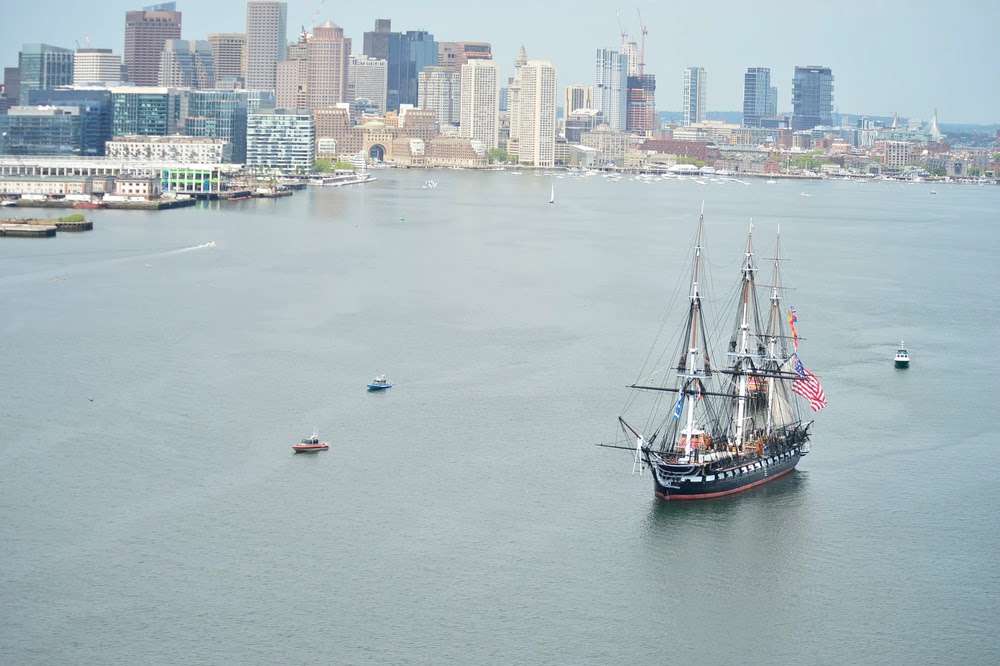
The USS Constitution, famously known as “Old Ironsides,” is the world’s oldest commissioned warship still afloat. Launched in 1797, she remains a powerful symbol of the early United States Navy and its transition into a global maritime power.
Origins and Construction
The ship was one of the original six frigates authorized by the Naval Act of 1794. Designed by Joshua Humphreys, these ships were intended to be the backbone of the young American Navy.
- Materials: She was built in Boston using Live Oak from Georgia, which is significantly denser and heavier than the White Oak typically used in shipbuilding.
- Design: Humphreys designed her to be “over-gunned” and faster than any ship of her class, allowing her to outrun ships-of-the-line (larger battleships) and outfight any other frigate.
The War of 1812: Becoming a Legend
The Constitution earned her nickname and fame during the War of 1812 in a series of dramatic victories against the British Royal Navy.
The Battle with HMS Guerriere (1812)
During a heated exchange, British sailors were astonished to see their cannonballs bouncing off the Constitution’s thick hull. One sailor reportedly shouted:
“Huzza! Her sides are made of iron!” Thus, the name “Old Ironsides” was born. She won the battle decisively, marking a turning point in American naval prestige.
Other Major Engagements
- HMS Java: Later in 1812, she defeated the HMS Java off the coast of Brazil, further cementing her reputation.
- HMS Cyane and Levant: In 1815, she fought and captured two British ships simultaneously, proving the tactical superiority of her design even when outnumbered.
Preservation and Modern Role
By the 1830s, the ship was considered unseaworthy and slated for deconstruction. However, public outcry—fueled by Oliver Wendell Holmes’ poem Old Ironsides—saved her from the scrapyard.