Armenians Gather in Times Square to Commemorate the 111th Anniversary of the Armenian Genocide
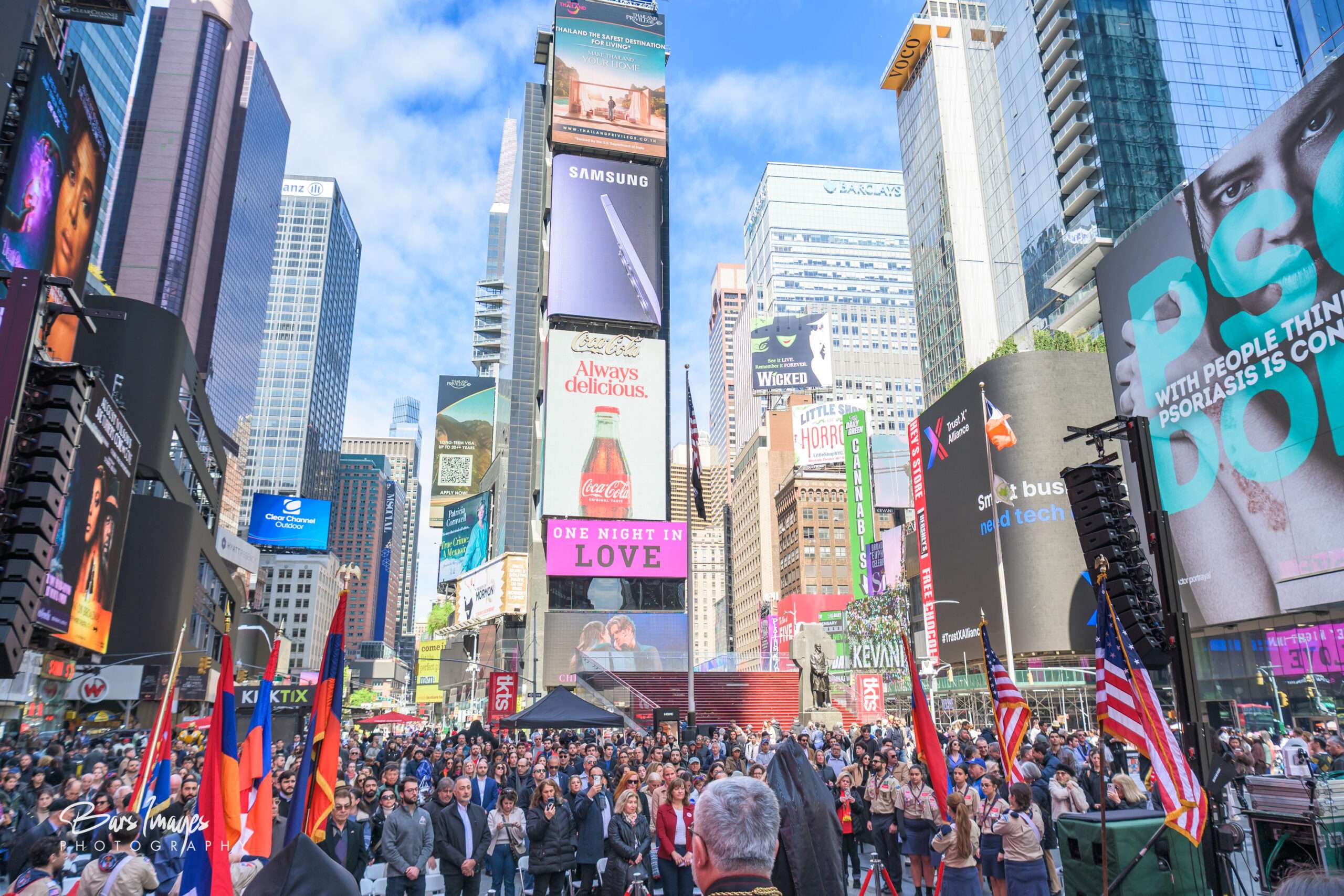
NEW YORK, NY — Hundreds gathered on Sunday, April 26, in Times Square to commemorate the 111th anniversary of the Armenian Genocide at the long-running genocide commemoration event spearheaded by the Knights and Daughters of Vartan. The theme of this year’s event, “Carrying the Past and Claiming the Future,” resonated throughout the day’s speeches and performances, paying homage to ancestral Armenian roots and looking towards the future of Armenian advocacy on Capitol Hill and beyond. Masters of Ceremonies Lucine Beylerian, Chantelle Nasri, and Nairi Diratsouian led the event.
Beylerian opened the program and acknowledged the clergy present, including His Eminence Archbishop Anoushavan Tanielian, Prelate of the Eastern Prelacy of the Armenian Apostolic Church, Very Rev. Fr. Simeon Odabashian, Vicar of the Eastern Diocese of the Armenian Church of America, and The Most Reverend Bishop Mikael Mouradian, Bishop of the Armenian Catholic Eparchy of Our Lady of Nareg, before introducing the speakers.
The crowd observed a moment of silence for the Armenian martyrs and all those who are victims of genocide, violence, and persecution. Those in attendance also paid homage to the cultural landmarks destroyed and hostages held captive by Azerbaijan.
Nasri thanked Vartan Abdo of the Armenian Radio Hour of New Jersey for livestreaming the event. Classical singer Karina Vartanian kicked off the event with a vibrant performance of the Armenian and American national anthems, surrounded by Homenetmen Scouts proudly waving Armenian and Artsakh flags.
Archbishop Anoushavan Tanielian gave the invocation, highlighting the significance of the Times Square Commemoration: “There has been no end to such atrocities,” he said. “The genocide continues today through the actions of Azerbaijan.” He also paid tribute to the atrocities committed against Armenians in Sumgait and Baku, and the 120,000 Armenians forcibly exiled from Artsakh in 2023. “The act has not only been against people. It is also a cultural genocide in Nagorno-Karabakh, which peaked in 2005 with the destruction of thousands of khachkars, most recently with one in Stepanakert.” He highlighted that the Armenian cause is no different than the cause of all minorities worldwide, and that denial, distortion, and oppression will not hold us back. “Our endurance is deeper than oceans and higher than mountains,” he stressed. “We should expect Turkish generations, those who are scouting us right now, to become aware of the facts of history.”
Congressional Representative Frank Pallone (D-NJ) shared the latest legislative work he is sponsoring in Congress in support of Armenians, such as the Armenian Strategic Partnership Act. After discussing the continued importance of justice for Artsakh and the right to return, he outlined his plan to strengthen the relationship between America and Armenia through better military, humanitarian, and economic assistance. As a founding co-chair of the Congressional Caucus on Armenian Issues, Congressman Pallone has been a staunch advocate for the Armenian people, both in the United States and in Armenia. He was instrumental in U.S. recognition of the Armenian Genocide and has supported pro-Armenian legislative actions in Congress. “We can’t backtrack,” he stressed, touching upon President Trump’s refusal to use the word genocide. “It is important to continue to speak out,” he said. “People should be able to go back to Artsakh, and there should be reparations.” He urged the crowd to contact their members of Congress to co-sponsor the Armenian Strategic Partnership Act.
Times Square Alliance board member and chair of community board 4, Leslie Boghosian Murphy, shared her family’s own story of the genocide. “When I stand here among you, I’m reminded that every Armenian carries their own version of this story and the same thread of endurance,” she shared. “I am not speaking about a distant tragedy,” she reminded the crowd. She remained steadfast in her proud Armenian advocacy, “When we acknowledge the truth, we affirm the dignity of us as people.”
The commemoration commended Kathy Hochul’s proclamation of April 24th as Armenian Genocide Commemoration Day. Beylerian also acknowledged New York City Mayor Zohran Mamdani’s affirmative statement on “X” acknowledging Turkey as the persecutors of the genocide, the expulsion of Armenians from Artsakh as “continuing the genocidal campaign that had begun over 100 years prior,” and “the right of all people to freedom, safety, and self-determination,” which drew applause and support from the crowd.
The Master of Ceremonies read statements on behalf of Congressman Mike Lawler (R-NY) and, later, Congressman Tom Kean (R-NJ).
Karina Vartanian performed a powerful rendition of “Groong” by Komitas, and Bishop Mouradian offered his prayers. “We are the voice of our ancestors,” he said. “The blood of our martyrs was not shed in vain. We do not stand as mourners, we stand as builders of the future.” He posed the question: “In a world that struggles with violence, the martyrs challenge us. Will we choose silence, or will we choose courage?” He looked out to the crowd and concluded: “The future we envision is not one of revenge but one of justice.”Shogh Tarpinian of the Armenian Democratic Liberal Party stressed the importance of remembrance. “The time has come for a renewed way of thinking, one rooted in unity,” she shared. She reminded the crowd that we should focus on building a future worthy of such sacrifice.
Dr. Jesse Arlen, Director of the Krikor and Clara Zohrab Information Center at the Eastern Diocese of the Armenian Church of America, began with a quotation from the 11th century describing invasions of Armenian lands, echoing memories more familiar to genocide survivors centuries later. His statement reflected upon the history of Cilicia and the brave Armenians who rebuilt cultural institutions of their homeland on foreign soil. But he then asked: “What about us today?” He reminded the crowd that most Armenians came to America as migrant workers who planned to return home, and this longing for home remains true. The scholar emphasized investing in Armenian resources and cultural institutions here in the United States, especially as Armenian culture is still under threat. He discussed his late sister, Tenny Arlen’s book, To Say with Passion: Why Am I Here? — the first American-born Armenian to produce an Armenian-written work of creative literature. He ended his segment by posing the question: “Can we build a new Armenian Cilicia here?”
The Armfolk Group was brought to New York through the International Arts Fund, as a part of a larger 21-state US tour, supported by the International Youth Cultural Exchange. The Armfolk dancers performed a graceful tribute, paying homage to Cilicia. Following the somber tribute, kanoun performer Yelena Torosyan delivered a vibrant arrangement that echoed throughout Times Square. The dancers returned, clad in forget-me-not dresses, to perform again. Set to an English-language poem recounting the history of the genocide, the performance evolved into a group dance. The performance ended with the dancers unveiling scarves spelling out ‘Armenia 1915.’
Nasri introduced the sponsor and organizer of the commemoration, the Knights of Vartan and its sister organization, the Daughters of Vartan. The Grand Chairwoman of the Daughters of Vartan, Lily Sarkissian, shared remarks. She reminded the crowd of Adolf Hitler’s reference to the Armenian genocide, which led to the Holocaust, paying tribute to her own ancestors who were killed in the genocide.
Grand Commander of the Knights of Vartan Bob Avakian then commended Mayor Mamdani’s statement. He also reminded the crowd of the importance of Armenian genealogy, which creates new bridges of evidence to the genocide. He made note of the Turks who participated in Hrant Dink’s funeral march, acknowledging the Turkish people’s rejection of their government’s denial of the genocide. He shared Taner Akçam’s statement about a path towards the total acknowledgement of the Armenian Genocide.
Sarah Leah Whitson of the Armenian Bar Association highlighted the importance of accountability in her remarks. “We are awash in genocide,” she said. She acknowledged the Palestinian genocide in Gaza and the potential impending genocide in Iran. She condemned the use of the Armenian genocide as a political bargaining chip. She also condemned former mayor Eric Adams for his ties to Turkey and the coinciding corruption and bribery, and also condemned Azerbaijan: “We are horrified that Azeri forces destroyed the largest Armenian church in Stepanakert,” she said. “We have a duty to fight the scourge of racism and hatred, not just for Armenians but for people worldwide. We must seek change and accountability first here at home.” She acknowledged the continued persecution throughout Gaza and Lebanon. She concluded, “We are a symbol of the survival and struggle of our people.”
Bryan Ardouny, executive director of the Armenian Assembly of America, followed: “We stand to honor the unbreakable will of those who survived. Remembrance alone is not enough. In 2023, the world watched as Armenians were ethnically cleansed.” He stressed: “We say, never again means never again, now.” He called upon elected officials to stand for justice — and pointed to the Armenian Assembly Advocacy summit earlier this year, which was a testament to the future in the hands of young Armenians.
Nairi Diratsouian spoke on behalf of the Armenian National Committee of America (ANCA). She proclaimed, “Without universal recognition, the cycle of brutality continues unabated.” She highlighted the destruction of cultural heritage sites and the enduring efforts to perpetuate denial. She noted that though the congressional recognition in 2019 was a step, it remains vulnerable to denial and revisionism: “The survival of the Armenian people is never guaranteed.” She emphasised the role of local, state, and federal government — all critical to the battleground mobilizing communities. “The legacy of our ancestors shapes the future we’re building,” she said. She also advocated for Armenian genocide education, including the passage of the Armenian Genocide Education Act, and for sanctions against Azerbaijan.Aren Kabarajian, co-chair of the AGBU Young Professionals of Greater New York, touched upon the resilience of Armenians. He highlighted that the strength of Armenians lies in our unity, connecting this thread to the history of the AGBU, sharing the work the AGBU accomplished in the aftermath of the genocide. He also advocated for the documentation of the first post-genocide Armenian generation’s stories. He emphasized spending time with our community elders is more crucial than ever: “Remember the cultural identity you have. Let us focus on channeling their strength and endurance. Each of us is here because of our collective history.”
Aram Arkun, executive director of the Tekeyan Cultural Association, touched upon the importance of being the voice for those who are silenced. He pointed to the Turkish demonstration behind the commemoration. “Never again remains just a phrase,” he said. “The struggle not only helps our fellow Armenians, but makes us better people.”
Dr. Henry Theriault, associate vice president for academic affairs at Worcester State University and a leading academic specializing in genocide studies, reminded the crowd of the other ethnic minorities facing similar persecution: “We are also remembering Assyrians and Greeks. The Native Americans, Rwandans, Ukrainians, Bangladeshis, and all the other people who have suffered genocide,” he stressed. “Let’s not forget the Palestinians, the Black Sudanese, those in Brazil, and those in northern Europe suffering the same ways we have.” He discussed the political impacts of genocide, first saying that “Genocide, by its nature, is political,” and then stressed, “Genocide is at the core of the Turkish Republic.” He reminded the crowd that the destruction of Artsakh was explicitly the continuation of the Armenian genocide by the leader of Turkey.
Armenian Evangelical Church pastor Obed Bazikian then encouraged the crowd to get involved in local Armenian churches and communities. He offered a prayer to remember the Armenian martyrs.
Andranik Manukyan of the Gata Band gave a lively solo performance, which brought the crowd to their feet. To accompany the spirited performance, a blend of Armenian folk and pop music, the crowd gathered in dance.
Armfolk returned in new costumes with traditional Marash patterns to perform one final time. The crowd joined in clapping and singing along before Very Rev. Fr. Odabashian took the stage. He offered a prayer to remember the souls of martyrs and to protect Armenian soil. He also prayed to preserve the name of Artsakh and ended with the Hayr Mer prayer.
The Times Square Crowd (Photo credit: Harout Barsoumian-Bars Images)