Azerbaijan’s demolishing of Stepanakert Cathedral is cultural genocide of Christian Amenia
History has taught us that genocide does not end with the removal of a people. It ends with the removal of their memory. In the heart of the South Caucasus, a silent erasure is unfolding.
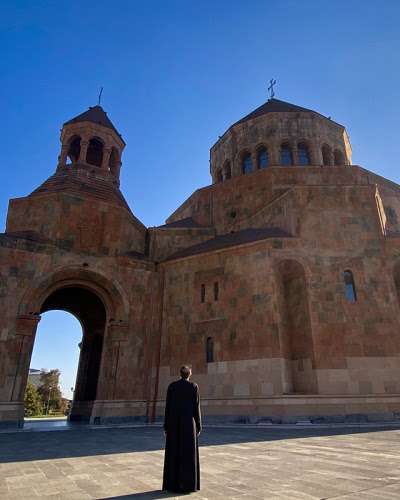
While the geopolitical maps of the region were redrawn following the ethnic cleansing of more than 120,000 Armenians from their ancestral homeland of Nagorno-Karabakh (Artsakh) by Azerbaijan, a secondary, more insidious Azeri campaign is reaching new heights. The latest casualty in this war of attrition is the Stepanakert Cathedral, a sacred landmark and a symbol of Armenian life in Artsakh. Recent satellite imagery and reports indicate the systematic dismantling of this holy site, a move that signifies not just the end of a building, but the deliberate deletion of an entire civilization’s existence.
This is not collateral damage. It is the textbook definition of cultural genocide. In 1915, the world watched as Armenian churches were leveled and its history wiped away. Today, in 2026, the international community’s silence is once again giving Azerbaijan the green light to finish what was started over a century ago.
The destruction of the Stepanakert Cathedral is the most visible symbol of a much larger policy emanating from Baku. For decades, researchers and advocacy groups, including the Cornell-based Caucasus Heritage Watch, warned of a state-sponsored program to “Albanize” or destroy Armenian heritage in the region. By claiming these ancient sites as “Caucasian Albanian,” and removing their Armenian inscriptions, Azerbaijan is essentially using the pretext of a conflict to rewrite history.
This pattern follows a grim precedent when thousands of khachkars (cross-stoned monuments) were destroyed in Nakhchivan between 1997 and 2006. That event was a trial run for what we are seeing today in Shushi and Stepanakert. When a cathedral is demolished in a city emptied of its people, the message Azerbaijan is trying to send is that Armenians were never here, and they can never return.
The destruction of the Stepanakert Cathedral is a direct affront to the International Court of Justice (ICJ). In December 2021, the ICJ issued a provisional measure ordering Azerbaijan to “take all necessary measure to prevent and punish acts of vandalism and desecration affecting Armenian cultural heritage.”
By continuing this systematic destruction, Baku is testing the limits of international law. If the world allows the erasure of a thousand-year-old heritage to proceed unchecked, it signals to every other expansionist power that the 1954 Hague Convention for the Protection of Cultural Property is not worth the paper it was written on.
This broader campaign of heritage erasure also does more than destroy stone and mortar. It fundamentally dismantles the psychological and legal foundations required for true and lasting peace.
For a peace treaty to be more than a temporary ceasefire, it demands a minimum level of trust and acknowledgment of the right to exist. If Azerbaijan can violate these orders with impunity, it tells Armenia that any future peace treaty, which would rely on international monitors and legal guarantees, is essentially worthless. It reinforces the belief that only military strength, not international law, provides security.
There is no denying that the world’s attention is fractured right now with the wars in Iran and Southern Lebanon, yet the cost of inaction in the South Caucasus is high. Cultural genocide is often the final stage of ethnic cleansing. It is the act of making that purge permanent. So, what can the world do to hold Azerbaijan accountable?
For starters, there should be independent monitoring. The UNESCO fact-finding mission, which has been stalled for years, must be granted immediate and unfettered access to the region.
Economic and diplomatic consequences must be tied to the preservation of heritage sites. The destruction of cultural property should be a red line in peace treaty negotiations.
Finally, the international community must support the ongoing cases at the ICJ and the European Court of Human Rights, ensuring that satellite evidence of demolition is met with legal penalties.
History is a shared resource and experience. When a cathedral in Stepanakert is razed, it is not only an Armenian loss. It is a loss for the collective history of the world. We cannot claim to value a rules-based international order while standing by, as a state systematically bulldozes the physical evidence of an entire people’s existence.
The stones of Stepanakert may be silent, but our response cannot be. Accountability is the only way to ensure that the peace and coexistence being arranged in the region isn’t built on the rubble of a vanished culture.
Stephan Pechdimaldji is a communications strategist living in the San Francisco Bay Area. He is a first-generation Armenian American and grandson of survivors of the Armenian genocide. You can follow him on X at @spechdimaldji.