How Armenia Lost Its Strategic Compass
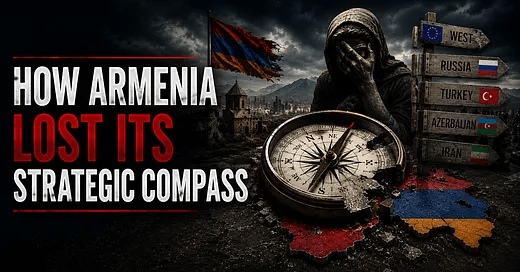
Armenia risks becoming a smaller version of what Syria became: a geopolitical intersection where larger powers pursue competing strategic agendas through local fragmentation.
When I listened to my conversation with Dr. Arthur Khachikyan about Armenia’s future, I had the impression that we were no longer discussing ordinary politics in the South Caucasus. We were discussing the possible extinction of the Armenian state itself, through a long process of managed surrender, psychological exhaustion, geopolitical manipulation, and elite failure that is slowly convincing Armenians to detach themselves from the very foundations that allowed them to survive for centuries.
What struck me most during the discussion was: how does a nation with Armenia’s historical memory arrive at a moment where dismantling its own strategic position is marketed as modernization, where weakening its own state institutions is presented as reform, and where dependency on external powers is sold as sovereignty?
Because this is really the issue now. Armenia is no longer simply debating East versus West. The deeper issue is whether Armenia still possesses the political seriousness necessary for survival in an increasingly brutal geopolitical environment.
And this is where I think many Armenians, especially among the Pashinyan supporters, misunderstand the nature of the world they are entering.
For years, Armenia has been sold the fantasy that geopolitical reality can be replaced by moral branding. That if one speaks the language of democracy loudly enough, waves European flags enthusiastically enough, and distances oneself from Russia aggressively enough, then somehow the hard realities of geography, military balance, and regional power politics will soften. But history does not work that way. Geography certainly does not work that way. And the Caucasus, perhaps more than most regions on earth, punishes illusions mercilessly.
The European project being marketed inside Armenia today is built largely on emotional aspiration rather than strategic reality. Of course, many Armenians would like visa-free travel, European integration, educational opportunities, economic modernization, and closer ties with Europe. Those are understandable desires. But wanting something and possessing the geopolitical conditions necessary to secure it are not the same thing.
No serious European power is offering Armenia security guarantees. No serious Western state has demonstrated a willingness to defend Armenia against Turkish or Azerbaijani aggression. And this matters because states survive not through slogans, but through power, leverage, deterrence, and realistic balancing.
What Armenia is being offered instead is something much more dangerous: symbolic integration without actual protection.
And this is where the contradiction becomes severe.
Because the same Western actors speaking endlessly about democracy and human rights remained largely passive during the destruction of Artsakh. The same European leadership now embracing Nikol Pashinyan did not intervene meaningfully when 120,000 Armenians were displaced from their ancestral homeland. The same governments speaking about international law accepted realities imposed through military force, the moment those realities aligned with broader geopolitical interests involving Turkey, Azerbaijan, energy corridors, and the containment of Russia.
That is not an emotional complaint. It is simply how international politics functions.
And once you understand that, the deeper Armenian crisis becomes visible.
The problem is not merely Pashinyan himself, though Arthur made a devastating case against him during our discussion. The deeper problem is that large parts of Armenian political culture still approach geopolitics emotionally rather than strategically. Armenia continues searching for civilizational protectors instead of constructing durable balancing mechanisms rooted in its actual geography.
Arthur made a point during our conversation that stayed with me long after the stream ended. He said Armenians still psychologically behave as though Byzantium exists, as though Europe remains spiritually and strategically anchored in the Caucasus, as though salvation will eventually arrive from Paris or Brussels because Armenia is Christian and therefore naturally belongs to the Western world.
But the geopolitical map changed centuries ago.
Armenia today exists between Turkey, Azerbaijan, Iran, and Russia. Whether one likes that reality or not is irrelevant. States do not choose their geography. They survive by understanding it soberly.
And this is why the Zangezur corridor issue matters so profoundly.
Because what is being discussed is not merely infrastructure or trade connectivity. It is the restructuring of the South Caucasus itself. Turkey and Azerbaijan understand this very clearly. For Ankara, direct territorial and logistical connectivity stretching from Turkey through Nakhichevan into Azerbaijan and eventually toward Central Asia represents a historic geopolitical opportunity. It would deepen Turkey’s role not only in the Caucasus but across the wider Turkic world, while simultaneously strengthening NATO’s long-term access to the Caspian basin and Central Asia.
For Israel and the United States, such connectivity also weakens Iran strategically by narrowing Tehran’s northern access routes and increasing Turkish-Azerbaijani leverage in the region.
And that means Armenia is no longer merely a small republic navigating difficult neighbors. It is increasingly becoming a frontline geopolitical corridor inside a much larger struggle involving Russia, NATO, Turkey, Iran, Israel, and broader Eurasian competition.
This is precisely why the illusion of neutrality through weakness is so dangerous.
Weak states located in strategic corridors do not get left alone. They get absorbed, pressured, fragmented, instrumentalized, or transformed into arenas of competition between larger powers.
And here I think Arthur was correct to raise alarms about the gradual dismantling of Armenia’s institutional pillars.
Because once a country loses territorial confidence, military confidence, civilizational confidence, and finally historical confidence, what remains is a society psychologically prepared for managed decline.
The attack on the Armenian Apostolic Church is especially important in this context. Not because church institutions are beyond criticism; no institution is. But, because in Armenia’s case, the church historically functioned as a civilizational survival mechanism. Through genocide, imperial collapse, exile, and centuries of foreign domination, the Armenian Church helped preserve continuity when statehood itself disappeared.
So when the state begins treating the church not as a historical anchor but as an obstacle to geopolitical realignment, many Armenians naturally interpret this as civilizational severance.
And frankly, one cannot fully separate this from the broader ideological atmosphere imported into Armenia since 2018.
What we increasingly see is a familiar post-Soviet pattern: NGOs, media ecosystems, activist networks, donor structures, and externally financed political cultures reshaping national discourse until strategic realism itself becomes morally suspect. Once that process matures, questioning Western alignment becomes “treason,” caution becomes “Russian propaganda,” and geopolitical skepticism becomes “anti-democratic extremism.”
This does not mean Russia is blameless. Far from it. Russian policy toward Armenia and the wider region has often been passive, contradictory, and strategically shortsighted. Moscow clearly underestimated the scale of Western penetration into Armenian society after 2018, underestimated Turkish-Azerbaijani coordination, and failed to prevent the collapse of Artsakh despite maintaining peacekeepers on the ground.
And this is where the Iran factor becomes decisive.
The war surrounding Iran changes everything for Armenia because Armenia sits directly beside one of the central geopolitical fault lines of the emerging Eurasian conflict. If pressure on Iran intensifies further, Armenia risks becoming even more strategically contested as competing powers seek leverage over north-south transit routes, energy corridors, and regional logistics.
In other words, Armenia risks becoming a smaller version of what Syria became: a geopolitical intersection where larger powers pursue competing strategic agendas through local fragmentation.
That is why the coming Armenian elections matter far beyond domestic politics alone.
The real question is no longer whether Armenians prefer Europe or Russia emotionally. The real question is whether Armenia can still produce a leadership capable of understanding that survival in the Caucasus requires balance, realism, deterrence, diplomacy, and strategic maturity rather than ideological fantasies imported from abroad.
Because the world entering existence now is not the liberal world many Armenians still imagine.
It is a harder world. A colder world. A more transactional world.
And small states that confuse symbolism for strategy tend to disappear first.
—Kevork Almassian is a Syrian geopolitical analyst and the founder of Syriana Analysis.