Secretary of State Marco Rubio and Foreign Minister Ararat Mirzoyan sign a strategic agreement regarding TRIPP at Zvartnots Airport on May 26
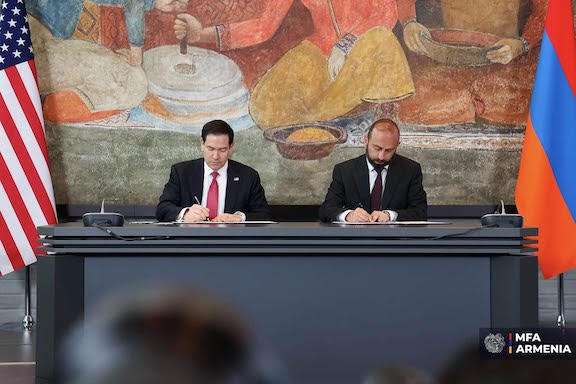
Secretary of State Marco Rubio and Foreign Minister Ararat Mirzoyan sign a strategic agreement regarding TRIPP at Zvartnots Airport on May 26
Azatutyun.am
Secretary of State Marco Rubio and Foreign Minister Ararat Mirzoyan met at the Zvartnots International Airport in Yerevan where the American official made a brief stop to sign several agreements and touted progress toward opening the Trump Route for International Peace and Prosperity, known as TRIPP.
The two top diplomats held brief talks at the airport but signed three agreements, one of them a “strategic cooperation” documents regarding TRIPP.
Rubio becomes the second U.S. Secretary of State to visit Armenia. When serving in that position, Hillary Clinton visited Armenia. During that trip she went to Dzidzernagapert and famously characterized it as a “personal” visit to the monument.
The agreement signed Tuesday reaffirms the key terms of a joint “implementation framework” for the TRIPP signed by the two officials in January. Those include the creation of a joint U.S.-Armenian venture that will manage for at least 49 years a railway, a road, energy supply lines and other infrastructure to be built along the Armenian-Iranian border to connect Azerbaijan to its Nakhichevan.
According to the agreement, the U.S. government will own 74 percent of the TRIPP Development Company. Armenia will grant the company “exclusive land use rights, development rights, related permissions, and all other rights” necessary for the transit arrangement.
“Armenia agrees that the TDC shall be empowered to select third parties to support each TRIPP Project established by the SPVs (TDC subsidiaries), including the third parties serving as the concessionaire, sponsors, operators, contractors, and EPC (engineering procurement & construction) providers of such TRIPP Project,” reads the agreement publicized by Armenia’s Foreign Ministry.
“This agreement marks the biggest step to date on making this historic route a reality, on advancing peace, on increasing prosperity in Armenia and frankly in the region,” said Rubio, whose trip was touted as a major official visit to Armenia, when in reality he spent less than an hour at the Yerevan airport on his way back from a visit to India.
“Our relationship is not simply limited to TRIPP,” Rubio told reporters. “We are building upon that in so many different ways, and it’s a top priority of this administration.”
Rubio pointed to a new charter of U.S.-Armenian “strategic partnership” and a memorandum of understanding on the extraction of “critical minerals” signed by him and Mirzoyan, who said that the agreements will yield “unprecedented opportunities” for Armenia.
Rubio’s visit to Yerevan comes less than two weeks before crucial parliamentary elections in Armenia. While he did not meet Prime Minister Nikol Pashinyan, Rubio’s trip is being framed by Armenia’s opposition as a boost for the ruling party in the election.
However, Rubio, unlike Vice President JD Vance, stopped short of endorsing Pashinyan. While visiting Armenia in February Vance endorsed the incumbent prime minister.
“Both yourself and the prime minister and your entire team here in Armenia are blazing the trail for the brighter and more independent future for Armenia, and we are very happy to be here to show my support for their courage…” Rubio told Mirzoyan. “My support for their vision, my support for their dedication, my support for their willingness to see for the future of their country where it takes to get there. And we are very happy and proud to be a part of that, and we can’t wait to be more together.”
The visit comes as the row between Russia and Armenia is growing, with Moscow pressing Yerevan to make a decision on its membership in the Eurasian Economic Union, which will hold a summit at the end of week. President Vladimir Putin of Russia has vowed to bring up this issue at the summit, as Armenia has sought to pursue membership in the European Union.
Iran has also voiced its opposition to the TRIPP project. Tehran has said that the project will create a foothold for the U.S.’s security apparatus in the region, as Iran and the United States work to uphold a fragile cease fire after the U.S. and Israel waged war on Iran in February.