Competitive Authoritarianism Jumps the Shark: Brief Thoughts on a Chaotic Weekend in Turkey
A great deal has happened since I published my three-part series a couple of months back on Erdoğan’s road to authoritarian consolidation. Notably, Viktor Orban, another frequently cited example of a would-be authoritarian, decisively lost a recent election in Hungary and is—at least for now—no longer in power.
Hungary is not all of a sudden a healthy democracy, but Orban’s defeat shows that there are real limits to the so-called “competitive authoritarianism” model. Both he and Erdoğan managed to stay in power for so long because they have successfully sustained a critical mass of popular support—something approaching fifty percent of the electorate—despite their polarizing styles. That model of governance simply ran out of gas on Orban.
And Erdoğan’s sagging popularity suggests the same dynamic is playing out in Turkey. But instead of setting himself up for possible electoral failure, Erdoğan has decided to double down on authoritarianism.
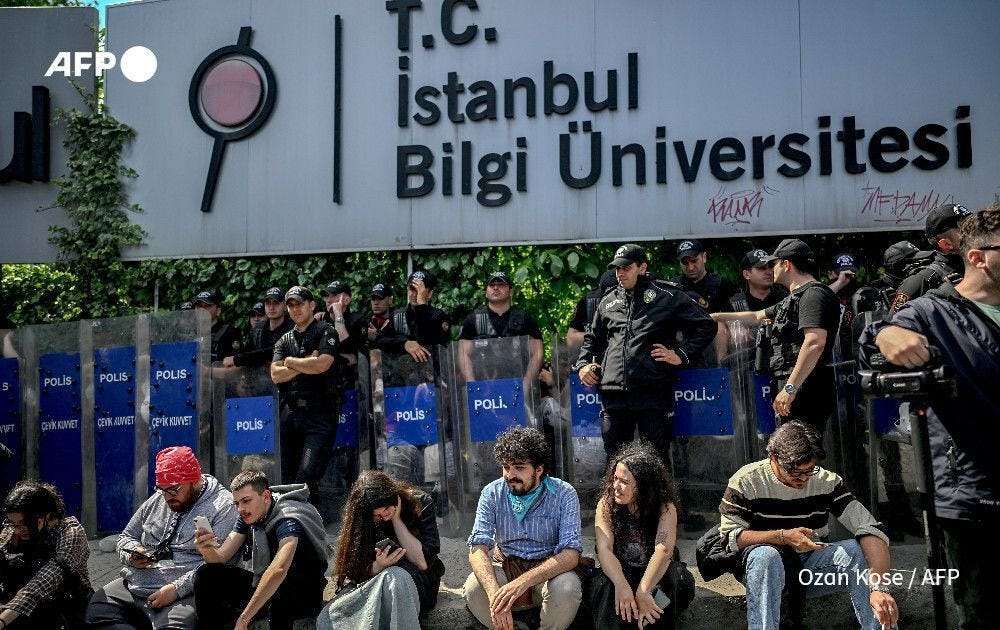
This past Friday, May 23, Erdoğan released a two-sentence presidential decree ordering the closure of Bilgi University, one of Turkey’s most prestigious private institutions. The president provided no rationale or justification for revoking the university’s license to operate. It seems Bilgi was an annoying liberal thorn in Erdoğan’s side, and so he decided to take care of the problem once and for all.
Erdoğan’s decree was met with shock both at home and abroad. Blindsided and still processing what had happened, Bilgi students and faculty attempted to occupy the campus. After being violently removed, they protested outside of the campus gates. Barely two days after issuing the decree closing the school, Erdoğan issued another equally cryptic two-line decree allowing it to reopen.
 |
Perhaps handling two major controversies was just too much for the aging president. On Saturday, one day after issuing the decree closing Bilgi, police raided the headquarters of the opposition Republican People’s Party (CHP) in Ankara. Before the raid, the Erdoğan-aligned Turkish judiciary issued a decision that invalidated CHP’s current leadership and returned to the head of the party its septuagenarian and chronically unpopular former leader, Kemal Kılıçdaroğlu.
As was the case with Bilgi University, party members attempted to occupy the building and, once forcefully evicted by the police, staged protests outside of it, with photos of the now-ousted CHP leader, Özgür Özel, leading them. Unlike in the Bilgi case, there is no indication that Erdoğan and his allies plan to back down.
 |
CHP has its own mixed record when it comes to democratic governance. But if elections were to be held today, Özel would have a strong chance at winning the presidency. By removing Özel as leader—a decision made by the supposedly independent judiciary— Erdoğan can avoid the bad visuals that would come with shuttering the CHP outright or cancelling presidential elections. Instead, he can choose who he runs against: in this case, the ineffectual Kılıçdaroğlu.
Orban’s position was weakened by the fact that, as a member of the EU, Hungary is especially vulnerable to diplomatic, political, and economic pressure from more powerful member states. Any attempt by Orban to do what Erdoğan is doing now in Turkey would have been met with likely insurmountable political opposition both within Hungary and outside. EU membership remains popular in Hungary, and the EU had already frozen billions in development aid to Hungary in response to Orban’s rule-of-law violations. While the EU often appears politically and diplomatically feckless, it is hard to imagine it standing by idly had Orban resorted to extreme measures to meddle in the electoral process.
Erdoğan, meanwhile, benefits from Turkey’s geopolitical importance vis-à-vis both Russia and Iran. There is simply no appetite on the part of EU leaders to stoke political instability in Turkey. Erdoğan is operating with a veritable diplomatic blank check as he runs roughshod over the last remaining vestiges of Turkish democracy. Indeed, at the same time Erdoğan’s government was shutting down Bilgi University and occupying CHP headquarters, Spain’s foreign minister celebrated his country’s “robust partnership” with Turkey. Mark Rutte, secretary general of NATO, signaled his enthusiasm for the coming NATO summit to be held in Ankara, promising the hosts would put on a “good show.”¹ It’s hard to come away with any other conclusion than the near-term picture in Turkey is truly a bleak one.
There is no question that we are living in an era of widespread democratic backsliding. It is also the case that the path taken in one country does not predict the path that will be taken in another. I think it is also worth considering what lessons we are to take from the fact that a supposed beacon of democratic vitality such as Spain and a self-proclaimed democratic bulwark such as NATO are willing to let diplomatic and political expedience trump support for the ideals of democracy in the case of Turkey.
We may once again live in a world where democracy feels like it is on the ascent, but the road ahead is a rocky one. And it is clear that democratic restoration in Hungary, Turkey, and elsewhere will be very challenging without robust institutional, political, and diplomatic support.