The enduring legacy of Dhaka’s historic Armenian Church
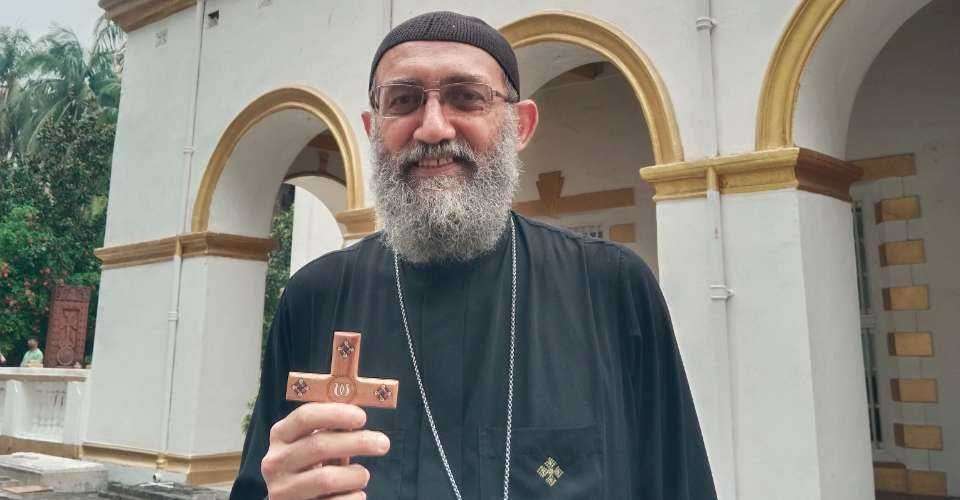
Egyptian Coptic Christians lead regular prayers, while a Muslim and a Hindu look after the 18th-century Church
Egyptian Coptic priest Augustine Zaki is seen in front of the Armenian Apostolic Church of Holy Resurrection in Bangladeshi capital Dhaka on May 26. (Photo: Justin Gomes/UCA News)
As the clock ticks 8:30 am, the eerie silence breaks down inside the well-lit, two-storied Armenian Apostolic Church of the Holy Resurrection at Armenian Street in the old parts of the Bangladeshi capital, Dhaka.
Led by a priest, a dozen worshippers join a rare liturgy at what are the last vestiges of a once-thriving Armenian community that lived and died in the South Asian city.
Neither the presider nor the congregants were Armenians who built the historic Church in 1781. It was not even an Armenian liturgy and not in the Armenian language.
The liturgy uses ancient Egyptian Christian traditions. He prays for the repose of 361 Armenians who lie buried in the adjacent graveyard.
The event on May 26 was part of an ecumenical collaboration between the trustees of the Bangladesh Armenian Church and the Egyptian Coptic Church to continue the legacy of the 18th-century Church and Dhaka’s once-thriving Armenian Christian community.
“This church should not remain silent,” said Father Augustine Zaki, 59, an Egyptian Coptic priest who joined the liturgy. He has been visiting Bangladesh since 2018.
“When we learned there was an Armenian Church here without regular liturgy, we felt encouraged to come and pray here and help reopen the space for worship,” he said.
Besides the ecumenical initiative, the Church has been running a monthly food assistance and medical program for poor people.
The Michael Martin Food Assistance Program is named after Dhaka’s last resident Armenian and the last warden of the Church, Michael Joseph Martin, who died in Canada on April 10, 2020.
Martin, who lived in Dhaka for about three decades since the 1980s, is credited with playing a crucial role in reviving the lost heritage of the Armenian Church. His death brought an end to the Armenian era of Dhaka, now a part of the city’s history.
Every Thursday, the Church offers food packets to 400-500 poor people. Every month, it runs a medical camp for poor, sick people. It also offers education assistance to poor, meritorious students.
The welfare programs are funded by Armenian diaspora communities in various countries, including the US, Australia, Singapore, Hong Kong, London and Armenia.
A golden heritage
The white-storied, European-style Church declares its quiet but powerful presence in Armanitola (Armenian neighborhood) amidst the dense, concrete skyline in old Dhaka, washed by the Buriganga River.
The area was once home to Armenian migrants who played a major role in Dhaka’s commercial and cultural life in the 18th and 19th centuries, according to historians.
Armenians are credited with introducing the horse-drawn carriage as a public transport and popularizing tea culture in Bengal.
The Armenian Church was built to serve the needs of Armenians in Dhaka, who helped the city become a regional trade hub using Bengal’s riverine landscape.

A view of the Armenian Church in Dhaka. (Photo: Justin Gomes/UCA News)
Armenian merchants flourished by trading jute, salt, leather, raw silk, and textiles in Bengal through connecting foreign markets in other continents, particularly Europe.
Their contributions extended beyond commerce.
Armenian merchant Nicholas Pogose founded Pogose School in 1848, considered the first modern, private school in present-day Bangladesh. He later became one of the earliest commissioners of Dhaka Municipality.
Much of the heritage slowly became part of history as next generations of Armenians started to migrate to Europe, the Americas and to Armenia.
Interfaith alliance for the historic Church
Before Michael Joseph Martin left Dhaka for Canada due to declining health in 2014, he passed the Church’s wardenship to Armen Arslanian, a US-based Armenian businessman.
Born in Buenos Aires, Argentina, Arslanian is part of the Bangladesh Armenian Heritage Project, a network of Armenian diaspora trustees committed to safeguarding the legacy of their ancestors in present-day Bangladesh.
Like many Armenian immigrants across the world, Arslanian’s parents fled to Argentina in the 1920s to escape the horrors of the Armenian genocide carried out by the Ottoman Empire.
Arslanian visits Bangladesh several times a year. The rest of the year, a Muslim and a Hindu look after the Church, including the food and medical program.
Al Mamun M. Rashel, a Muslim businessman, serves as the deputy warden of the Church.
He is supported by Shankar, a Hindu man who lives inside the Church’s premises with his family.
Rashel oversees administrative activities and coordinates with Armenian trustees living abroad.
“People from Hindu, Muslim and Christian communities all work together here,” the 50-year-old told UCA News.
“There is a mosque and madrasa nearby, and everyone peacefully coexists while carrying out their own religious activities,” he said.
Rashel said the Church has undergone renovation thrice since 2014 to strengthen the aging structure. The latest facelift was completed earlier this year.
He said preserving the church is not simply about maintaining a building.
“This church is part of the history of Bangladesh,” he said.
The Egyptians jump into the fray
The Armenian Church created an unexpected bridge with only a dozen Egyptian Coptic Christians living in Bangladesh.
The Church offered them not just a place for worship but also to expand their medical mission, said Father Augustine Zaki.
“We are here primarily to help needy people, especially the sick,” he said, adding that they bring in doctors from Egypt to organize regular medical camps inside the church compound.
“What we experienced from the Catholic Church, Anglican Church, Protestant churches and even Muslim communities was very welcoming,” Father Augustine said.
“All communities are trying to serve society, but often separately, like islands,” he added. “If we cooperate more, we can achieve much more and give a stronger message of tolerance and unity.”
Egyptian physician Dr. Abanoub arrived in Bangladesh in April to support the Coptic medical mission. He has conducted several medical camps since then, following prayer gatherings and food assistance programs.
Patients quietly line up beneath the old trees and beside centuries-old graves.
“People do not ask who is providing the service,” Dr. Abanoub said. “What matters to them is receiving medical help.”
He said skin diseases and infections are among the most common health problems they encounter, especially among children living in surrounding neighborhoods.
To him, preserving the church is also about protecting the Armenian legacy.
“These people worked very hard to establish this place,” he said. “It is our duty to ensure they are remembered.”
A place of spiritual solace
Adison Baroi, 28, a Catholic and a private jobholder, has been attending Armenian and Coptic Church events for the past several years.
“This is a historic event,” he said on May 26. “I really like participating in it.”
For him, the church represents both history and spiritual continuity.
Others have personal reasons for visiting.
Hasan Saif, a Muslim-born former journalist, often visits the church during worship despite no longer identifying himself strictly with any religion.
“The personality of Jesus Christ inspires me,” the 37-year-old said. “I come here out of that feeling.”
Saif described himself as standing in a “no man’s land” spiritually, yet he continues returning to the church searching for peace and meaning.
His presence reflects how the Armenian Church has gradually become more than a historical monument, but has evolved into a rare spiritual meeting ground of memories, interfaith relationships, and personal longing.
As the prayers ended, the congregation stepped back into the noise of the bustling city.
The candles at the graveyard of the Armenian Church continued to burn, recalling the bygone era of Dhaka’s now-vanished Armenians.