
Armenia’s 2026 Election: Between Geopolitical Rivalry, Domestic Fear, and the Search for an Armenian Strategy
BY RAFFY ARDHALDJIAN
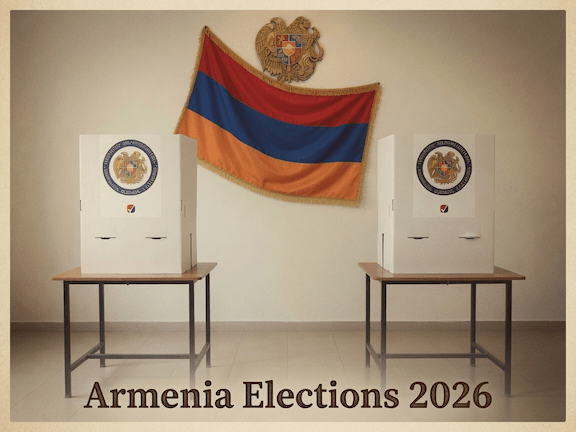
As Armenia emerged from its pivotal June 7, 2026 parliamentary elections, citizens felt that their vote represented an existential choice for the country’s strategic alignment. With a voter turnout of approximately 59 percent (the highest rate seen since 2017) voters handed Prime Minister Nikol Pashinyan’s Civil Contract party a victory with 49.7 percent of the vote. This outcome grants them a 64-seat majority in the 105-seat legislature, including ethnic minority mandates.
The opposition’s Samvel Karapetyan’s Strong Armenia alliance finished second with 23.3 percent (29 seats), followed by former President Robert Kocharyan’s Armenia alliance at 9.9 percent (12 seats). While all three political forces comfortably passed the legal threshold to enter the National Assembly, it remains unclear whether the two opposition alliances will choose to boycott parliament or follow through on their pledges to challenge the finalized results in court.
While the parliamentary election was “procedurally sound”, the resulting mandate for Prime Minister Nikol Pashinyan’s ruling party seemed deeply flawed and tainted by a highly distorted, polarized, and coercive political environment, as Hrair Balian argues in his recent Modern Diplomacy article. Stepping back from the immediate political noise, it is worth examining the broader environment in which these elections took place. As Greg Sarkissian noted in Armenia After the Election: Beyond Old Divides, Armenia’s political debate should now move beyond questions of patriotism and simplistic geopolitical labels. Viewed through that lens, the 2026 election was not merely a contest between Armenian parties, but a reflection of two powerful forces – geopolitical rivalry and fear — that continue to obscure the absence of a coherent Armenian-centered national strategy. The discussion below explores the broader geopolitical forces and voter anxieties that helped shape the election.
Geopolitical Rivalry
Against a backdrop of structural shifts in the global order, Armenia’s 2026 legislative elections occurred amid heightened geopolitical competition in the South Caucasus. The electoral cycle highlighted a profound domestic anxiety regarding the preservation of democratic institutions, national security, and sovereign identity during a protracted post-Soviet transition. While foreign powers aggressively utilized public endorsements and diplomatic threats to influence the incumbent administration (and at times the opposition), their deeper strategic objectives remained concealed beneath standard rhetoric. This delicate regional environment was further strained by the volatile de-escalation of the U.S.–Iran conflict, which introduced a critical variable shift to the local balance of power.
Russia continues to seek to preserve its traditional influence in the former Soviet space, using security dependence and information pressure to warn Armenians against a decisive turn toward the West. In the run-up to the vote, Russian officials and state-aligned outlets repeatedly cast Pashinyan’s pro‑Western course as a risk to Armenia’s security and economic stability. As highlighted by Radio Free Europe/Radio Liberty, this pressure culminated at the May 2026 Eurasian Economic Union (EAEU) summit in Astana. Russia, Belarus, Kazakhstan, and Kyrgyzstan issued a joint statement via Sputnik warning that Armenia’s EU integration created “significant risks” to economic security, paving the way for a formal review to suspend Armenia’s membership benefits.
Neo-Ottoman Turkey and Azerbaijan (backed by Pakistan in select diplomatic and security domains) continue to push a regional order built around new transportation and energy corridors, including potential routes through Armenia’s Syunik region (the Turan route in their view), with both powers signaling that ongoing negotiations and de-escalation are likelier to progress under the incumbent Armenian government.
Meanwhile, the European Union, whose relations with Moscow have been fractured since the 2022 invasion of Ukraine, sought deeper engagement in the South Caucasus. By holding high-level meetings in Yerevan and publicly embracing Armenia’s European trajectory just weeks before the vote, EU leaders underscored their preference for continuity in Pashinyan’s policy line. Though Armenian political discourse often cites a “collective West,” the reality is more nuanced: Washington and Brussels frequently cooperate, yet their long-term interests diverge. While both actors seek to secure access to Central Asian rare earth minerals, develop Caucasus transport & energy routes that circumvent Russia and Iran, and tacitly back the incumbent administration ahead of the elections, their primary strategic objectives differ. The United States views Armenia largely through a geopolitical lens as a transit corridor to bypass regional rivals, whereas the EU in the long run aims to structurally integrate Armenia into its economic, legal, and regulatory framework.
Iran, despite recent strain from conflicts with Israel and the US, emerged from a confrontation with the world’s most powerful military having not only survived, but with some favorable circumstances. It remains a key regional actor viewing South Caucasus developments through the lens of national security. Tehran has repeatedly warned against changes to Armenia’s southern border, maintaining its role as a potent factor in the regional balance. In the run-up to the June 2026 elections, this concern deepened into acute anxiety over the US-Armenia agreement on the TRIPP transit corridor through Syunik, which Iranian officials and state media aggressively framed as a Western geopolitical maneuver designed to oversee Iran’s northern border and sever its direct boundary with Armenia. Consequently, while maintaining formal diplomacy with the government, Tehran exerted rhetorical pressure on the electorate by amplifying opposition arguments that Pashinyan’s pro-Western peace course invited dangerous foreign rivalries at the direct expense of Armenian sovereignty.
Concurrently, China views the South Caucasus through a geoeconomic lens, treating the region as a vital trade link between Western China and Europe. Beijing has strongly backed the Middle Corridor transit network to secure reliable overland trade that bypasses traditional geopolitical chokepoints and insulates Chinese commerce from Western maritime sanctions. Meanwhile, India has emerged as a vital strategic partner for Yerevan by stepping in as a major supplier of heavy artillery, missiles, and anti-drone systems. New Delhi’s rapid military support for Armenia directly counters the defense axis of Pakistan, Turkey, and Azerbaijan, making the South Caucasus a key theater for India’s strategic interests.
Ultimately, none of these actors are neutral; each is driven by its own specific interests and preferred outcomes. Each relies on a different mix of security ties, economic leverage, and narrative influence to shape Armenia’s choices.
As geopolitical competition intensified, Armenia’s elections became increasingly entangled in the strategic rivalry of larger powers. Political messaging, media narratives, diplomatic signaling, and information campaigns sought to shape how Armenians understood both the threats facing the country and the choices available to address them. The result was a political environment in which voters were often encouraged to choose between competing geopolitical alignments rather than engage in a deeper discussion about what serves Armenia’s long-term national interests. In the case of a small state situated at the crossroads of rival empires, this may be the most subtle form of external influence: not determining how its citizens vote, but shaping the framework through which they interpret their choices.
Politics of Fear
Beyond the rivalry of empires, the second major factor shaping the election was fear. Armenian voters went to the polls after years of frontline violence, devastating territorial losses, the total displacement of the population of Artsakh, economic uncertainty, and persistent existential threats to the republic’s remaining borders. In such an environment, fear became a powerful force in political mobilization, weaponized by both external powers and local political participants
On May 10, Azerbaijani President Ilham Aliyev directly intervened in Armenia’s political discourse by warning that “it is the Armenian people who will suffer” if any candidate other than incumbent Prime Minister Nikol Pashinyan came to power.
On one side, the incumbent administration anchored its campaign on the fear of an immediate, catastrophic war. By presenting normalisation efforts and border adjustments with Azerbaijan as the only path to survival, the ruling party implicitly messaged that any disruption to the status quo would trigger an instant, overwhelming invasion. Opposition factions were collectively framed as a reckless, war-mongering front whose ascent to power would nullify fragile diplomatic progress and plunge an unready nation back into conflict. For a population exhausted by near-continuous front-line losses, this narrative transformed the ballot into a raw choice between an imperfect, painful concessionary peace or total physical destruction. At the same time, the government portrayed itself as defending Armenia’s sovereignty against Russian interference, while arresting numerous opposition figures and accusing various political actors of participating in destabilization efforts.
Conversely, the main opposition alliances countered by stoking fears that the ruling party was orchestrating a slow, piecemeal surrender of the state. They aggressively attacked the government’s normalization agenda and regional transit initiatives (specifically the May 2026 TRIPP corridor agreement) framing them not as a path to peace, but as a dangerous framework that surrendered vital land and economic control to foreign interests. A central pillar of the opposition campaign warned that Pashinyan’s policies would ultimately permit the mass resettlement of Azerbaijani citizens within Armenia, permanently altering the country’s demographics. Furthermore, by alignment with the leadership of the Armenian Apostolic Church, the opposition argued that the administration’s pro-Western course was actively erasing Armenia’s national history and cultural identity to appease a hostile, pan-Turkic regional alliance.
As a result, many Armenians were not presented with a hopeful choice between competing national visions, but rather with two competing fears: fear of renewed war on one hand, and fear of gradual national decline on the other. The election thus became less a contest over Armenia’s future potential than a referendum on which danger voters considered most immediate and most credible.
The Missing Armenian Strategy
Amid growing rivalry between external powers, Armenian political discourse has become increasingly polarized between competing geopolitical orientations: pro Russian, pro Western, and more recently, a vision centered on normalization with Turkey and Azerbaijan. Missing from much of this debate is a serious discussion about how Armenia can realistically navigate this environment while preserving its sovereignty and advancing its own interests.
This shortcoming is not limited to the incumbent government. The opposition has also largely failed to articulate a convincing approach for dealing with great-power competition without becoming overly dependent on one external power or another. Likewise, given the military and diplomatic pressure exerted by Azerbaijan and Turkey, and the growing political, financial, and institutional influence of Western actors, it remains unclear how much of Armenia’s current geopolitical reorientation reflects an independently developed national vision and how much is a response to external pressures.
The deeper problem is that Armenian political debate is too often framed as a choice between rival centers of power rather than a discussion about Armenia’s own priorities. Throughout much of Armenian history, survival depended on navigating between larger empires, whether Roman and Persian, Byzantine and Arab, or Ottoman and Russian. In many periods, the primary political question was not what retrieval or strategy Armenians wanted for themselves, but which external power posed the lesser danger. Proponents of the incumbent administration argue that its current diplomatic pivot, including the normalization track and Western-backed transit initiatives, represents a conscious break from this cycle to build a modern, self-reliant state. Yet, while immediate physical survival remains the paramount strategic priority for the republic today, simply shifting dependence from a traditional regional patron to Western economic and regulatory frameworks risks repeating the same historical pattern. True endurance requires moving entirely beyond the defensive habit of choosing an external protector, focusing instead on internal institutional capabilities and an independent national strategy.
Thirty four years after independence, the central challenge is not choosing between East and West, Russia and Europe, or confrontation and accommodation. It is developing the political thought, leadership, and institutions necessary to define Armenian interests independently and pursue them consistently. Viewed from this perspective, the greatest weakness revealed by the 2026 election may not be foreign influence or political polarization, but the absence of a broadly shared Armenian vision capable of rising above the binary choices presented by both domestic politics and external powers.
Conclusion
Armenia’s 2026 elections show the difficult position of a small nation caught between the global plans of larger states and empires. While local issues certainly mattered to voters, the election environment was heavily weighed down by the strategic goals of foreign powers and the deep anxieties of an exhausted public. By forcing the conversation around competing terrors, specifically the fear of immediate war on one side or slow national decline on the other, both local politicians and foreign actors narrowed the political debate.
The immediate aftermath of the vote has only sharpened the domestic crisis following the 2020 war. Because the ruling party failed to win a two-thirds supermajority, the political landscape has shifted from a standard electoral contest into a deep battle, with the incumbents wielding state institutions against their opponents. The government has responded with aggressive legal and administrative actions against major opposition figures, prompting six opposition parties to unite in rejecting the results. This weaponization of state power proves that running smooth elections is not enough to secure a stable democracy.
This bitter internal warfare paralyzes Armenia at the exact moment it needs unity. A country consumed by existential domestic battles cannot build the internal stability required to resist outside pressure. To break this historical cycle of vulnerability, Armenia must look inward, focusing its energy on building resilient state institutions, supporting independent media, and shaping a unified strategy centered primarily on its own needs. Ultimately, the survival of a modern independent Armenia depends on the ability of its citizens to build a state capable of choosing a future based on national goals rather than collective fear.
Raffy Ardhaldjian is a Fletcher School graduate and advisor to tech companies, public institutions, and NGOs. In his spare time, he writes about strategic topics spanning Armenia and the Armenian Diaspora.