Behind the curtain, Saro Keresteciyan keeps Cirque du Soleil’s performers stage-ready
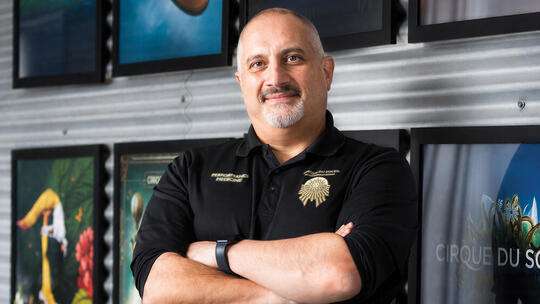
According to Saro Keresteciyan, Cirque du Soleil’s performance clinical lead, “If there’s an emergency, I’m on call. If you see me running, it’s not because I don’t want to talk to you—it just means something’s happening and I need to go.”
It’s a fitting start to a conversation from the show’s Canadian headquarters. Keresteciyan is on high alert, prepared for the possibility that he might have to run at any moment.
“Training is still happening,” he explains. But for more than two decades, “something happening” has been Keresteciyan’s professional constant. He’s ensured the gravity-defying artists can return to the stage night after night, city after city, for more than 2,500 shows—and he has seen thousands more. Yet he still hasn’t had the morning he dreads, the one where he wakes up and thinks about stopping.
“If that day ever comes,” he says, “that’s the day I quit. But it’s been 21 years and I still haven’t said that.”

Keresteciyan was born in Turkey and moved to Canada at age two, growing up in Montreal’s tight-knit Armenian community. His introduction to AGBU came early, first as a student at the Alex Manoogian School in Montreal, and later through AGBU’s beloved summer institution, Camp Nubar.
“I’ve always been involved with AGBU,” he says. “Camp Nubar was one of the best things I’ve ever done.” He began his Camp Nubar journey in 1992 as a senior counselor and later became waterfront director—a role he describes as his “peak.”
“When you’re waterfront director, you’re dealing with everyone,” he explains. “For me, the most memorable part was getting to know everybody—from the kids to the counselors. Seeing people start at eight years old and then become counselors down the line was amazing.” He still remembers their names, a skill he carries with him at Cirque du Soleil.
Although Keresteciyan was always athletic, swimming and playing soccer, basketball, and volleyball, it wasn’t until high school that everything clicked. As a budding football player, Keresteciyan broke his leg. For young and hungry athletes, this would often be a career-altering injury. For Saro, watching the trainers on the sidelines rush into action became a revelation. “That was an opening,” he recalls. “I realized these guys are part of the team. It all seemed like the right path for me.”
He pursued exercise science at university, specializing in athletic therapy—the Canadian equivalent of athletic training in the United States. “I had to do internships in clinics, on the field, and work with different football and basketball teams.” All of this experience would prepare him for his next step: the Paralympics.
There’s no book that says, ‘This is how you treat this.’ You learn the human body. But how you treat each person is different.
After graduation, Keresteciyan’s volleyball team hosted Canada’s standing Paralympic volleyball team for a training camp. Seeing the opportunity, he couldn’t resist. “I just opened my mouth,” he says with a laugh. “I said, ‘Look, I’m an athletic therapist. If you need anything, let me know.’”
The following weekend, they invited him to Ottawa. Soon after, he became their full-time trainer. That opportunity carried him to the 2000 Sydney Paralympic Games and into international classification work with World ParaVolley. Today, he still serves as chief medical classifier for the Pan American zone, overseeing eligibility evaluations for disabled volleyball athletes across North, Central, and South America.
Through this role, he made every athlete, regardless of disability, feel part of a team. “I couldn’t have asked for anything better,” he reflects. “Was it luck? Yes. But I could have stayed quiet. Everything happens for a reason.” This was also the beginning of a life on the road for the dynamic athletic trainer.
Keresteciyan’s entry into the circus world came through an equestrian company called Cheval, where he treated acrobats. When the company closed, a former Cirque co-founder encouraged him to apply. He interviewed in 2005 and started right away. “I thought maybe I’d do it for six months. Maybe a year,” he says. “It turned into 21.”

He began on tour, traveling with a single show from city to city. “Over the years, you can change shows. But I’ve done a little bit of everything, like big-top shows, arena shows, and resident shows.” He laughs, “People used to call me a Circus Carnie.” His tours have taken him around the world, including a resident show with Disney in Orlando. “Now I’m clinical lead at the headquarters here in Montreal,” he says, where he focuses on injury prevention.
How different is treating a Cirque acrobat from the average patient?
“The injury might be the same,” Keresteciyan says. “But how they got it and what they’re going back to is completely different.” A back injury for an office worker carries different demands than one for an aerialist suspended 30 feet in the air. “We know they’re going back on stage. They’re putting their bodies through a whole lot of stress. We have to ask, ‘How do we make sure they don’t get injured again?’”
Cirque’s performers are, in Keresteciyan’s words, “our athletes.” Cirque du Soleil isn’t the run-of-the-mill circus. Their shows blend acrobatics, character-driven theater and dance, visual arts, dazzling costumes, and original music compositions for a truly magical performance unlike anything audiences typically see on stage. Many performers come from elite gymnastics or acrobatic backgrounds. Others are generational circus artists. There is no textbook for these cases. But they all share one ethos: “The show must go on. It’s tattooed on their heart,” he says. “Sometimes we have to say, ‘Maybe you need to step out today.’ But they don’t stop, they just want to perform.”
After 21 years in the industry, Keresteci-yan says he’s still learning. “Contortionist anatomy might be different from you and me, but you learn as you go. There’s no book that says, ‘This is how you treat this,’” he says. “You learn the human body. But how you treat each person is different.” That adaptability would become the cornerstone of his career. A single show might include 52 acrobats, which means 52 puzzle pieces—entirely different bodies, disciplines and cultural perspectives. “There’s no norm here,” he explains. “You have to think outside the box.”
However, one mantra rings true: prevention is essential. Daily warm-ups, strength work, monitoring chronic injuries—these are as important as emergency response. And when accidents happen, training takes over. “We can’t predict accidents,” he says. “But we train our teams to respond.”

Behind every seamless performance is someone like Saro ensuring that bodies hold up under extraordinary demands. A typical show day is physically demanding and may stretch from 14 to 16 hours. An athletic trainer’s job is to warm up performers, treat injuries, and remain on standby during shows.
“You do treatments all day, then you stay for the show in case of emergency,” he says. “There are days when you go home exhausted.” Yet, Keresteciyan never tires of the thrill of the show. “If I help somebody get back on the court or back on stage, especially knowing I had something to do with that, it beats any feeling in the world,” he says. “The applause tonight? I take it for me too.”
Resilience drives his work philosophy, inspired by his clients. He has seen everything from performers returning to the stage after ACL tears to 65-year-old acrobats refusing to retire. “That’s all they know how to do,” he says with admiration.
And he encourages aspiring athletic therapists to be just as resilient. His advice is simple: “Don’t hold back. If that’s what you want to do, go for it. There’s no wrong way of doing things.”
The next time the lights dim and an acrobat defies gravity, the audience will have all eyes on stage. They won’t see Saro backstage. But he will be there, observing and believing, as he always has, that the show must go on.