Chasing an Armenian Legend in Jerusalem
From Arthur Hagopian
Sydney, Australia
Isaac Gazmararian, writer, editor, movie maker, storms into the lives of the Armenians of Jerusalem, in a fervent though belated bid to ferret out nuggets from their cherished memories of life in the Armenian Quarter of its Old City.
And to preserve the culture and heritage of a genealogical legend: a unique vibrant community, the “Kaghakatsi,” an extended family, whose members are all related to one other, either directly or indirectly.
In the process, he hopes to emerge with a “village book of sorts, for the Armenian Jerusalemites of the past and present,” he explains, describing himself “as a storyteller and visual artist.”
He has already had his 15 minutes of fame in the wake of a dozen or so short films which have picked up awards at some international film festivals.
In his quest, which has so far taken him halfway around the world, culminating in far flung Australia, he will be following in the footsteps of a few other fellow-travelers who have themselves contributed to the onerous task, made unenviable because of the dearth of official or viable personal records or documentation.
One of the portals that has proved helpful to him is the Armenian Jerusalem website (armenianjerusalem.altervista.
Born in Atlanta, Georgia, Isaac was inculcated early into his Armenian heritage, and as the years rolled along, he became convinced it would not be enough to say he was Armenian.
He had to show what makes an Armenian tick.
His antecedents, the Gazmararian, were one of the leading “Kaghakatsi” families who lived in the Armenian Quarter, before relentless attrition, death or emigration, whittled their number, depriving the community of one of its most dynamic groups.
Isaac knows it won’t be easy to resurrect the past despite the formidable tools at his disposal.
“I am committed to the project and determined to bring it to fruition, no matter how long it takes,” he says.
He launched his quest with a visit to the Old City, the foray ushering him into a verisimilitude of the world of the Arabian Nights, an experience that drew him into the ambience of the uninhibited hospitality of compatriots who plied him with food and drinks, and overwhelmed his mind with their fantastic stories.
When he comes to interview me, he brings along a large map of the Armenian Quarter, delineating its streets and homes, and amazes me with his extensive grasp of the topology, asking me to fill in the blanks.
We proceed slowly, retracing hallowed landmarks which he marks on the margin of the map. I wonder how he will manage to decipher the meandering scribbles when he is done.
In one of his first tasks, he undertook the creation of a family tree, later expanded to include other extended family members.
He has offered to merge the 800 names he has catalogued with the 3,000 that feature in the Armenian Jerusalem website, culled from the registers of births/baptisms, weddings and deaths (“domar”) housed within the offices of the Armenian Patriarchate which has been keeping track of the city’s Armenian population for countless years.
But the ones I had access to only go back to around 1840, with some unavoidable duplications due to the various sources who contributed their genealogical information to the project.
Going through those registers, one comes across quaint but touching entries identifying people by their specific trade or profession. Thus Hovhaness the watchmaker, has the epithet “jamakordz” next to his name. A photographer will have “badgerahan” to show what he did, and a tailor, “tertsag.”
Isaac’s own family name, “gazmararian,” reveals his ancestor to have been a book binder (gazmarar).
Will the other trove of buried registers Isaac hopes to unearth within the archives of the Patriarchate when he returns to Jerusalem, also entertain and illuminate researchers the same quaint way?
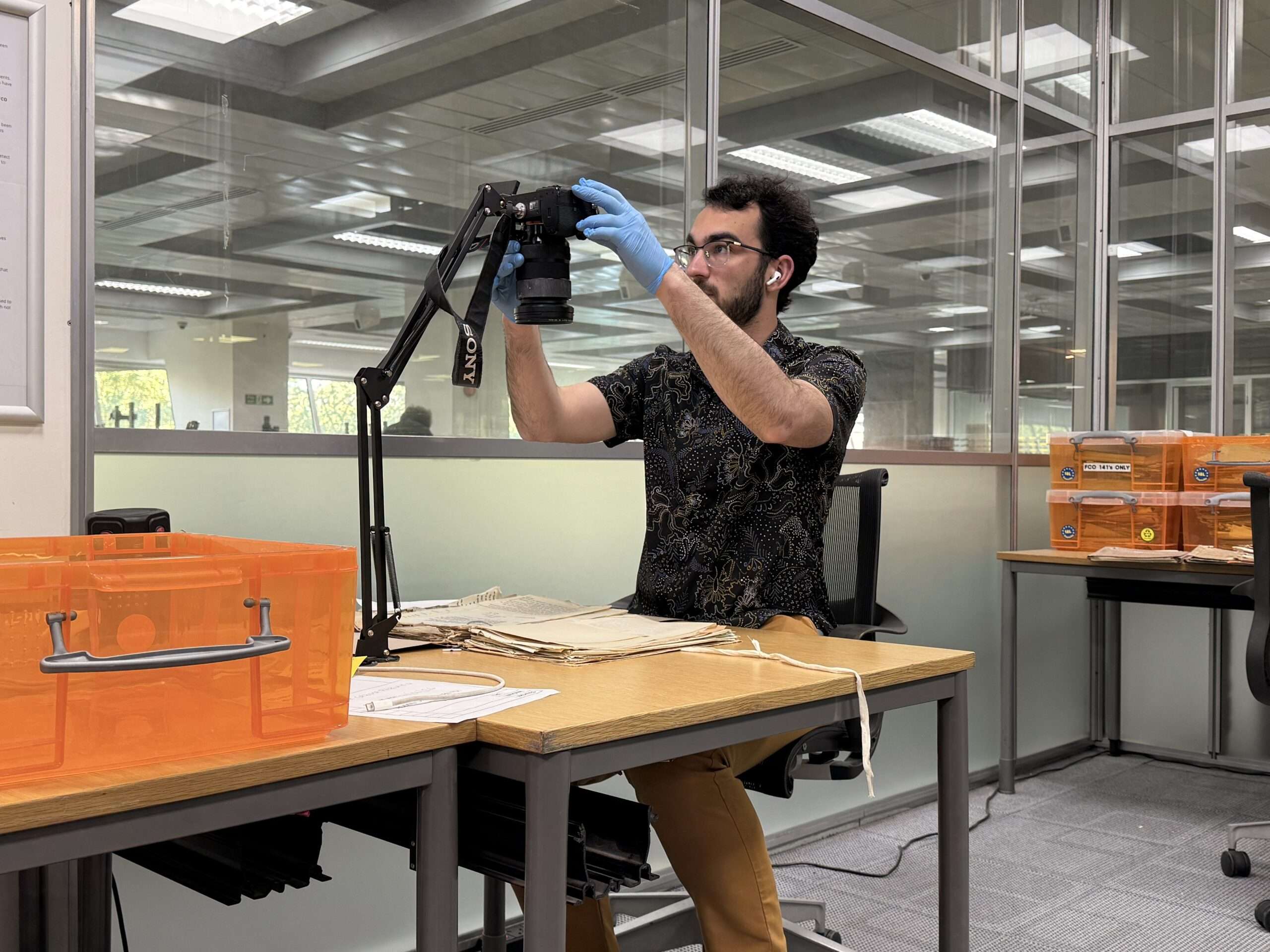
Photo: Isaac Gazmararian on the hunt