103 years since the Treaty of Lausanne: Are there hidden clauses and an expiration date?
103 years have passed since the signing of the Lausanne Peace Treaty, which was the founding document of the Republic of Turkey.
With the agreement signed on July 24, 1923 and named after the city where the peace conference was held in Switzerland, the political and economic independence of Turkey was registered.
In the negotiations between the Ankara government and the major powers known as “Düvel-i Muazzama” at that time, there were unresolved issues such as sovereignty over the Straits and the status of Mosul.
BBC Turkish’s Hilken Doğaç Boran examines the most controversial issues of the Lausanne Treaty.
What was the priority of the Ankara government?
The Ankara government, led by Gazi Mustafa Kemal Pasha, signed the Mudanya Armistice on October 11, 1922 with England and France after defeating the Greek occupation forces.
After the ceasefire, the Ankara government and the Sultanate in Istanbul were invited to a peace conference to be held in Switzerland.
On November 1, 1922, the Sultanate was abolished by the decision of the Parliament. Thus, only the Ankara government represented the Turks in Lausanne.
Boğaziçi University Atatürk Institute Lecturer Professor Dr. Sevtap Demirci says that the main goal in Lausanne is “to gain economic and political independence.”
Speaking to BBC Turkish, Demirci emphasizes that Ankara’s government “is in Lausanne to register the achievements in the field at the diplomatic desk.”
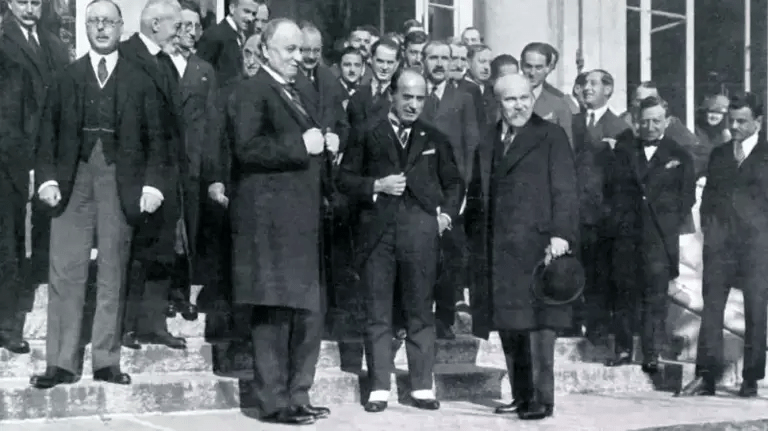
Allied foreign ministers attending the Lausanne Peace Conference. From left to right, British Foreign Secretary Lord Curzon, Italian Foreign Minister Benito Mussolini and French Foreign Minister Raymond Poincare.
The delegation sent from Turkey to Switzerland was headed by Ismet Pasha, Atatürk’s comrade-in-arms and the then Minister of Foreign Affairs.
He also sat at the table representing the Ankara government in Mudanya.
England, France, Italy, Japan, Greece and Romania, as well as the Kingdom of Serbia, Croatia and Slovenia, which would later be called Yugoslavia, also participated in the conference.
In addition, the USA was invited as an observer, and the Soviet Union as a participant in the Straits issue.
Dr. Ozan Özavcı, a historian from Utrecht University in the Netherlands, says that one of the most important priorities of the Turkish delegation is the “Armenian issue”.
Ozavci, the founder of The Lausanne Project, an international academic research and information sharing initiative on the Lausanne Peace Treaty, emphasizes that the plans to establish an Armenian state in the east of the country are “absolutely unacceptable” for the Ankara government and continues:
“The settlement of Ottoman debts was also a very important process and one of the longest debated issues of the period.”
The Ankara government argued in Lausanne that the remaining debts of the Ottoman Empire should be distributed among the countries established after the collapse of the empire.
This approach was adopted in Lausanne. Turkey, which took the largest share, completed its payments in 1954.
The Ankara government also aimed to resolve issues such as Western Thrace, Aegean Islands and population exchange between Turkey and European states.
Dr. Murat Arslan from Yeditepe University’s Department of Political Science and International Relations argues that Lausanne means Ankara’s government is registered as a superpower.
Arslan comments on Lausanne’s results:
“Relatively specific goals were put on the table, and in fact the negotiations were concluded in the most positive way by Turkey. Of course, there are also shortcomings.”
What problems were not solved in Lausanne?
During the negotiations that began in 1922 and culminated in the signing of the Lausanne Peace Treaty in July 1923, the Ankara government made critical achievements.
The borders of modern Turkey, excluding Hatay, were internationally recognized thanks to this treaty.
Capitulations left over from the Ottoman era were abolished, thus ensuring economic independence, one of the important conditions of national sovereignty.
Minority rights were granted to Turks in Western Thrace and non-Muslims in Turkey.
Arrangements were also made regarding the Aegean Sea and its islands.
As a result of the negotiations, the Ankara government gave up on its demand for full sovereignty over the Straits.
Within the framework of the treaty, a temporary solution was reached to demilitarize the straits and open them to unrestricted civilian and military traffic under the auspices of the International Straits Commission under the auspices of the League of Nations.
Turkey’s sovereignty over the Straits could only be confirmed by the Montreux Straits Convention signed in 1936.
Dr. Murat Arslan says that the Ankara government “prioritized the constitutive issues” in Lausanne and that it aims to “solve over time” issues such as the Straits and Hatay issue.
Arslan says, “The Republic of Turkey was patient, and in the end patience justified Ankara. Montreux and Hatay is a result of that patience.”
What happened in the talks about the Aegean Islands and Mosul?
The deal on the Aegean Islands in Lausanne and the postponement of the Mosul issue are among the topics that have been criticized from time to time.
Mosul, which is within the boundaries of Misak-ı Milli, was one of the red lines of the Ankara government.
The Misak-ı Milli is a six-point national oath adopted by the last Ottoman Mebusan Assembly on January 28, 1920.
In this oath, it is said that “the territories of the Turkish and Islamic majority that were not occupied by the enemy at the time of the signing of the Armistice of Mondros are one and cannot be divided.”
Mosul-Kirkuk, West Thrace and Batum are among the places that are located in Misak-ı Milli and today are outside the borders of Turkey.
Prof. Dr. Sevtap Demirci reports that the first half of the negotiations was interrupted due to Ismet Inonu’s refusal to make concessions on the Mosul issue.
Demirci says that the issue was removed from the scope of the Lausanne Conference and Turkey and England agreed to deal with it bilaterally.
In the process of including the League of Nations after Lausanne, Turkey transferred Mosul and Kirkuk to Iraq, which was the British mandate of the time, with the Ankara Treaty signed in 1926.
In return, 10 percent of the oil revenue of these provinces was given to Turkey for 25 years.
Dr. Ozan Özavcı explains that it is a “normal process” to make concessions on some issues in multilateral peace talks like Lausanne.
Özavcı reminds that despite the victory of the Ankara government, it does not have absolute military superiority over the big powers and touches on the impact of the risk of war on the negotiation process:
“The war could go on and nobody wants that. The British don’t want to bring their armies back.
“Neither the French nor the Italians want the war to continue at that point.”
Illustration of the Lausanne Peace Conference by Hungarian cartoonist Alois Derso. Because cameras are not allowed during the debates, media organizations have hired cartoonists.
Within the framework of the Treaty of Lausanne, Turkey recognized the agreements that gave some islands, including Midili, Chios and Sisam, to Greece, and renounced its rights to 12 islands.
However, Bozcaada, Gökçeada and Tavşan Islands at the entrance of the Çanakkale Straits were demilitarized and the control of these islands was left to Turkey.
President Recep Tayyip Erdoğan said in September 2016, “You don’t see the Aegean right now is it? In Lausanne we gave the islands where the cry would be heard. Is this victory?”
Prof. Dr. Sevtap Demirci reminds that 12 islands were lost after the Tripoli war against Italy in 1911, and the Aegean Islands came under the control of Greece after the Balkan Wars in 1912-13.
Dr. Murat Arslan also emphasizes that control of the Aegean islands was lost long before Lausanne.
Regarding Ankara’s government’s relinquishment of these islands, Arslan says, “Lausanne is legalizing the de facto situation [in the Aegean] since 1912-13.”
The claim that there are secret articles in Lausanne that limit Turkey’s sovereignty comes up periodically.
It is said that since 1923, Turkey’s sovereign rights have been restricted, especially because underground resources such as boron and natural gas cannot be used.
Working in the British archives for many years and having secret documents on the subject Prof. who studied many sources including Dr. Sevtap Demirci says that he has not found any evidence that Lausanne has secret substances.
Dr. Murat Arslan also interprets the secret material movements as a “conspiracy theory” and says the following:
“There may have been secret agreements, but there are no secret clauses in a disclosed agreement.”
In April 2023, the Speaker of the National Assembly Mustafa Shentop said the following in an assessment he made to members of the press:
“When an agreement is made, it goes to the parliaments of the signatory countries, where it is ratified.
“How will a secret provision be approved in the parliament? Who will review and approve? There can be no secret provision in international agreements.”
Historian Ozan Ozavcı says, “Why do we think there are secret substances? That is the real question,” and adds:
“It is necessary to look at the fact that the Balkans and the Middle East became a playground between the great states of Europe at that time. They create a political and historical trauma of 100, 150 years.
“Part of the reason why people in Turkey and the Ottoman Empire are so prone to believe these kinds of conspiracy theories is because of this long-term trauma.”
Does Lozenge have an expiration date?
There have been claims that the validity period of the Treaty of Lausanne will expire in 2023, the 100th year of its signing.
The version of the treaty approved by the Parliament, signed by Turkey and many other countries, does not contain any time limit or validity clause.
However, in an interview given to the Greek press in 2017, President Erdoğan expressed the idea of ”updating” Lausanne.
Erdogan said, “This update can be useful not only for Turkey, but also for Greece, for both sides.”
No action was taken following this proposal, which provoked a reaction from Greece.
Regarding the validity period, Dr. Murat Arslan says, “Treaties defining borders and status are indefinite, otherwise there would be no stability in the world.”
Prof. Dr. Sevtap Demirci also emphasizes that Lausanne is not temporary and says “it is the founding document of the Republic of Turkey.”