A Week of Listening, Learning, and Belonging
How a week with artists from across the country reshaped my understanding of culture, community, and the responsibility of carrying tradition forward.
|
When I was selected to participate in the Smithsonian Center for Folklife and Cultural Heritage’s For the People program, I knew I would have the opportunity to learn from an extraordinary group of artists, educators, and cultural practitioners. What I didn’t anticipate was how profoundly the experience would shape the way I think about my own work and the responsibility we all share in preserving culture.
 |
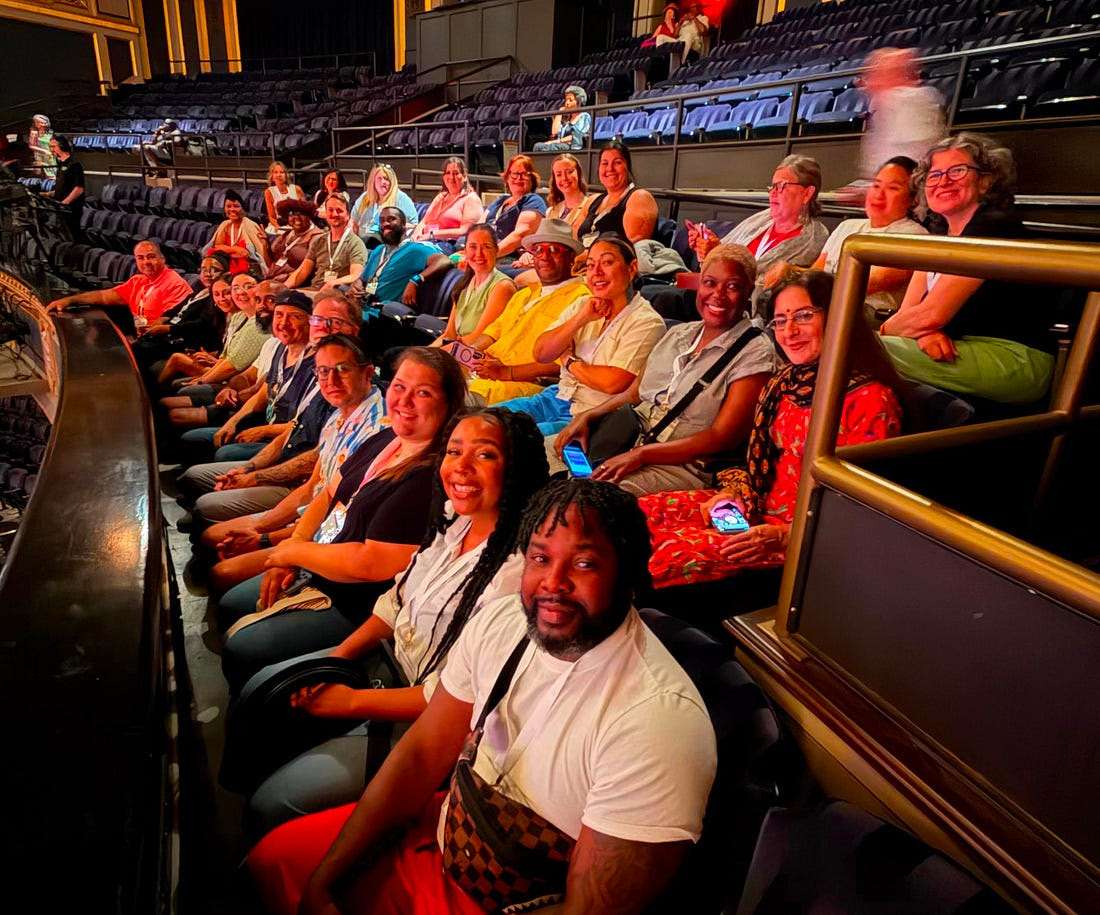
Many of the Smithsonian cohort attending a phenomenal musical performance of Miles From India which was he opening group at Concert of Colors, held at the Detroit Institute of Arts Film Theater.
For the People is a national professional development program that brings together cultural practitioners from across the United States who are dedicated to preserving, sharing, and sustaining the traditions of their communities. Through virtual learning, collaborative discussions, and an in-person gathering during Detroit’s Concert of Colors, participants explore how cultural knowledge is carried, interpreted, and passed from one generation to the next. Rather than focusing solely on artistic excellence, the program emphasizes community, storytelling, cultural stewardship, and the vital role tradition bearers play in strengthening the fabric of American life.
For several months, this cohort group of 30+ individuals only met via Zoom. At times, twice a month, these two hour sessions provided an avenue for us as teaching artists and teachers to meet one another. However, we all know Zoom has its limitations and for me, unless I can sit in front of a person – its hard to interact effectively as well as actually remember names and what they do!
Recently this group of talent came to Detroit, a city I am proud to live and work in. Our first evening brought us together for a community dinner in our revitalized Corktown district. I was apprehensive. Sure, I am an extrovert, but these were still new people to me and the first time to see someone in the flesh.
Then the bus pulled up to the restaurant.
As they stepped off, eager to finally meet in person, I was greeted with the warmest of welcomes. Hugs replaced handshakes, smiles filled the room, and within moments it felt as though we were reconnecting with old friends rather than meeting for the first time.
What followed was a remarkable week of conversation, curiosity, and discovery. We shared not only what we create, but why we create it. We talked about how we practice our art, how we share it with our communities, and the deeper purpose that fuels our work. Each story offered a window into a different culture, yet together they revealed a common commitment: preserving traditions, strengthening communities, and ensuring that these cultural practices continue to thrive for future generations.
So much about the week left a lasting impression on me.
I was deeply moved by the passion each participant brought to the program. Although our artistic traditions, backgrounds, and communities were incredibly diverse, there was a common thread woven through every conversation: a genuine desire to use our work to educate, inspire, and connect with others. Many of us were developing programming for middle school students, and it was inspiring to hear the thoughtful ways each person approached teaching culture through their own artistic practice.
One day, our cohort gathered at the Arab American National Museum, a place that holds special meaning for me. Over the years, I have had the privilege of performing there and attending many outstanding world music performances. Walking through its galleries always reminds me of the importance of preserving cultural stories and creating spaces where they can be shared.
 |
Although it wasn’t part of the day’s agenda, I felt compelled to introduce the group to the kanun and share a piece of my Armenian heritage. It wasn’t a formal presentation—just a heartfelt opportunity to explain the instrument’s history, demonstrate its unique sound, and talk about why preserving this music has become such an important part of my life’s work.
What gave me the confidence to do so was the environment we had created together. Throughout the week, our cohort fostered a space of genuine curiosity, respect, and encouragement where every culture and every story was valued. I never questioned whether my music or heritage would be understood—I simply knew they would be welcomed.
Presenting the kanun, sharing my culture, and doing so in my hometown of Detroit became one of the most meaningful moments of the entire experience. It reminded me that when people come together with open minds and open hearts, sharing your story doesn’t feel vulnerable—it feels like a gift.
Throughout the week, I found myself reconnecting with Detroit in a way I hadn’t expected. I took great pride in sharing the city’s story with my fellow participants—from its remarkable revitalization and vibrant neighborhoods to its incredible culinary scene. But more than anything, I found myself talking about the talented artists, musicians, makers, and cultural leaders who give Detroit its soul. It reminded me just how fortunate we are to have such a rich and creative community, one that continues to shape the city’s identity and inspire those who experience it.
If there was one thing that moved me most throughout the week, it was witnessing the depth of passion each artist brought to their work. Whether through music, storytelling, dance, or education, every person I met carried an unwavering commitment to preserving and sharing their culture. That passion was on full display during the opening Miles From India performance at Concert of Colors. I found myself captivated by percussionist V. Selvaganesh and his mastery of the kanjira. I had never heard the instrument played with such speed, precision, and musicality. His performance was mesmerizing—not because of its technical brilliance alone, but because of the joy and expression he brought to every note. I left that evening inspired, already imagining what it might be like to collaborate one day with a musician of that tradition.
That same sense of inspiration continued at the Arab American National Museum. As each participant spoke about their work, I wasn’t simply listening to presentations—I was listening to people describe their life’s calling. Their devotion to preserving culture, educating young people, and strengthening their communities reminded me that, regardless of where we come from, we are all engaged in the same work. We are caretakers of stories, traditions, and memories that deserve to be carried forward. That realization may be the greatest gift I took home from the Smithsonian’s For the People program.
Thank you Smithsonian Institute! Special thanks to this inaugural cohort and to the effort of Ashleigh, Phillipa, and Lisa for your abilities to herd cats and pivot on a dime! 🙂
 |
The final photo…courtesy of Wade Fernandez. Bittersweet moment but you can see how we have all bonded and will hopefully remain friends for years to come!