Armenian, Suroye, and Greek groups renew push for federal recognition of 1915 genocides in Australia
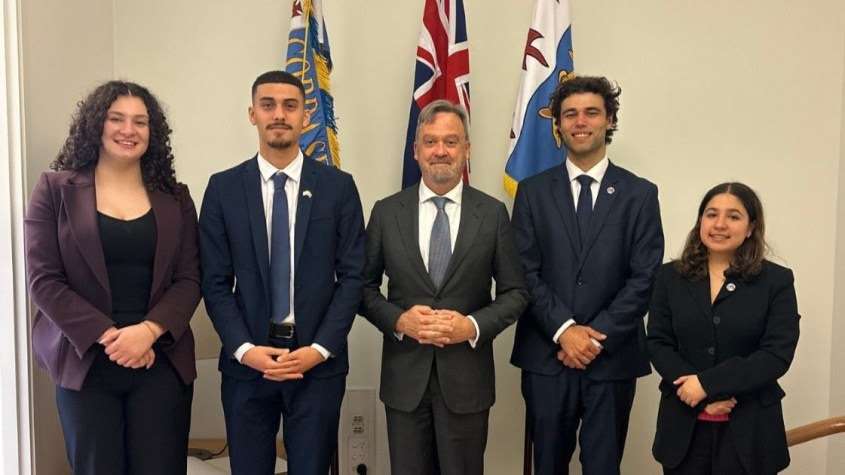
The delegation was organized by the Joint Justice Initiative (JJI), a coalition established in 2020 by the Armenian National Committee of Australia (ANC-AU), the Assyrian National Council–Australia (ANCA), and the Australian Hellenic Council (AHC) to jointly advocate for recognition of the mass killings and deportations of Armenians, Suroye, and Greeks in the Ottoman Empire during the First World War and its aftermath.
JJI representatives met with the offices of six senators — Fatima Payman of Western Australia, David Pocock of the Australian Capital Territory, Andrew McLachlan of South Australia, Paul Scarr of Queensland, Jess Collins of New South Wales and Lidia Thorpe of Victoria — seeking to build broader parliamentary support for federal recognition.
The delegation briefed parliamentarians on the history of the 1915 genocides and Australia’s military and humanitarian involvement in the region. The groups argued that recognition would not only acknowledge the suffering of the three survivor communities but also recognize an important chapter in Australia’s own history.
The campaign comes amid a longstanding debate in Australia’s federal parliament over recognition of the Armenian genocide and the broader crimes committed against Christian minorities in the Ottoman Empire.
In 2023, the House of Representatives debated a motion that explicitly referred to “the Armenian, Assyrian [Sayfo] and Greek genocides committed by the Ottoman Empire between 1915 and 1923” and called on the Australian government to join countries that had formally recognized them.
Australia’s connection to the events also extends beyond its wartime military role. Australian soldiers encountered survivors and witnessed the consequences of the Ottoman government’s policies during the First World War, while Australian civilians subsequently organized relief campaigns to assist survivors and orphans.


Australian military personnel were also involved in efforts that affected Assyrian survivors. The Australian War Memorial documents the actions of Captain Stanley Savige, who helped rescue tens of thousands of Suroye refugees during the violence in northern Persia.
The JJI has made these historical links a central part of its campaign, arguing that federal recognition would acknowledge not only the victims and descendants of the genocides but also Australians who responded to the humanitarian crisis.


Majarian said the campaign was also about recognizing Australian nurses, priests, servicemen, and civilians who contributed to relief efforts.
“For more than a century, Australians have carried the legacy of those who sacrificed what little they had to help save lives and prevent the complete annihilation of our communities,” he said, arguing that the government’s failure to formally recognize the genocides was also a disservice to Australians who had assisted survivors.
The JJI is also seeking additional members of federal parliament to sign its Joint Justice Initiative Accord, a parliamentary grouping of lawmakers who have publicly expressed support for federal recognition of the Armenian, Sayfo, and Greek genocides.
The initiative’s campaign reflects a broader effort by the three communities to present recognition as a shared historical and humanitarian issue rather than as separate national causes. Their advocates maintain that acknowledging the crimes committed against Armenians, Suroye, and Greeks would strengthen Australia’s commitment to genocide prevention and historical accountability.
The issue has previously received support from lawmakers across Australia’s political spectrum. During a 2018 parliamentary debate, senators and MPs highlighted Australia’s early humanitarian response to the Armenian massacres and its links to the country’s emerging national identity.
For the JJI, however, parliamentary advocacy remains necessary until the federal government formally adopts a position recognizing the three genocides.
The coalition said it would continue lobbying federal and state parliamentarians across Australia as it seeks to secure formal national recognition of the events of 1915 and their aftermath.