Court Punts Case Against Karekin II and Bishops to Yerevan Court
The judge presiding over the criminal case against Catholicos Karekin II and six other bishops decided to transfer the case to a court in Yerevan.
Judge Serzh Rushanyan of the First Instance Court of Armavir Province on Friday insisted that he was not seeking to avoid hearing the case, but believed there was an issue of jurisdiction. The case, he said, must be heard in the jurisdiction where the alleged crime was committed.
The indictment does not specify where exactly the Catholicos decided to defrock Bishop Gevorg Saroyan.
Both the prosecution and defense objected to the decision.
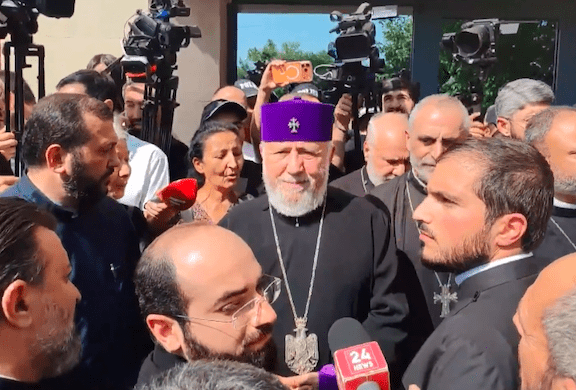
“We disagree with the court’s decision because we believe that since the Catholicos of All Armenians directive was issued in the city of Etchmiadzin, the case should have been heard by this court. The judge did not share that view,” Ara Zohrabyan, a member of the Catholicos’ defense team, told reporters.
“On the one hand, this also indicates that judges, in any case, understand that this is a problematic case. On the one hand, there is their conscience, and ultimately justice and truth; on the other hand, there is political pressure. In this regard, perhaps this is the path they have sought and found,” Zohrabyan continued.
The 29-year-old Rushanyan replaced another judge assigned to the criminal indictment against the Catholicos and others who on August 7 recused himself from the case citing conflict of interests.
Zoharabyan, an attorney on the Catholicos defense team, called the transfer of the case to Yerevan problematic.
“You remember that in the case of Archbishop Mikael Ajapahyan, they similarly forced the case to be heard in Yerevan, and in the end it turned out that there had been a violation of the jurisdictional rules, and the decision was overturned. In other words, they wasted all this time. And now, hearing the case in Yerevan naturally carries the same risks,” Zohrabyan said.
He also expressed concern that the case could be assigned to judges whom the public does not trust. “In that case, naturally, we will have concerns about expecting justice,” he said.
Zohrabyan said that he and his team will wait to see who is assigned to the case and, accordingly, present their position.
“In any case, I see that judges, in one way or another, see a problem with hearing this case. On the one hand, that is positive, but on the other hand, it is negative, because if that awareness exists, then they could simply issue a fair judicial ruling,” the attorney said.
He added that the defense intends to file a motion to have the case dismissed at this stage.
The Catholicos and six other bishops did not attend the hearing on Friday. Karekin II and five of the other clergy attended the first hearing on August 7. It was the first time in the history of independent Armenia that the head of the Armenian Apostolic Church appeared before a court.
Karekin II and six senior clergymen are accused of failing to comply with a judicial ruling. The Catholicos had removed Bishop Gevorg Saroyan, Primate of the Diocese of Masis, from his position, while a court ordered that the clergyman be reinstated.
The Mother See of Holy Etchmiadzin, however, did not reinstate Saroyan and instead defrocked him, arguing that such matters fall outside the jurisdiction of the courts and that the ruling constituted interference in the autonomy of the Church.
The hearing took place days after Prime Minister Nikol Pashinyan told parliament that part of his government’s five-year program was to pursue the campaign to depose the Catholicos and initiate church reforms. For the first time, Pashinyan cited Karekin II’s and the Church’s support for Artsakh as yet another impetus to unseat the pontiff.
The Supreme Spiritual Council of Etchmiadzin responded that neither the parliament nor the government had jurisdiction over enacting church reforms.
“The Government has neither the authority nor the constitutionally established competence to make the reform of the Church part of its program or, at its own discretion, impose any ‘proposals’ or demands upon the clergy,” the Supreme Spiritual Council said in a statement issued on Wednesday.
The council headed by Karekin II again rejected Pashinyan’s “blatantly false accusations” and accused him of “openly violating the country’s Constitution and disregarding rights enshrined in international law.”
If the court finds the senior clergymen guilty, they face a maximum sentence of two years in prison.