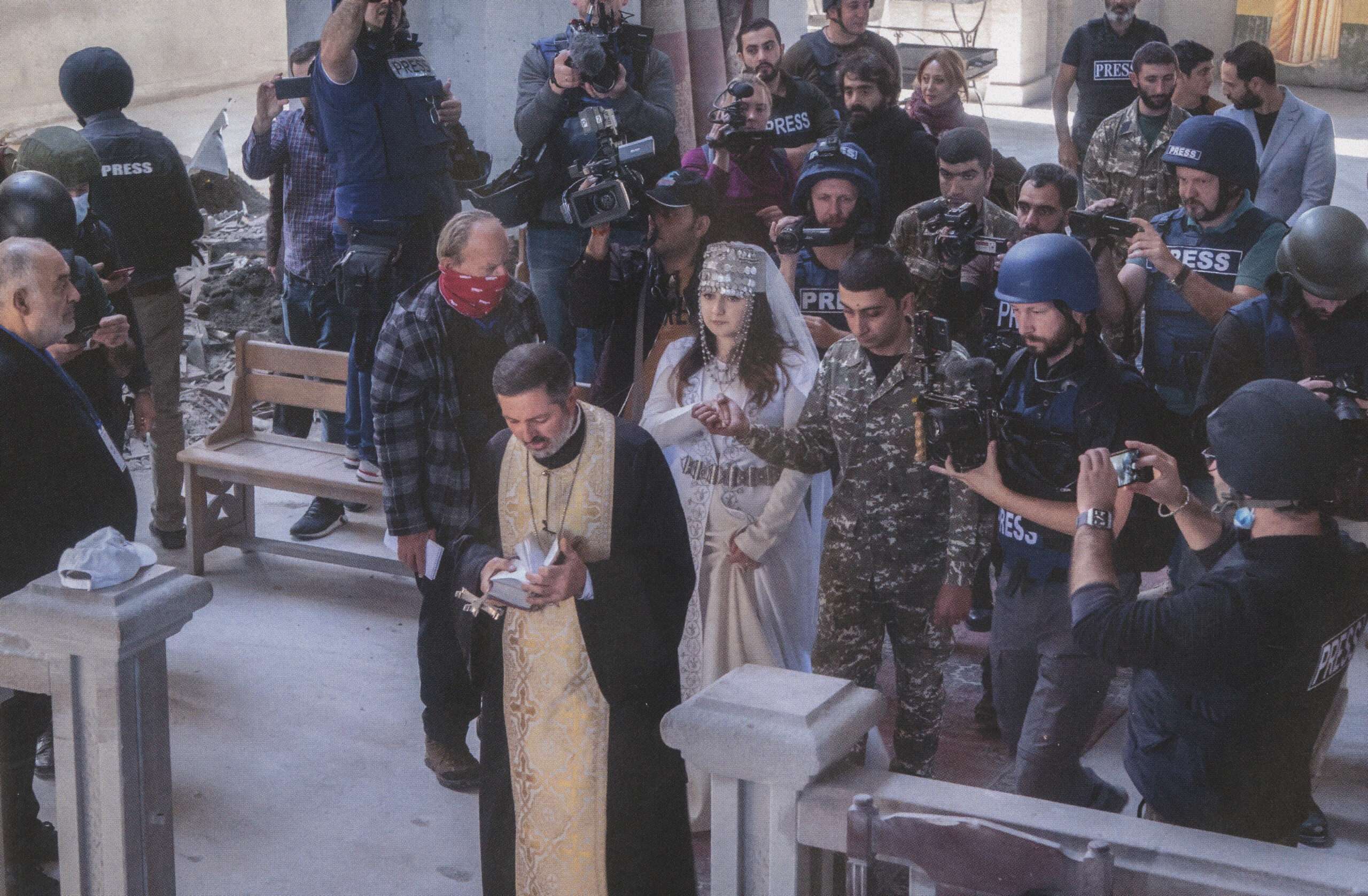
| FRESNO, CA – When war is documented, the images that reach us are often of soldiers, weapons, explosions and destroyed buildings. Photographer Ezras Tellalian wanted to tell a different story—the story of the ordinary people trying to hold on to life, family, faith and hope while war unfolded around them. The Armenian Museum of Fresno’s communications manager, Suzanne Crosina-Sahm, recently sat down with Tellalian to talk about Humanity During War, his deeply personal photographic exhibition opening Wednesday, Sept. 2, at the Armenian Museum of Fresno. A third-generation Armenian-American and descendant of Armenian Genocide survivors, Tellalian traveled to Artsakh (Nagorno-Karabakh) during the 44-day war in 2020, taking his camera into a region under relentless attack. Rather than focusing primarily on the battlefield, he turned his lens toward the civilians living beneath the shelling—families sheltering in basements, children who remained after others had fled, a young couple determined to marry in a cathedral that had been struck by artillery, and displaced women crushing grapes to make wine they hoped they would someday live to drink. Together, the photographs tell a story not only of war, but of the remarkable resilience of people who continued to extend hospitality, celebrate love, practice their faith and plan for a future even as the world they knew was being destroyed around them. The conflict began on Sept. 27, 2020, when large-scale fighting erupted between Azerbaijan and Armenian forces in and around Artsakh, a predominantly ethnic-Armenian region also known internationally as Nagorno-Karabakh. Azerbaijan received extensive military support from Turkey, and international reporting documented the presence of Syrian fighters recruited to fight on Azerbaijan’s side. Over the next 44 days, civilians endured intense bombardment, including attacks on populated areas. The fighting ended in November 2020 with a Russia-brokered ceasefire agreement among Armenia, Azerbaijan and Russia. Under its terms, Azerbaijan retained territory it had captured during the war, while Armenia agreed to return additional surrounding territories to Azerbaijani control. Russian peacekeepers were deployed to the region, and tens of thousands of ethnic Armenians were displaced. The story, however, did not end with the ceasefire. In September 2023, after months of blockade and shortages and a new Azerbaijani military offensive, virtually the entire ethnic-Armenian population of Artsakh—more than 100,000 people—fled to Armenia. The people Tellalian photographed can no longer return to the homeland depicted in his images. That reality gives Humanity During War an even greater poignancy today. What Tellalian captured in 2020 has become not only a record of civilians enduring war, but a visual record of a community and a way of life that has since been uprooted. Yet the photographs are not solely about loss. Again and again, Tellalian’s camera found something that survived the shelling: humanity, resilience and hope. In the following conversation, Tellalian shares the stories behind some of those photographs, what compelled him to travel into a war zone, and what he hopes people will understand about the human experience of war after seeing Humanity During War. |