
Napoleon’s Armenian bodyguard
-
Roustam Raza slept across Napoleon’s doorway and loaded his personal pistols. Yet this wildly famous Armenian bodyguard had exactly zero impact on French-Armenian relations.
Born to Armenian parents in Tiflis, Georgia, kidnapped at age thirteen, and sold into slavery in Cairo, he eventually became Napoleon Bonaparte’s most recognizable attendant, riding directly behind the Emperor in extravagant silk robes. Roustam was presented to General Bonaparte in 1799 by the Sheikh of Cairo during the French campaign in Egypt and Syria. He was a Mamluk—part of a caste of enslaved boys who were converted to Islam and trained as elite soldiers. Though ethnically Armenian, Roustam’s identity had been entirely shaped by his Mamluk upbringing. When he arrived in France, he did not represent the Armenian diaspora, the Armenian Apostolic Church, or any political faction. He was a devoted personal servant, not a diplomat.
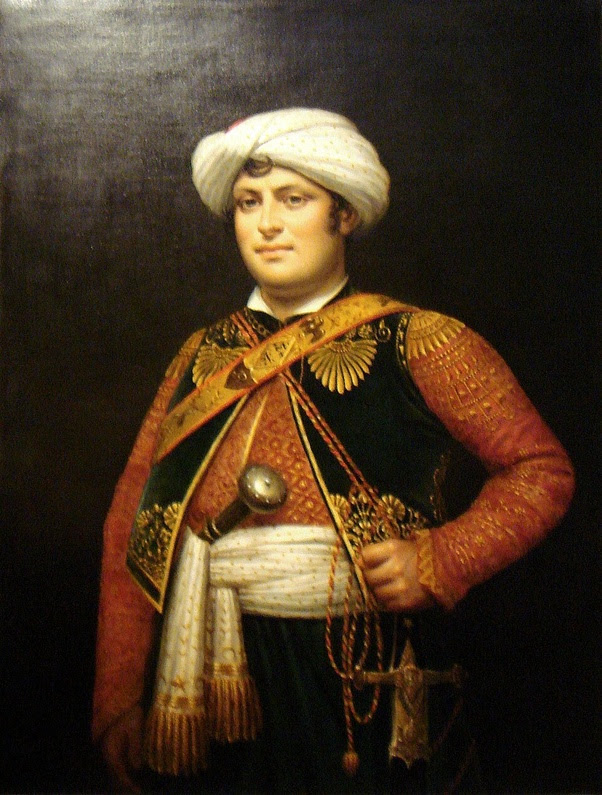
Rather than acting as a geopolitical bridge, Roustam served as living propaganda. Dressed in brilliant turbans, baggy trousers, and armed with a scimitar, he fed into Europe’s growing fascination with Orientalism. His highly visible presence at state events, military parades, and in imperial portraits was designed to remind the French public of Napoleon’s Eastern conquests. He projected the image of a vast, cosmopolitan empire whose ruler commanded the loyalty of exotic warriors. To the French public, he was never an Armenian representative; he was simply “the Mameluk.”
Roustam’s service ended abruptly in 1814. When Napoleon abdicated and was exiled to Elba, Roustam refused to follow him, fearing he might be assassinated or blamed for the Emperor’s downfall. He instead settled in the French town of Dourdan, married a local woman, and lived a quiet life. His only enduring legacy is his memoir, Souvenirs de Roustam, which provides an intimate look at Napoleon’s private life but contains no advocacy for the Armenian people.
An 1806 portrait of Roustam Raza, Napoleon’s famous Armenian bodyguard, wearing his customary uniform. Source: Wikimedia Commons.