
Games of Chance Came Long Before Probability Theory
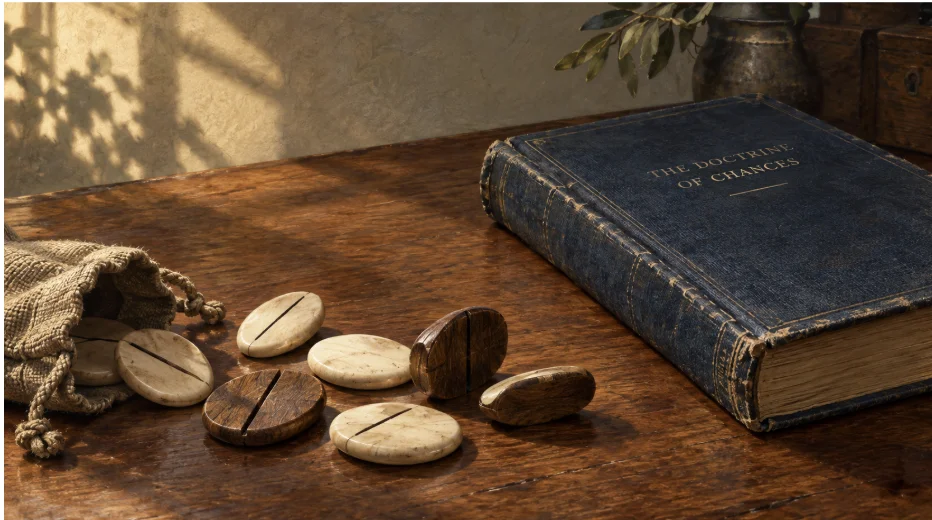
https://drive.google.com/file/d/1djNeCVd4MBlLIGTfvp65hFcQFQlSYjoY/view?usp=sharing
ALT text: Marked gaming pieces beside a book titled The Doctrine of Chances
Image Source: Editorial illustration by author
A game can be played before anyone can calculate its probabilities. Players need shared rules about what counts, how a turn ends, and which result settles the contest. Working out the likelihood of each result is a different task. That distinction helps explain how games of chance could exist thousands of years before formal probability theory, and why finding an ancient die tells us more about the existence of play than the mathematical knowledge of its players.
In April 2026, Live Science reported on archaeological evidence of dice more than 12,000 years old. Archaeologist Robert Madden identified early examples from sites of the Folsom culture in North America by comparing their features with historically documented Native American dice. These were two-sided objects, unlike the familiar six-sided cube. The historical comparisons included bone and wooden pieces, with flat or curved faces and markings that made one side distinguishable from the other. Recognizing such features allows researchers to reconsider an object’s purpose, even when it carries no familiar dots or numerals. The study places such gaming deep in the past, although its findings cannot identify a definitive inventor or recover everything that happened when those objects were used.
Rules make the question precise
The distinction remains visible in casino games. At an online casino, knowing that a game uses cards, dice, or a wheel tells only part of the story. Blackjack compares a player’s hand with the dealer’s under a limit of 21; roulette settles wagers according to where the ball finishes. The objects establish the form of play, while the rules determine what their results mean. A total on a card hand and a numbered pocket on a wheel become significant because the rules specify how to interpret them.
Even within one game, understanding the sequence of play differs from calculating the likelihood of an outcome. A blackjack player can understand when a hand exceeds 21 without being able to analyze every possible sequence of cards. A roulette player can distinguish a wager on one number from a wager covering a group of numbers without calculating either probability. Familiarity with the activity can therefore precede a formal explanation of it.
What an ancient die can tell us
Madden’s investigation drew on descriptions assembled by ethnographer Stewart Culin in his 1907 book, Games of the North American Indians. Historically documented dice often had one marked face and one unmarked face. Those distinguishing features helped Madden assess objects in archaeological collections that might otherwise be difficult to identify.
Culin’s accounts also described scoring systems. In documented games, players could count particular combinations of faces and track progress toward an agreed total, sometimes using counting sticks.
Those historical descriptions provide comparisons for recognizing much older objects. They do not supply a surviving rulebook for every prehistoric find. Similar equipment can support different scoring arrangements, and a recognizable die does not reveal the vocabulary players used to discuss chance. Madden acknowledges that the depth of ancient players’ understanding remains difficult to establish.
The dates require similar care. An early surviving object establishes evidence of a practice by that time. It cannot, by itself, tell us when someone first devised that practice. Preservation and identification shape the archaeological record alongside the activities it records.
Standard European roulette has 37 pockets: the numbers 1 through 36 and a single zero. Standard American roulette retains those numbers and adds a double zero, bringing the total to 38. These roulette variants use a wheel and share a name, but they present different sets of possible landing places.
https://drive.google.com/file/d/13yJxen4YcdFy4oIreqSQ5FX3SMY4ODyw/view?usp=sharing
ALT text: European roulette has 37 pockets; American roulette adds double zero for 38
Image Source: Infographic by author
Craps illustrates another difference. The same dice can serve several wagers, each settled according to its own conditions. Describing the equipment therefore leaves an essential question unanswered: which result is being counted? A mathematical account needs that detail. A description of the objects alone cannot establish the event whose likelihood someone wants to calculate.
From familiar games to formal mathematics
Formal probability developed in the 16th and 17th centuries as mathematicians investigated questions raised by games of chance. The change lay in constructing systematic mathematical explanations for uncertain outcomes. Rules that players followed became conditions an analyst could state, examine, and use in a calculation.
Abraham de Moivre’s The Doctrine of Chances, published in 1718, with a second edition in 1738, belongs to that later mathematical history. It was part of an existing development, rather than the beginning of games of chance or the first recognition that outcomes were uncertain. Expressing a problem mathematically made it possible to compare different games through their underlying questions: which outcomes are possible, how they combine, and how likely a specified result is under the stated conditions of play. A probability calculation describes how likely an outcome is; it does not identify the next individual result.
Shared rules let players recognize a game’s outcome without calculating its likelihood in advance. Formal theory addressed a further question: how could that uncertainty be described precisely? Thousands of years separate these surviving examples of prehistoric dice from that mathematical development. The gap reflects different kinds of knowledge, with practical rules sufficient to make a game playable long before its probabilities received a formal explanation.