
Armenians from the diaspora in Türkiye retracing the steps of the genocide
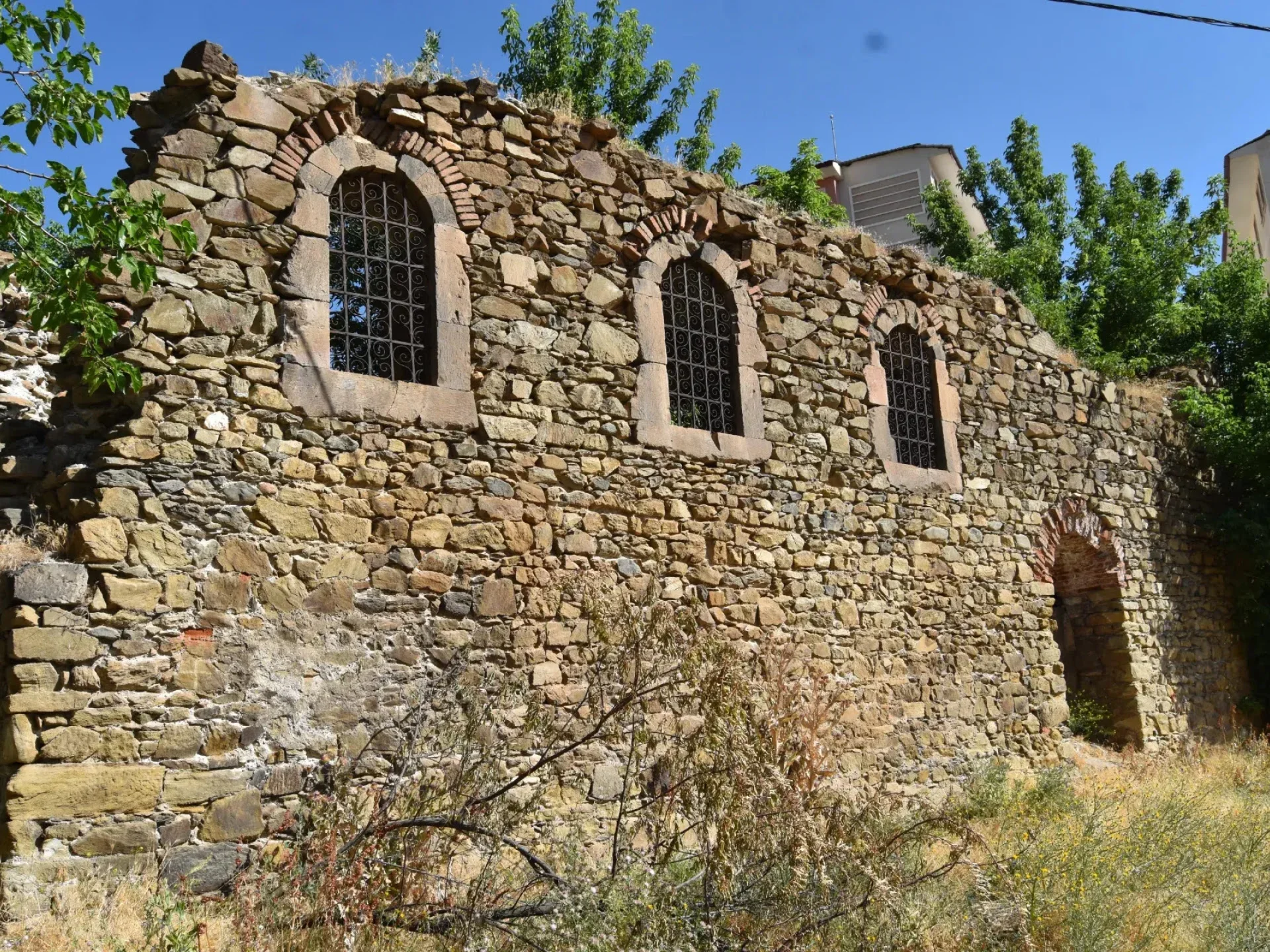
Ruins of the presbytery of Ste-Marine in Moush. The churches of the ecclesiastical complex have been razed to the ground. © Jacques Berset
Cath.ch
“I had sworn never to set foot in Turkey, the country where my father’s ancestors had survived the 1915 genocide. And yet here I am!” Cédric, a young man from Antwerp, is part of a “journey of memory” in Eastern Anatolia, which was Western Armenia eradicated on the orders of the Committee of Union and Progress (CUP), better known as the “Young Turks”.
Jacques Berset, for cath.ch
Cédric is part of a group of 25 Armenians from the diaspora, mostly young people, who set out this July in search of remnants of a past whose traces have been meticulously erased. Ranging in age from 18 to 77, they belong to the Armenian Cultural Union, “Hamazkain Armenian Educational and Cultural Society,” and come from Lebanon, the United States, Belgium, France, Armenia, Australia, and Syria. Since the group members spoke Western Armenian—the language spoken in the diaspora—I was accompanied by Azniv Aslikian, head of tourism development projects for the Swiss Humanitarian Foundation KASA, a highly experienced French-speaking guide.

Among these young travelers, one stands out: Johanna (not her real name), 77, has lived in California for 15 years. Born in Armenia, she had a career in Yerevan, the Armenian capital, before retiring. “My lifelong dream has been to see the land of my great-grandparents again. They were from Kars on my mother’s side and Alashkert (called Toprakkale by the Turks) on my father’s. This past is deeply ingrained in my memory. I wanted to touch the stones of these places before I die!”
The Armenians have disappeared, but the stones speak.
The ever-enthusiastic Christ shares the group’s motivation, all of whose members have roots in this physically vanished country. “But the Armenian stones, often salvaged and visible in the foundations of Kurdish houses, speak to attentive eyes.” In Armenian schools in the diaspora, students learn the history of the Armenian genocide in Turkey, where the Armenians had been present for millennia.
Christ, who attended university in Beirut, has been teaching Armenian for three years in the Armenian community of Issy-les-Moulineaux, in the Paris region. He has no emotional issues with the Kurds and Turks, but he laments that the Turks are rewriting history. Thus, churches that were not razed to the ground, cemeteries that were not devastated, are never referred to as Armenian, even though large, finely carved cross-stones, the khachkars, can still be seen there.

Thus, on Akhtamar Island in Lake Van stands a magnificent medieval Armenian Apostolic Church, built as a palatine church for the Armenian kings of Vaspurakan, notably Gagik I in the 10th century, and later serving as the seat of the Catholicosate (seat of the Armenian Apostolic Church) of Akhtamar. In front of the Church of the Holy Cross, the official cemetery sign indicates that this is the cemetery of the “Alanis,” the “Alans,” a people of the Caucasus and the Asian steppes. These tribes never founded a church in eastern Anatolia…
Everywhere, Turkey rewrites history to erase the Armenian memory from these places, but it cannot erase the Armenian script engraved everywhere in stone. This historical revisionism will be evident throughout our journey in ancient Western Armenia.
“Dönme” rediscover their Armenian roots
Sofya Hakobyan, a journalist, filmmaker, and Turkologist, spent nearly ten years studying the lives of Islamized Armenians, particularly in the Sassoun region of Batman Province . She believes that very little has been written about the Christian Armenians forcibly converted to Islam, which allowed them to escape mass executions. Hundreds of thousands of them are unaware of their origins, until, for a few, a grandfather reveals the great secret on his deathbed. Some of these “Dönme” (forcibly converted to Islam) rediscovered their Armenian roots when a grandparent confided in them this lifelong secret.

But the vanished villages remain in people’s memories, as do the songs whispered in dreams, the poems, and the traditional home-cooked meals. The lost Armenia is still subtly present in the stories of survivors who escaped death by being taken in by Kurdish or Turkish families, who Kurdified or Turkified their names and converted them to Islam. The Turks call them the “remnants of the sword,” referring to the hidden and Islamized Armenians of Turkey. A few were baptized and received Armenian Christian names, but for the sake of society, most kept their Muslim names, either out of fear of reactions from those around them or to preserve their professional careers.
Diyarbakir is recovering from the devastating fighting of 2015-2016
In Diyarbakir, a major city in southeastern Anatolia, considered the historical and cultural capital of the Kurdish nation , the bell tower of the Armenian Apostolic Church of Surp Giragos (Saint Cyriacus) dominates the historic Sur district. Or what remains of it, since the entire medina with its narrow streets was razed following fighting between militias of the Kurdish PKK group and Turkish armed forces in late 2015 and early 2016.
On several occasions between September and November, the residents of Sur were subjected to a strict curfew, with no possibility of communicating with the outside world and no electricity. Seventy percent of the Sur neighborhood was destroyed, and the local population was forcibly displaced. The historic black basalt houses were razed and have now been rebuilt by the public institution TOKI, without any regard for the historical heritage.

This led to gentrification of the population, with significant consequences for the Armenian community that frequented the Surp Giragos parish, which has not seen the same attendance as before the fighting, especially since the neighborhood was cordoned off for several years. The damage inflicted on the church has been repaired, notably with assistance from the Kurdish municipality.
In the bustling parish – where mostly Muslim visitors throng to visit the church – we encounter “crypto-Armenians” and Muslim Armenians who have chosen to become Christians. But they are cautious and require strict anonymity.
Christian Armenians rediscover their roots
One of our interviewees was baptized several years ago in the nearby Assyrian church of St. Mary. At the time, Surp Giragos had not been renovated, had no roof, and only bare walls. This clandestine Christian came from a village in Sassoun; his mother was a Christian Armenian and his father was a Muslim Armenian. Another parishioner told us that he was baptized secretly, and that his immediate family—his Muslim wife and children—are unaware that he has converted to Christianity.
In Diyarbakir, about ten Armenian families identify as Christian. They hope one day to have a resident priest, as he only comes from Istanbul for Easter, an occasion for organizing weddings and baptisms.
The Armenians in Diyarbakir, supported by the Kurdish municipality, are now a recognized and integrated minority. The church of Surp Giragos, which was rebuilt and reconsecrated in November 2011, has allowed many “crypto-Armenians” to rediscover their roots.
Discrimination persists
Commenting on the general situation of Armenians in Turkey (they number around 90,000 in Turkey, mainly in Istanbul), Sofya Hakobyan believes that many of them, in order to have a more comfortable and peaceful life, convert to Islam. But those who have retained their Christian identity are wary of them.
Certainly, being a Christian in Turkey today is easier than it was in the 1980s and 90s. But Christians remain third-class citizens. They do not have access to important positions. If it is known that someone has returned to Christianity, they try to tolerate them, but they will never be accepted as a ‘true Turk’! (cath/be/bh)
A denied genocide
Still denied by Turkey, the Armenian Genocide (in Turkish, Ermeni Soykırımı), perpetrated from April 1915 to July 1916, and then until 1923, caused the disappearance of the vast majority of Armenians—estimated at nearly one and a half million deaths—living at the time in what is now Turkey. They perished as a result of deportations, organized famines, and large-scale massacres. JB