At Armenia’s Military Academy, Former Israel Aerospace Industries Executive Proposes Connecting Armenia and Israel
The former Israel Aerospace Industries vice president called for reciprocal Armenian access in a peace settlement with Azerbaijan, challenged Turkish influence over Baku and urged Israeli action for Armenians displaced from Nagorno-Karabakh.
YEREVAN – – Israeli strategist Shay Gal, Founder and Principal of Line of State and former Vice President for External Relations at Israel Aerospace Industries, proposed a regional architecture connecting Jerusalem and Yerevan through Greece and Cyprus, with a place for Azerbaijan independent of Turkish influence.
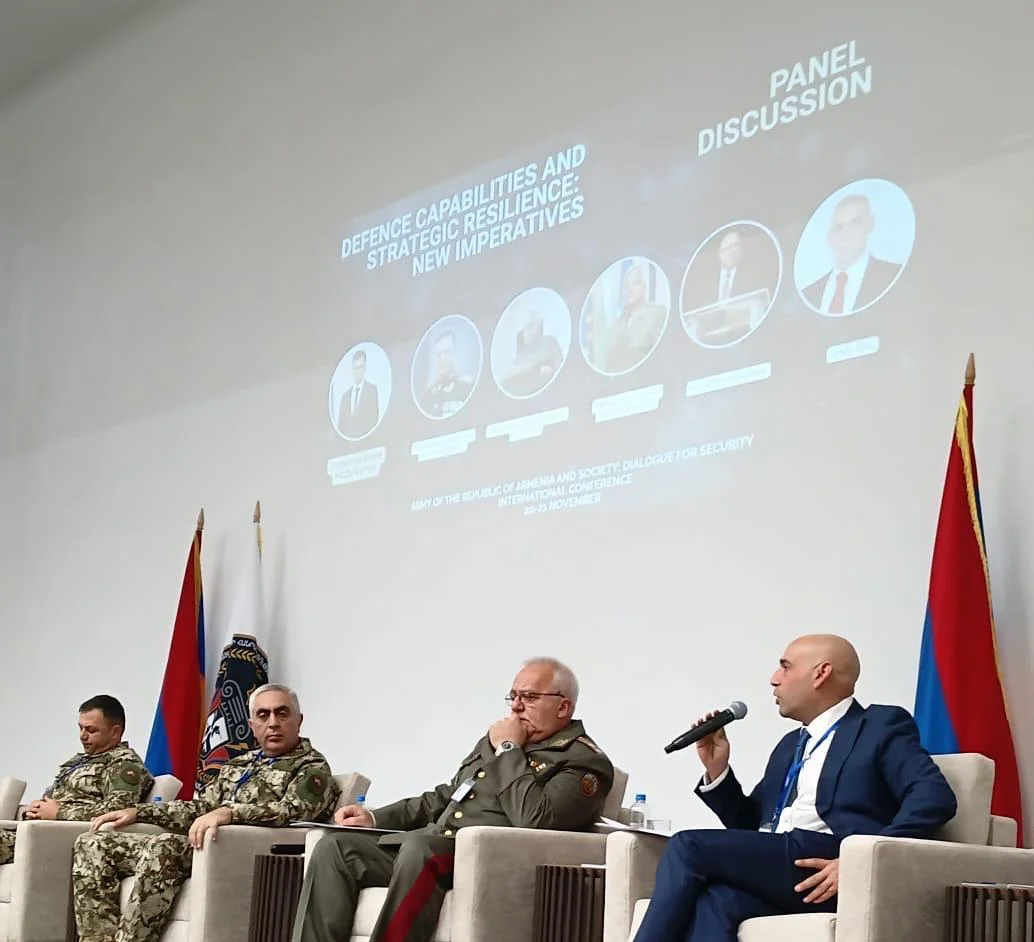
Gal addressed Friday’s international conference, Army of the Republic of Armenia and Society: Dialogue for Security, at the Vazgen Sargsyan Military Academy. He joined a panel on defence capabilities and strategic resilience, drawing on Israel’s experience of civil–military relations, before leading a workshop for Armenian officers titled Who Owns Readiness? Civilian Oversight After the Arms Purchase.
Israel, Greece and Cyprus already cooperate in defence, energy and critical infrastructure; Armenia, Greece and Cyprus maintain a separate defence framework covering military training, education and exercises. Gal proposed connecting them through direct cooperation between Jerusalem and Yerevan.
Defence industry, engineering, maintenance, critical infrastructure and connectivity would strengthen Armenia’s capabilities while creating contributions its partners need. Technical rights, local maintenance and upgrade authority would secure independence through competence, rather than substitute one foreign dependency for another.
The architecture also accommodates Azerbaijan through its own interests, alongside Georgia and Black Sea connectivity.
Gal distinguished Turkey, a common strategic adversary for Israel and Armenia, from Azerbaijan, a prospective partner. Both countries share an interest in an Azerbaijan free to determine its own foreign policy.
Military victory does not guarantee political independence. Ankara holds no formal veto over Azerbaijani diplomacy. Only Baku can confer one.
As Prime Minister Nikol Pashinyan pressed parliament this week on the need to make peace with Azerbaijan irreversible, Gal set out the conditions for a durable settlement: reciprocal access, enforceable commitments and sovereign freedom of action.
Such a settlement can secure Armenia’s borders while expanding Azerbaijan’s independence. Armenia must secure commensurate returns for the connectivity it provides.
“Armenia should gain access when it grants access.”
Passage between Azerbaijan and Nakhchivan must be matched by dependable Armenian access westward, including through Turkey, backed by enforceable commitments and remedies. The published TRIPP framework preserves Armenian sovereignty and jurisdiction. Commercial arrangements must not make those rights prohibitively costly to exercise.
Sovereignty must remain exercisable, not merely recognised.
The same principle governs Israel’s diplomacy.
“Loyalty to Baku must leave Jerusalem free to develop a relationship with Yerevan.”
Israel’s partnership with Azerbaijan cannot dictate its relations with Armenia. Closer Azerbaijani–Turkish cooperation cannot silently enlarge third-party rights over Israeli technology. Equally, Armenia must remain free to pursue partnerships that diverge from Israeli preferences.
Gal also confronted the human consequences of Azerbaijan’s September 2023 offensive, in which Israeli weapons were used and after which more than 100,000 Armenians fled Nagorno-Karabakh.
“I support Azerbaijan’s territorial integrity and make no apology for Israel standing by an ally.”
Israel’s alliance with Azerbaijan does not absolve it of responsibility towards the displaced Armenian families. Jerusalem must work with Armenia, international partners and the families themselves to secure lasting solutions.
The workshop examined how civilian decisions govern military endurance after procurement: who authorises repairs, controls technical information, replenishes stocks and guarantees support. The same standard applies to a state’s diplomatic partnerships and regional commitments.
“An officer should never have to certify a political hope as a professional fact,” Gal concluded.