“AMONG THE ARMENIANS”
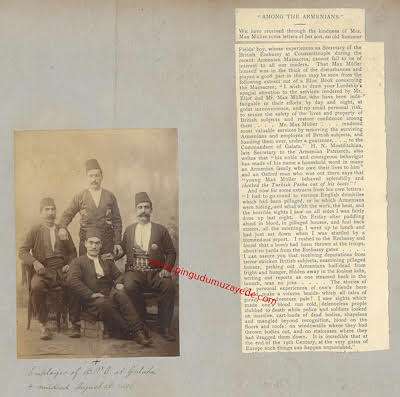
Rare Photograph of the employees of the British Post Office in Galata who were killed by Turks protesting the Ottoman Bank raid by Armenians on August 26, 1896
From the album of Diplomat William Max Müller.
We have received through the kindness of Mrs. Max Müller some letters of her son, an old Summer Fields’ boy, whose experiences as Secretary of the British Embassy at Constantinople during the recent Armenian Massacres, cannot fail to be of interest to all our readers. That Max Müller himself was in the thick of the disturbances and played a good part in them may be seen from the following extract out of a Blue Book concerning the Massacres; “I wish to draw your Lordship’s special attention to the services rendered by Mr. Eliot and Mr. Max Müller, who have been indefatigable in their efforts by day and night, at great inconvenience, and no small personal risk, to secure the safety of the lives and property of British subjects and restore confidence among them. Mr. Max Müller . . . rendered most valuable services by removing the surviving Armenians and employés of British subjects, and handing them over, under a guarantee, . . ., to the Commandant of Galata.” H. N. Mostidichian, late Secretary to the Armenian Patriarch, also writes that “his noble and courageous behaviour has made of his name a household word in many an Armenian family who owe their lives to him” and an Oxford man who was out there says that “young Max Müller behaved splendidly and cheeked the Turkish Pasha out of his boots”!
And now for some extracts from his own letters: “I had to go round to various English domiciles which had been pillaged, or in which Armenians were hiding, and what with the work, the heat, and the horrible sights I saw on all sides I was fairly done up last night. On Friday after paddling about in blood, in pillaged houses, and foul back streets, all the morning, I went up to lunch and had just sat down when I was startled by a tremendous report. I rushed to the Embassy and found that a bomb had been thrown at the troops, about 20 yards from the Embassy gates. I can assure you that receiving deputations from terror stricken British subjects, examining pillaged houses, picking out Armenians half-dead from fright and hunger, hidden away in the foulest lofts, writing out reports as one steamed back in the launch, was no joke . . . . The stories of the personal experiences of one’s friends here would make a volume beside which all tales of piracy and adventure pale! I saw sights which made one’s blood run cold, defenceless people clubbed to death while police and soldiers looked on inactive, cart-loads of dead bodies, shapeless and mangled beyond recognition, blood on the floors and roofs; on windowsills where they had thrown bodies out, and on staircases where they had dragged them down. It is incredible that at the end of the 19th Century, at the very gates of Europe such things can happen unpunished.”