Anjar: The Armenian Citadel of Security in Lebanon
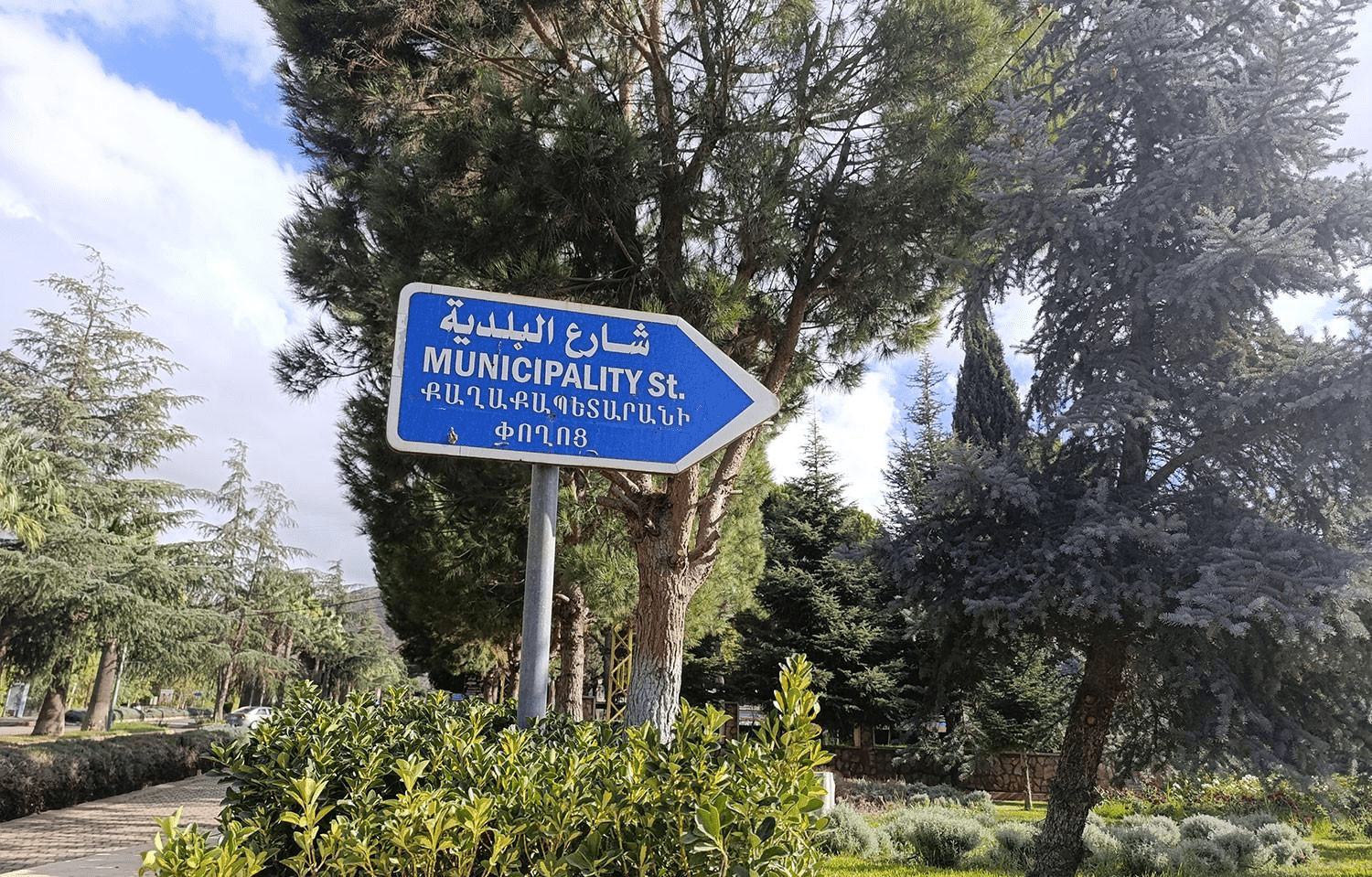
Unlike many Lebanese settlements with few street signs, Anjar’s prominent sign directly informs visitors of their location.
The central street rises to the foot of the Anti-Lebanon mountains, beyond which lies Syria, and on the right and left are narrower streets intersecting it, with inscriptions in Armenian, English, and Arabic.
These streets, bearing Armenian and Arabic names (Komitas, Shiraz, Mashtots, Narekatsi, Sasun, Arax, Aghajanian, Der-Kaloustian, Zeitlian, Karageozian, etc.), are symmetrical and uniform. It is evident that the settlement was built according to a clear plan. And indeed, Anjar is the only settlement in the Bekaa Valley, considered the heart of Lebanon’s agriculture, for which a plan-map was drawn up before construction.
A Bit of History: From Mount Musa to Anjar
The name Anjar (Aanjar) has an Arabic origin: ayn al-jaar, which is interpreted in different ways: flowing spring, water flowing from a spring or water flowing from a rock. “Ayn” in Arabic means spring, and there is also an opinion that the name comes from the components “ayn” and “Gera”/”Zhara”, that is, the spring of Gera or Zhara (according to this version, the place was previously called Gera). In any case, the name of the settlement comes from a spring flowing from the Anti-Lebanon mountains, which can be considered the main source of life in this part of the Bekaa Valley (the presence of the spring attracted not only people, but also formed a rich flora and fauna in the vicinity).
Anjar is a historical settlement, people have lived here since the 8th century, but Armenians came to Anjar eighty-seven years ago, in 1939.
And it all began during the Armenian Genocide in 1915, on Mount Musa (Musa Dagh), 275 km north of Anjar. After resisting the Ottoman army for 53 days on this mountain on the Mediterranean coast in July-September 1915, more than 4,000 Armenians were transported by French and English warships to the Egyptian port city of Port Said, which was under the control of the British from the Entente powers.
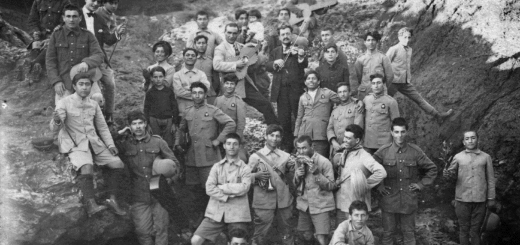
A group of fighters in the heroic battle of Mount Musa
The participants in the heroic battle of Musa Dagh were from six Armenian-populated villages near the mountain: Kabusiye, Vakef, Kheder Beg, Yoghunoluk, Haji Habibli and Bitias. (Map)
A tent city was established in Port Said for the Musa Dagh residents, where they spent 4 years, until 1919. After the defeat of Germany and its allies, including Ottoman Turkey, in World War I, the Musa Dagh residents were able to return to their homes (they had been destroyed and looted during the Genocide), as the area had come under French control, and the Sanjak of Alexandretta had been formed. The population here was mainly Arabs (Alawites and Sunnis), Turks, Armenians, and Greeks. In July 1939, the area was annexed to Turkey by the Franco-Turkish agreement, which raised a wave of discontent among the non-Turkish population.
Emigration from the sanjak had begun as early as 1938, when the Hatay State was formed here under Turkish influence, which was annexed to Turkey in 1939. By the end of 1938 and the beginning of 1939, 70 percent of Armenians had already emigrated from the Sanjak of Alexandretta. And in the summer of 1939, the last Armenians left here, not wanting to live under Turkish rule again. The conditions were not favorable for a new attempt at self-defense: from a geopolitical point of view, the attention of the superpowers was focused on Europe, where fascism had risen, and World War II was about to begin. Thus, about 35 thousand Armenians, as well as tens of thousands of Arabs and Circassians, left the territory of the former Sanjak of Alexandretta, settling in neighboring Syria and Lebanon. Only a few Armenian families remained in the village of Vakef (Vakıflı), whose descendants still live there today.
However, work was done with the French authorities to convince them to relocate the Armenians of Musa Dagh to Syria or Lebanon en masse. They were temporarily relocated to the Syrian settlement of Ras al-Basit on the Mediterranean coast. The Armenians were to remain there until an order was issued to relocate them to a permanent place of residence. The homeless Musa Dagh residents spent forty difficult days in Basit, sheltering under mats and sheets. Suffering from a lack of drinking water and food, the people were left exposed to torrential rains. Various diseases soon spread, including dysentery. Diarrhea spread among the children. 200 of the refugees were transferred to a hospital in Latakia, close to Ras al-Basit, and the seriously ill were taken to Beirut. However, the Musa Dagh residents suffered 45 deaths in the difficult conditions created in Basit.
During that time, one of the leaders of the Musa Dagh self-defense, Movses Der-Kaloustian, who was a deputy of the Syrian parliament in 1927-1937, was conducting preparatory work with the French authorities to relocate the Musa Dagh residents to the Anjar area near the Lebanon-Syria border.
Afterwards, Musa Dagh residents were transported by ship to the port of Tripoli in Lebanon, from where they reached Rayaq by steam locomotive. From here, they were transported by car to the Anjar area in September 1939. The distance to the latter by road is 55 km from Beirut, 50 km from Damascus, and the altitude above sea level is 900-950 m.
In September 1939, the number of Armenians moved to Anjar was 5,125 (1,205 families). Until the houses were built, they temporarily lived in tents that were erected on the site of the ruins of an 8th-century fortress-palace of the Umayyad Caliphate (the tent fabric was provided by the AGBU, the Armenian General Benevolent Union).
Life in tent conditions was not easy; there was a lack of drinking water and food. Part of the refugees dispersed to neighboring settlements because of all this. Out of 1205 families, 1050 remained (803 Apostolic, 165 Catholic, 82 Evangelical).
As mentioned, Anjar is the only settlement in the Bekaa Valley that was built according to a plan. The author of the project, which looks like an eagle with spread wings, is architect Hagop Keshishian, who was assisted by Musa Dagh surveyor Abraham Der-Gazanchian.
According to the plan, Anjar was divided into 6 village neighborhoods according to the villages of Musa Dagh: Kabusiye, Vakef, Kheder Beg, Yoghunoluk, Haji Habibli and Bitias. And it is no coincidence that Anjar is officially called Hawsh Mօusa-Anjar (Arabic for “Musa’s yard”).
Anjar Mayor Setrag Havatian shows the village neighborhoods
Since the Armenians of these villages included both Apostolic, Catholic, and Evangelical, later three churches and three schools were founded in Anjar according to religious affiliation.
Initially, the immigrants brought drinking water by hand from the Anjar spring, which is 1.7 km from the center of the settlement. In parallel with the construction of the houses, pipes were laid from the spring to the reservoir built in the upper part of the village, where the water was pumped by a turbine, then from the reservoir it was directed to the eleven springs made in the village. From here, the residents took it.
The biggest problem for the Musa Dagh residents who settled in Anjar was the issue of livelihood. There were no draft oxen or agricultural machinery. They were forced to rent from neighboring villages (years later, the Iranian-Armenian benefactor Haig Tutunjian donated a tractor to the village). The AGBU acquired seed wheat, barley, lentils, peas, beans, millet, and bought fifty pairs of oxen, 110 cows, the same number of goats and sheep, several horses, and mules. The first crops were mainly peas and barley, and eating the bread made from them is still remembered by the Anjar people today as suffering.
The first years were quite difficult. Malaria reared its head. More than a third of the village’s patients had malaria, and the deaths were numerous. In 1942, a malaria epidemic began in Anjar, killing 90 people in one month. If Armenians had lost 18 victims in the heroic battle of Musa Dagh, then during the first two years of settling in Anjar, more than a thousand people died due to various diseases and poverty. To eliminate malaria, it was decided to drain the swamps around the village. For this, drainage canals were opened. Within three years, it was possible to eradicate malaria from Anjar.
Today’s Anjar: A Citadel of Security
However, the number of Armenians has decreased in the last four years, due to the economic situation in Lebanon (locals divide the situation into two parts in economic terms: before 2019 and after, since 2019 the Lebanese currency began to rapidly depreciate against the US dollar. Currently, US one dollar is about 90 thousand Lebanese pounds). This situation has led to emigration throughout the country.
“If this economic crisis had not happened, I am sure that those who were leaving would not have left, and there would have been those coming from abroad,” says Havatian.
The community leader says that during the Lebanese civil war of 1975-1990, some Armenians from Beirut came and settled in Anjar. The same happened during the Syrian war, when Armenian families from Aleppo and Kessab found refuge in Anjar, some stayed here, and some left for Canada, Australia, and other countries. “Anjar is like a citadel,” says Havatian, referring to the safety of the town.
During the Syrian war, Arabs sought refuge in camps around Anjar. Some found employment and housing in Anjar, while those remaining in tents are mainly working class. The Arabs work in restaurants and on local farms.
As mentioned, Anjar is in the Bekaa Valley, which is comparable in size (120 km long, 16 km wide) and importance to the Ararat Valley in Armenia. Havatian says that both in the past and today, the main occupation of Anjar residents is agriculture, but, as a rule, young people are far from this sphere, many work and live in Beirut, tey are mainly craftsmen. And those who continue their parents’ work are not satisfied with the land plot their family has, they take additional areas to expand their business and create a means of livelihood.
“In general, the population of Anjar is above the average age, we are experiencing that crisis, the lack of young people is becoming more noticeable every day,” says the head of the community.
In 2025, Anjar also faced a serious water shortage. Havatian notes that rainfall was low, which left the irrigated lands parched. However, this is not the only source of irrigation, as artesian wells were dug in time to irrigate the arid lands distributed to the residents. But our interlocutor says that the volume of water in these wells had also decreased significantly last year, some of them had even dried up, and the landowners had to make do with the less available water. The orchards, which used to receive water every fifteen days, were watered every 45-50 days, which resulted in a decrease in both the quantity and quality of fruit production (Anjar is best known for its apples).
“We are guests here, but there is an ultimate goal”
Lebanon is divided into nine governorates (muḥāfaẓāt), which are are further subdivided into districts. Anjar is in the Zahlé District of the Beqaa Governorate. East of the Armenian-populated town is the Lebanon-Syria border, which runs through the Anti-Lebanon mountain range. Lebanese border posts located on the mountains are visible from the settlement.
Near Anjar are Arab villages with a predominantly Sunni Muslim population. Mayor Havatian notes that they have good relations with their Muslim neighbors. The city of Zahlé, the regional and provincial center of some 150,000, is 18 km from Anjar. Christians mainly inhabit it: Catholic and Orthodox Greeks, and Maronites (Maronites are followers of the Maronite Catholic Church).
“We try to keep our ties warm with neighboring villages so that in case of any problem we can reach quick solutions. We participate in their celebrations, and they come to ours. You know that the civil war in Lebanon was conditioned by religious issues. That was a lesson to keep ties warm with our neighbors and to coexist peacefully,” says the head of Anjar and emphasizes, “After all, we are newcomers here, they are the hosts, this is their country, we live in Lebanon, not in Armenia. We are guests here. We must respect each other. Believe me, they have much greater respect for us. I will say this with all boldness: they respect Armenians a lot, because they learned a lot from Armenians.”
Havatian notes that their ancestors transformed the area from desert into a greener place, teaching the locals tree planting. Anjar grew rapidly; after the French built rooms for families, residents expanded or rebuilt homes. Armenians, known for building, inspired locals to do the same and to learn painting, music, crafts, and mechanics. Many young people gained skills working alongside Armenians, later starting their own businesses, and recalling what they learned.
If the people of Musa Dagh are guests in Lebanon, what is the final destination?
Mayor Havatian says: “There is a supreme dream, or rather, a goal. At our events, speakers stress that we are guests here and teach our children this. Above all, our aim is a free, independent, and united Armenia; returning to Musa Dagh is not mandatory.”
(To be continued)