
Armenian immigrant’s grocery left lasting impact on Syracuse’s Hawley-Green neighborhood
- Johnathan Croyle | [email protected]
Syracuse.com
Last month’s story about the renovation of a former grocery store at 401 Hawley Avenue revived an old name from Syracuse’s past.
“Babian’s!” one Facebook user wrote.
“Dude, I knew where this was just by the picture,” said another.
Syracuse attorney Karen Khanzadian recognized it too.
“That was my grandfather and his store!” she wrote in an email.
Readers remembered her grandfather, Vahram Agababian, just as fondly as they did his business, Babian’s Market.
“Your grandfather is fondly remembered by all children,” another Facebook commentator said. “He was so sweet and always gave extra penny candy. I still remember his black car. We knew he was open when we saw it parked on the corner.”
“It was a hangout,” Khanzadian reflected last week. “His candy counter was epic. He had everything. Everyone left with something in their pockets.”
She and another granddaughter, Jackie Hayes of Minneapolis, affectionately remember their grandfather.
Vahram Agababian was a survivor — an extremely smart and compassionate businessman.
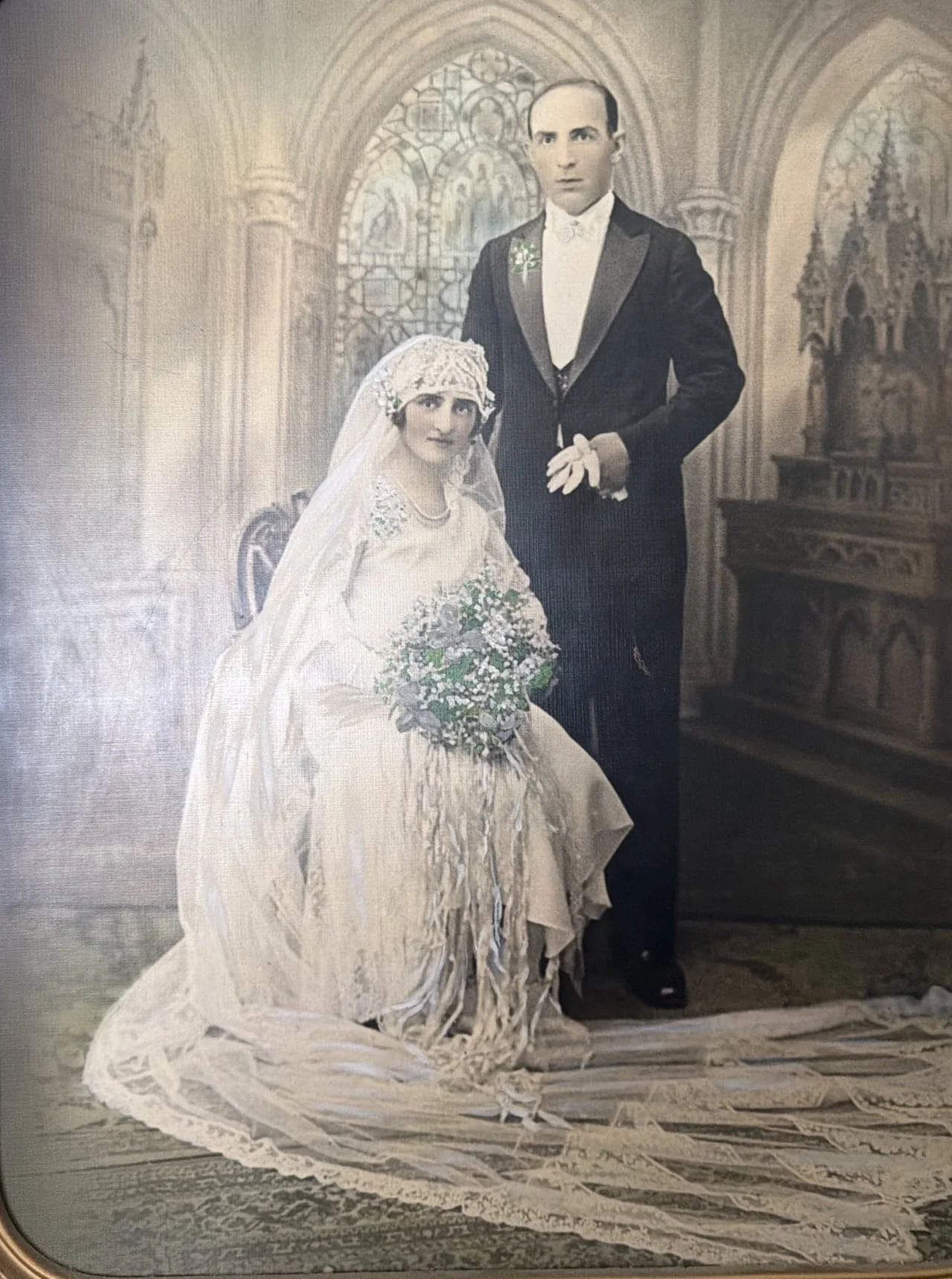
 The wedding photo of Vahram and Askanoush Agababian. The couple ran Babian’s Market at 401 Hawley Avenue for almost 50 years.Courtesy of Karen Khanzadian
His story begins in 1899 in his hometown of Bayburt, Armenia. His father was a local judge.
According to his 1983 obituary, Agababian was attending the prestigious Armash Seminary as a teenager when “he was exiled from the country during a World War I civil disturbance.”
That “disturbance” was the Armenian genocide, which was responsible for between 664,000 and possibly as many as 1.2 million deaths of Christian Armenians in the Ottoman Empire in 1915 and 1916. People died either in massacres and individual killings, or from systematic ill treatment, exposure and starvation.
It was the first genocide of its kind in the 20th century and a harbinger for the horrors to come. Before his armies invaded Poland to start World War II, Adolf Hitler referenced the plight of the Armenians.
“I have placed my death-head formations in readiness with orders to them to send to death mercilessly and without compassion, men, women, and children of Polish derivation and language,” he told his commanders. “Only thus shall we gain the living space which we need. Who, after all, speaks today of the annihilation of the Armenians?”
Vahram Agababian’s family was caught up in it. His father and a sister were killed and a brother and a sister were kidnapped. The rest of his family were exiled.
Agababian was forced into the Ottoman army as a medic, his granddaughters said.
Hayes believed that his education, including the ability to speak several languages, saved his life.
He tried to escape numerous times and was captured, beaten and starved.
But he was kept alive.
“He was useful and was able to charm,” Khanzadian said. “He was lucky too. I don’t know how many times he should have been killed. He had the personality like a bamboo. He could bend.”
After a third escape, he was captured by British soldiers and sent to a prisoner of war camp in Cairo. After World War I ended, he looked to relatives in America and a chance to join them.
At just 21 years old, Agababian arrived in the United States, at Brockton, Massachusetts, in 1920.
Khanzadian believed he was interested in attending Harvard medical school, using some of the knowledge he gained while being an army medic, but decided instead to use the money he earned while working at Boston area soda fountains and rug stores to get more of his relatives to the U.S.
He married an Armenian woman, Askanoush “Margaret” Markarian. The couple had two daughters, Adrienne and Angele.
They moved to Syracuse’s Hawley-Green neighborhood in 1934, and worked as a team to run Babian’s Market. The family lived on the top floor. They eventually bought their own house on East Genesee Street.
“They looked out for people,” Hayes said of her grandparents. “There was a service component to the store.”
Askanoush oversaw the business’ books while Vahram took care of its customers.
He would go to various markets every day to buy bread, meat, fruits and vegetables. The store sold ice cream, beer, milk, had hanging fruit and had its own butcher shop. He provided a delivery service to shut-ins.
 Glenn Hinchey found this photo of Babian’s owner William Agababian while working inside the grocery store at 401 Hawley Avenue in Syracuse. Agababian owned the store there from 1935 to 1983. Courtesy of Glenn HincheyCourtesy of Glenn Hinchey
“He would give customers credit,” Hayes remembered. “The store was very much a part of the community.”
The granddaughters helped at the store too when they were old enough.
“All of us had a gig,” Khanzadian said. “Candy was our pay.”
Hayes remembered accompanying him on morning market runs.
The couple were heavily involved in their church, St. Paul’s Armenian Apostolic Church. He was an archdeacon and she was president of the women’s guild.
Vahram also was a member of the Armenian General Benevolent Union and was a Civil Defense worker during World War II.
Both granddaughters agree that he was family-focused and interested in seeing his daughters and grandchildren get an education.
“One of his biggest thrills is when I graduated from law school,” Khanzadian said.
She said she never saw her grandfather raise his voice.
He was clearly frustrated in the early 1980s during a time of economic decline in his neighborhood.
There was a series of burglaries, fires and vandalism which plagued the area.
“He blames vandals for reducing his business from a fully stocked market with a meat counter to a tiny store with a few canned goods on the shelves and a soft drink cooler,” The Post-Standard said in a 1982 article.
“They ruined me,” Agababian said.
He retired in January 1983, eight months before he died at age 84. His wife lived until 1990.
For almost 50 years, Babian’s was a community landmark. It was a small, family-run business that survived life’s struggles and challenges.
Much like its owner.
“He was an incredible individual and a pillar of the community,” Khanzadian said. “And he was good to people.”
“He was hard working and generous,” Hayes added. “We grew up around that. He left a legacy.”
 Glenn Hinchey and his team are working to restore and preserve the former grocery store at 401 Hawley Ave. in Syracuse’s Hawley-Green neighborhood. For almost 50 years, it was Babian’s, a community landmark and grocery store.Katrina Tulloch