Armenia’s Jews in Israel: A legacy of migration and dual identity
The Jewish presence in Armenia dates back nearly two millennia, to the period of pagan Armenia. According to historical accounts, in 69 B.C., during the reign of King Tigranes II the Great, Armenian forces occupied parts of Palestine. When Roman armies retaliated, Tigranes was forced to retreat to Armenia, reportedly bringing with him approximately 10,000 Jewish captives.
By the fourth century A.D., Jewish Hellenistic migration into Armenia increased significantly. Between 360 and 370 A.D., several Armenian towns reportedly had predominantly Jewish populations. These communities included
Physical evidence of medieval Jewish life in Armenia remains. Along the Yeghegis River, near the village of Yeghegis in Vayots Dzor, a Jewish cemetery contains nearly 100 headstones with Hebrew and Aramaic inscriptions dated between 1266 and 1347. The site is widely cited by historians and archaeologists as proof of a long-standing Jewish presence in the region.
In 1828, the Russo-Persian War came to an end and Eastern Armenia — corresponding largely to the modern Republic of Armenia — was annexed to the Russian Empire. Jewish migration followed, including Polish and Iranian Jews. During and after World War II, Jews from the western regions of the Soviet Union relocated to Armenia, which was widely regarded as more tolerant than Soviet Russia or Ukraine. By the late 1940s, Armenia’s Jewish population had reached approximately 5,000.
Many were drawn by Armenia’s comparatively liberal atmosphere.
Following Soviet leader Mikhail Gorbachev’s liberalization of emigration laws in the late 1980s and the official dissolution of the Soviet Union on Dec. 31, 1991, large numbers of Jews left Armenia.
Between 1992 and 1994, more than 6,000 emigrated to Israel, primarily for economic reasons. As a result, Armenia’s Jewish population declined sharply, reaching an estimated 750 residents, most of them in Yerevan.
Russia’s invasion of Ukraine in February 2022 triggered a new wave of migration.
More than 40,000 Russian citizens relocated to Armenia to avoid military mobilization, including several hundred Jews. Community leaders estimate that Armenia’s Jewish population more than doubled as a result.
The head of Armenia’s Jewish community is Rima Varzhapetyan-Feller, who also represents Armenia in the European Jewish Parliament. Raised in an Armenian Jewish family, she is married to an Armenian Christian man; under Halakha, or Jewish religious law, which holds that Jewish identity is passed through the mother, their two sons are considered Jewish. The chief rabbi of Yerevan’s Jewish community is Rabbi Gershon Burshtein.
Several prominent Armenian public figures also have Jewish heritage. Chess grandmaster Levon Aronian, born in Yerevan in 1982, is the son of an Armenian mother and a Russian Jewish father. Lyudmila Ter-Petrosyan (née Froimi Pleskovskaya), who is of Jewish descent, served as Armenia’s first first lady from 1991 to 1998 as the wife of President Levon Ter-Petrosyan. The couple has one son, who is considered Jewish under Jewish law.
According to Varzhapetyan-Feller, roughly 15,000 Armenian Jewish families emigrated to Israel after the Soviet collapse. She estimates that Armenia today is home to approximately 280 Jewish families, though precise figures are difficult to confirm due to high rates of intermarriage. Rabbi Burshtein estimates that between 100 and 200 Jews currently reside in Armenia, while noting that as many as 500 individuals may qualify for Israeli citizenship under Israel’s 1950 Law of Return.
Despite ongoing emigration, some Armenian Jews remain reluctant to leave. “I adore Israel, but I feel comfortable here in Armenia. People are friendly to me,” one elderly Jewish woman in Yerevan said, citing the country’s sense of safety and social acceptance. With her late husband, she visited Israel more than one time, where she has a stepsister in Ashdod.
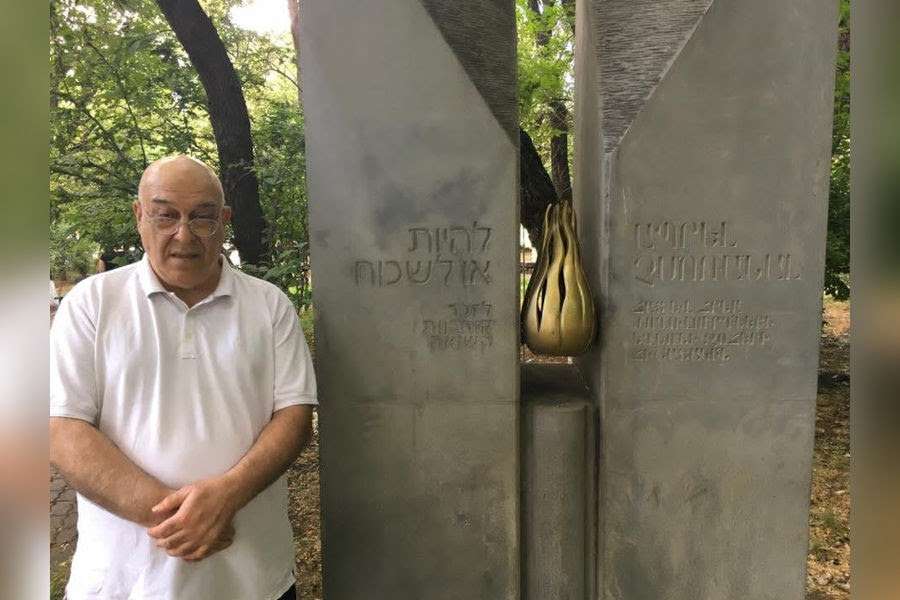
In 2006, Yerevan’s Jewish community, with support from the Armenian government, erected a joint Holocaust and Armenian Genocide memorial in Poplavok Park, near the intersection of Teryan and Moskovyan Streets.
Armenians in Israel
Israel’s Armenian community is small and historically distinct. It consists primarily of two groups whose ancestors settled in Palestine before the establishment of the State of Israel in 1948.
The first group, known as kaghakatsi hayer (“local Armenians”), are descendants of pilgrims who arrived after Armenia adopted Christianity as a state religion in 301 A.D. The second group, known as zuwwar (“visitors”), are descendants of Armenian Genocide survivors who fled the Ottoman Empire between 1915 and 1923. Most Armenian Christians in Israel live in East Jerusalem, particularly in the Armenian Quarter of the Old City.
Armenian Jews in Israel
After the collapse of the Soviet Union, a new and controversial Armenian Jewish community formed within Israel’s Green Line — the demarcation line defining the boundaries of the Palestinian territories occupied by Israel after its creation in the 1948 war. Its members are Jews who emigrated from Armenia, primarily settling in the cities of Petah Tikva, Tel Aviv, Haifa and Ashdod.
Following the official dissolution of the Union of Soviet Socialist Republics (USSR) on Dec. 31, 1991, thousands of Armenian Jews moved to the Jewish state, primarily for economic opportunities and a better life. Mass emigration had begun in the late 1980s, after Soviet leader Mikhail Gorbachev liberalized emigration laws. By 1991, approximately 15,500 Armenian Jewish families had emigrated from all across the former USSR. A large number of these Jewish families bear Armenian surnames.
The social status of these families is divided into two categories:
- Purely Jewish families, where both parents are Jewish.
- Mixed (intermarriage) families, where one parent is Jewish and the other is Armenian. This category is further divided based on Jewish law (Halakha), which defines Jewish identity as being passed through the mother or through a halakhic conversion):
-
-
- The father is Jewish, and the mother is Armenian: In this case, the family children are considered Armenian but they bear a Jewish surname.
- The mother is Jewish, and the father is Armenian: In this case, the family children are considered Jewish, but they bear an Armenian surname.
-
In Israel, Jewishness is defined according to Halakha, derived from the Jewish Holy Scriptures: Torah and Talmud.
Halachic Jews are either born to a Jewish mother or have undergone formal conversion. For most peoples, nationality was historically determined by the father. Only in the Talmud, which dates back to the 2nd and 3rd centuries, does the definition of Jewishness through the mother begin. In the sacred texts, Jewish men are instructed to marry only Jewish women to ensure that children are raised in Jewish traditions, with the mother responsible for maintaining the religious and cultural foundations of the household.
The same provision does not apply to women. A Jewish woman may marry a Jewish or non-Jewish man, and her children are still considered Jewish under Halakha, because the uterus in which they were developed was Jewish.
 The Armenian Genocide memorial in Petah Tikva, Israel (Photo courtesy of Dr. Gaby Kevorkian)
In 2020, some members of the older generation expressed solidarity with the Armenian Cause by erecting a memorial to the Armenian Genocide in Petah Tikva, joining an older memorial in the Armenian Quarter of Jerusalem.
The younger generation, however, is more proficient in Hebrew than Armenian and largely identifies with Israel, often indifferent to the Armenian Cause. Among the older generation, some remain active in advocating for Armenian Genocide recognition, including Marina Kozliner of Tel Aviv, who frequently travels to Armenia.
In summary, Israeli authorities classify Armenian Jews — those who immigrated from Armenia after the collapse of the Soviet Union — under the broader category of immigrants from the former USSR. While both Armenian Christian and Armenian Jewish communities exist in Israel, they remain separate groups. There is no unified ‘Armenian Jewish community,’ as most Armenians in Israel are Christian. Nevertheless, many Armenian Jews from mixed families attend the Armenian Orthodox Church in Tel Aviv-Yafo and the Armenian Cathedral of St. James in Jerusalem for prayers and weddings, and some are buried in Christian cemeteries. They often observe both Jewish and Christian holidays.