At A Crossroads: Europe Confronts Armenia’s Democratic Backsliding Amid Bid For Closer EU Ties
THEJ.CA
Legal experts and European officials warn that Yerevan’s escalating confrontation with the Armenian Apostolic Church and crackdown on dissent threaten the foundations of EU-Armenia cooperation.
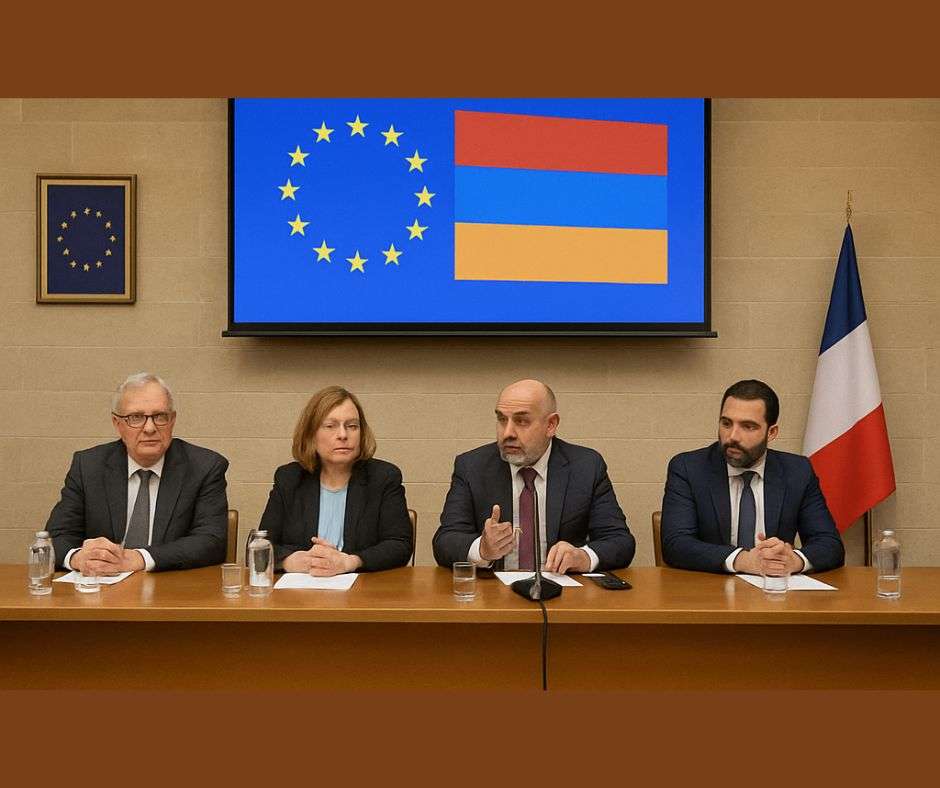
PARIS — Europe’s relationship with Armenia stands at a critical crossroads. As Yerevan signals increasingly clear European aspirations, its internal political turmoil is raising uncomfortable but unavoidable questions in Brussels. These tensions were laid bare at yesterday’s Paris conference, where a broad spectrum of legal experts, politicians, and civil society voices expressed deep concern over the Armenian government’s confrontation with the Armenian Apostolic Church and its handling of dissent.
The European Union has long positioned itself as a normative power, built not on coercion but on legal standards, democratic procedures, and human rights. Armenia’s current trajectory, described by many speakers as increasingly repressive, directly challenges this self-image. Several prominent French-Armenian figures warned that the detention of clergy, the suppression of opposition voices, and the politicization of the judiciary threaten to undermine the very foundations upon which EU-Armenia cooperation is supposed to rest.
At the Paris meeting, Nathalie Loiseau, Member of the European Parliament from the Renew group, struck a more cautious tone, emphasizing the need for democratic procedures and institutional restraint. Yet even her measured intervention implicitly acknowledged that the situation has crossed the threshold of routine political disagreement. When religious leaders and political opponents remain behind bars, procedural patience alone is no longer a sufficient response.
For the EU, the challenge is to act without appearing to impose external domination or to favor any single political faction. The strength of the European approach lies precisely in its insistence on rules rather than personalities. Brussels should therefore intensify its human rights monitoring mechanisms, deploy special rapporteurs to assess conditions of detention, and demand transparent judicial proceedings as part of its structured dialogue with Yerevan.
Financial and technical assistance must also be recalibrated. European support for institutional reform should be redirected toward strengthening judicial independence, protecting religious freedom, and safeguarding civil society. Without these safeguards, economic cooperation risks becoming an indirect subsidy for repression.
The Paris debate repeatedly returned to the singular role of the Armenian Apostolic Church as a pillar of national identity for more than fifteen centuries. Speaker after speaker warned that open confrontation with such an institution risks tearing at the deepest fabric of Armenian society. For Europe, whose own political architecture is built on reconciliation between state authority and historical tradition, this warning carries particular resonance.
Yet Europe must also resist the temptation of strategic convenience. Armenia’s European aspirations cannot be advanced through selective blindness to internal abuses. The credibility of the EU’s enlargement and partnership policies depends on consistency. If values become negotiable, the entire European project loses moral coherence.
The emerging consensus from Paris was clear: Europe should pursue a calibrated but firm engagement strategy — one that encourages de-escalation, demands respect for human rights and religious freedom, supports structural legal reform, and maintains Armenia’s European horizon without legitimizing authoritarian drift. Anything less would represent not neutrality, but quiet acquiescence.