Book Examines the Armenian Genocide Through Biographical Approaches
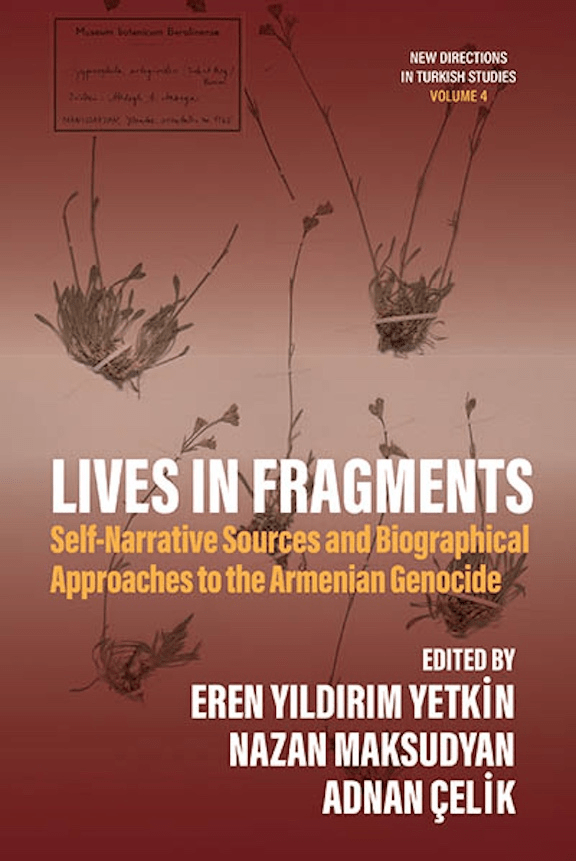
OXFORD/NEW YORK— Berghahn book publishers announced the publication of “Lives in Fragments: Self-Narrative Sources and Biographical Approaches to the Armenian Genocide“, edited by Eren Yıldırım Yetkin, Nazan Maksudyan, and Adnan Çelik. The volume embarks on an intricate exploration of biography, memory, and the legacies of violence. By focusing on life stories, it highlights contested memories and counter-narratives, offering new perspectives on the social dynamics that led to genocidal violence, its remembrance, and denial. Lives in Fragments emphasizes lives fragmented and shattered by the Armenian Genocide, providing a nuanced understanding of its complex historical and social dimensions. Diverse autobiographical sources are analyzed in chapters that examine both the historiography and remembrance of the genocide.
The book is structured into three parts, each tracing a distinct trajectory in the study and experience of the Armenian Genocide:
Part I: Methodological Questions on Biography, History, and Memory
This section opens with reflections on the intersection of biography and memory. Lena Inowlocki and Eren Yıldırım Yetkin address methodological challenges scholars face when navigating personal and collective memories. Nazan Maksudyan focuses specifically on biographical approaches to studying the Armenian Genocide, establishing the theoretical and methodological foundations for understanding individual lives amid historical cataclysms.
Part II: Lives in Genocide
This part turns to the lived experiences of survivors and witnesses. Fatma Müge Göçek provides a foreword framing the narratives. Boris Adjemian examines the life of a survivor in exile, emphasizing the role of libraries and writing in reconstructing a fractured self. Nazan Maksudyan presents the biography of Johannes Jakob Manissadjian, showing how knowledge, nature, and dispossession shaped a life interrupted by genocide. Bedross Der Matossian recounts Sahag II Khabayan, Catholicos of Cilicia, as a witness to massacres. Talin Suciyan and Paul Vartan Sookiasian trace the ongoing exile of Sourpik Tekian. Vahé Tachjian concludes by exploring how post-genocide Armenian memory is preserved and expressed through song, dance, and photography.
Part III: Afterlives of Violence and Genocide
This section examines the enduring impact of genocide across generations. Yael Navaro introduces the challenges of reconsidering biography under genocidal conditions. Alice von Bieberstein studies the “double” identity of Islamized Armenians, which complicates historical and epistemological understandings. Adnan Çelik analyzes memoirs of Kurdish intellectuals, while Duygu Taşalp investigates the genocidal literary style of Young Turk memoirs. Annika Törne recounts escape routes through Dersim, demonstrating how survival narratives traverse life and death. Eren Yıldırım Yetkin reflects on racialization, gendered narratives, and intergenerational memory in a family from Van. Michael Rothberg’s epilogue situates these life stories within frameworks of trauma, multidirectionality, and moral responsibility, highlighting the enduring afterlives of genocide.
Through this structure, the book demonstrates that the Armenian Genocide is not only a historical event but also a deeply human story, experienced through fragmentation, resilience, and lived memory. The volume emphasizes the importance of considering individual agency in biographical analysis. By engaging with personal trajectories, decisions, and actions, it problematizes approaches that ignore personal agency, offering critical insights into both the history of the Armenian Genocide and its denial in public discourse.
The editors commented, saying: “Personal stories are intertwined with histories of violence and contain watermarks of the social conditions, changes, and processes that go hand in hand with persecution. In genocide studies and interpretative social research focusing on the trauma and memory of mass violence, life-historical documents and biographical methods have been used as important components in the multi-perspective reconstruction of social and political processes Methodological designs may vary in terms of the type of data, its collection, and analysis, but working with biographies and life story narratives contributes to the analytical examination of violent events.”
According to them, the volume considers these aspects as its main focus and explores biographies and related biographical materials on the Armenian genocide. The book uses life stories and biographical sources to reflect this perspective and shows how biographical reconstructions can offer valuable insights into the violent past and its memory across various collective, individual, and intergenerational levels. They argue that an essential point is to view biographies in terms of actors’ agency and their ability to decide and act, rather than viewing them as passive. In this context, biographical approaches challenge interpretations of social and political dynamics that, by nature, do not account for personal agency as a genuine component of these processes. To critically examine the history and significance of Armenian genocide denial in public debates that overlook individual paths, decisions, and trajectories, engaging with life stories, biographical sources, and methods is of utmost importance.
 Eren Yıldırım Yetkin
Eren Yıldırım Yetkin is a social scientist at the Catholic University of Applied Sciences Berlin, with a PhD in sociology from Goethe University Frankfurt. His research focuses on collective and individual memory, political violence, and narrativity. He authored “Violence and Genocide in Kurdish Memory” (2022) and coauthored “Jugendliche Erinnerungspraktiken “(2025). He serves on the advisory board of ISA Research Committee 38, “Biography and Society.”
 Nazan Maksudyan
Nazan Maksudyan is a Senior Researcher at Centre Marc Bloch and a visiting professor at Freie Universität Berlin. Her research examines the social and cultural history of the late Ottoman Empire and modern Turkey, with interests in children, youth, gender, sexuality, exile, migration, and sound studies. Key works include “Orphans and Destitute Children in the Late Ottoman Empire” (2014) and “Ottoman Children & Youth During World War I” (2019).
 Adnan Çelik
Adnan Çelik is an associate professor of anthropology at EHESS, Paris. His research centers on political violence, memory regimes, and transnational activism. Publications include “Dans l’ombre de l’État: Kurdes contre Kurdes” (2021) and “Laboratories of Learning” (2024), as well as co-edited works on Kurdish experiences and social.