California Assemblymembers Visit Fresno State to Honor Armenian Heritage and Community Legacy
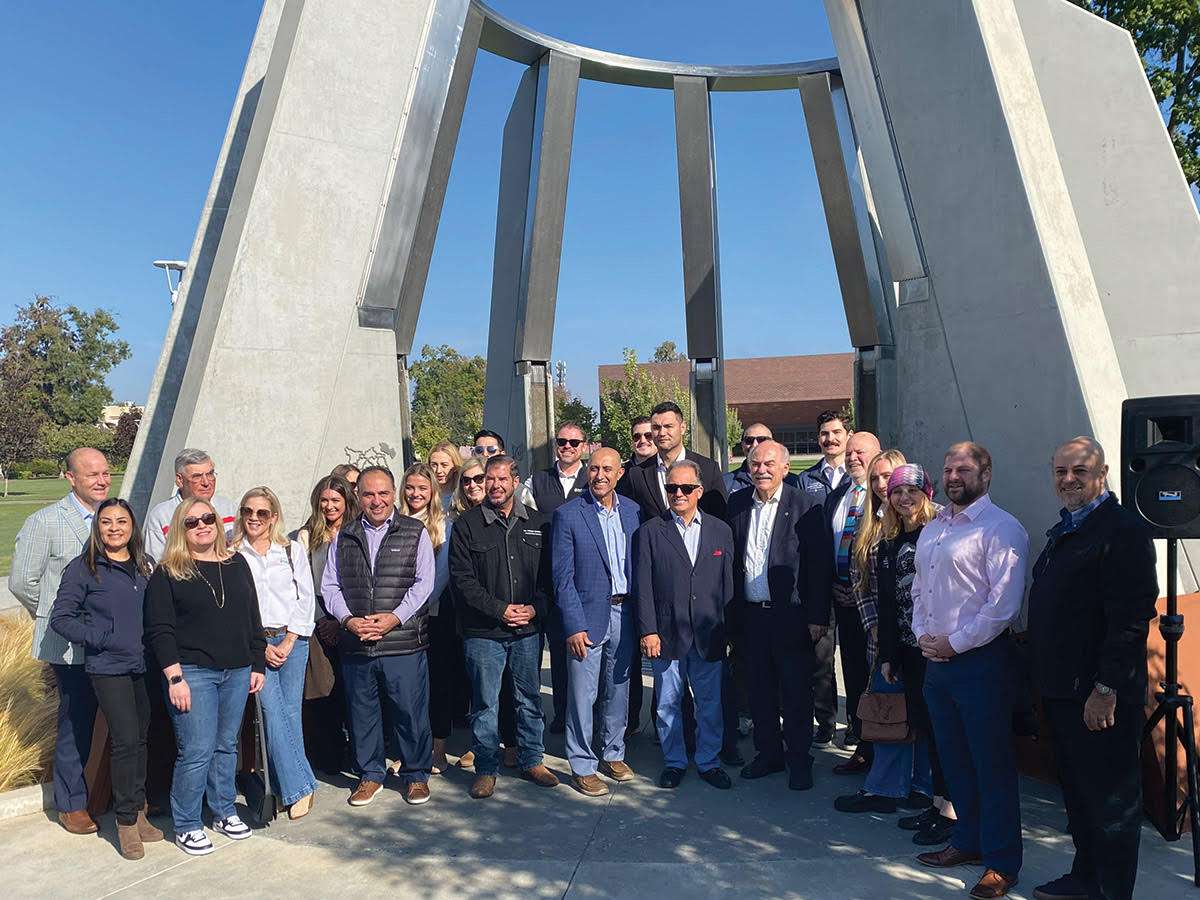
Fresno State welcomed several members of the California State Assembly for a special legislative visit recognizing the deep historical roots, accomplishments, and ongoing contributions of the Armenian community in the Central Valley. Assemblymember David Tangipa (AD-8), Assembly-member Esmeralda Soria (AD-27), Assemblymember Dr. Joaquin Arambula (AD-31), and Fresno State officials, along with community leaders and students attended the Wednesday, October 16, gathering.
The delegation toured the Fresno State Armenian Genocide Monument, met with campus representatives, and heard firsthand accounts of Armenian history in Fresno. The visit highlighted the close ties between the Armenian community and the San Joaquin Valley, emphasizing agriculture, education, civic leadership, and cultural preservation.
The event opened with comments from Assemblymember David Tangipa, who represents the district in which Fresno State is located and serves as the Vice Chair of the Armenian Caucus.
“It is an honor to be here. This is home for me,” Tangipa said. “A huge portion of Armenian history started right here in Fresno. We couldn’t appreciate this community more, the changes it has made, the impact it has had on our region, and on the entire state of California.”
Tangipa also spoke about the depth of Armenian influence in Fresno. “We cannot go anywhere in Fresno County or in the Valley without seeing the impact the Armenian community has had, the roots they’ve planted, the facilities they’ve built, and the philanthropic contributions that have shaped this university and our entire community.”
Assemblymember Esmeralda Soria welcomed visitors to Fresno and emphasized the region’s strong agricultural and cultural ties. “Fresno State is a jewel of this entire region. My district is home to thousands of Armenian families. The contributions have been countless. Many of our most successful farmers are Armenian, and their roots in agriculture run deep.”
Assemblymember Dr. Joaquin Arambula highlighted the importance of unity and mutual understanding: “In Fresno, we talk about being ‘One Fresno.’ It’s important to listen to our neighbors, to understand their culture, their language, and their contributions to our community…I’m grateful today for the opportunity to learn more about our Armenian community.”
Michael Lukens, Executive Director of Government Relations for Fresno State, emphasized how deeply Armenians are part of the university and the region: “It’s almost impossible to work in Fresno and not work with Armenians. They are all hard workers, and they all move forward for what’s best for the community and for Fresno State. Their impact is everywhere.”
Several speakers also reflected on the significance of having the Armenian Genocide Monument in the heart of campus.
Paul Halajian, the architect of the Monument, showcased how the monument’s symbolism is woven into every structural detail.
He added that Fresno State’s willingness to approve such a meaningful and politically sensitive monument “demonstrates a commitment to discourse, education, and honoring history.”
Professor Barlow Der Mugrdechian, Berberian Coordinator of the Armenian Studies Program, provided a historical account of the Armenian presence in Fresno, tracing it back to 1881, when the first Armenian families arrived seeking a drier climate. By 1920, nearly 10,000 Armenians lived in Fresno County, making up a significant portion of the population.
“The Armenian community has always been rooted in faith, hard work, and dedication,” Der Mugrdechian said. “They struggled, faced discrimination, and overcame obstacles, from housing restrictions to limited opportunities in education. But they became an essential part of this community.”
As the morning wrapped up, the Assemblymembers expressed deep appreciation for the Armenian community’s resilience, generosity, and rich cultural legacy in the Central Valley.
The visit served as a reminder of how Fresno’s history, and its future, are shaped by the contributions of generations of Armenian families.
With the Armenian Genocide Monument standing at the heart of campus, the legislators left Fresno State with a renewed understanding of the community they proudly represent.