Catholicos’s name omission disrupts liturgy meaning
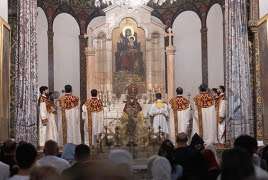
“The mention of the bishop and diocesan leader during the Divine Liturgy holds the following essential significance:
A. Ritual — fully expressing the essence of the Divine Liturgy and the celebrant’s role as part of the Church’s officially sanctioned sacred rites;
B. Ecclesiastical-canonical — affirming that the local community gathered around the Eucharist is part of the Universal Church under the spiritual leadership of the bishop, with the celebrant priest or bishop confirming their canonical unity with the Mother Church and its head.
In the Armenian Apostolic Church, the earliest recorded reference to this practice appears in the 10th century in Khosrov of Andzev’s commentary on the liturgy. According to Khosrov, mentioning the bishop’s name is crucial because the bishop is the overseer of orthodox doctrine, and the priest thus affirms receiving sacred authority from him and conducting the liturgy in accordance with orthodox teaching.
The deliberate or arbitrary omission of the names of the Catholicos and the bishop by the celebrant not only violates long-established liturgical norms of the Universal Church but also distorts the full understanding of the Holy Liturgy’s meaning.
Mentioning these names during the liturgy marks the Church as part of the apostolic and universal body. Omitting them suggests that the celebrant:
— casts doubt on the orthodoxy of the Liturgy, as the bishop and the Catholicos are guardians of doctrine;
— places themselves outside ecclesiastical unity;
— rejects the authority of the Church’s leader,” the statement reads.
In recent times, priests celebrating liturgy in the presence of Prime Minister Nikol Pashinyan have omitted the Catholicos’ name. The Prime Minister has not denied that, prior to the liturgy, an officer from the National Security Service or another individual urged the priest to omit the name.