EASTER IN THE LAND OF CHRIST
By Arthur Hagopian
Sydney, Australia
Under the ominous shadows of war, the devastation and the pain, Easter in the land of Christ will not be the same this year.
To the dismay of the thousands of Christian faithful, from various parts of the world, who had been preparing to commemorate the resurrection of Jesus in the Old City of Jerusalem, in the city where he taught, performed miracles, was crucified, and rose from the dead.
The event, which is traditionally centered around the church of the Holy Sepulcher, will be drastically muted, after a decision to close the church by Israeli authorities, was rescinded.
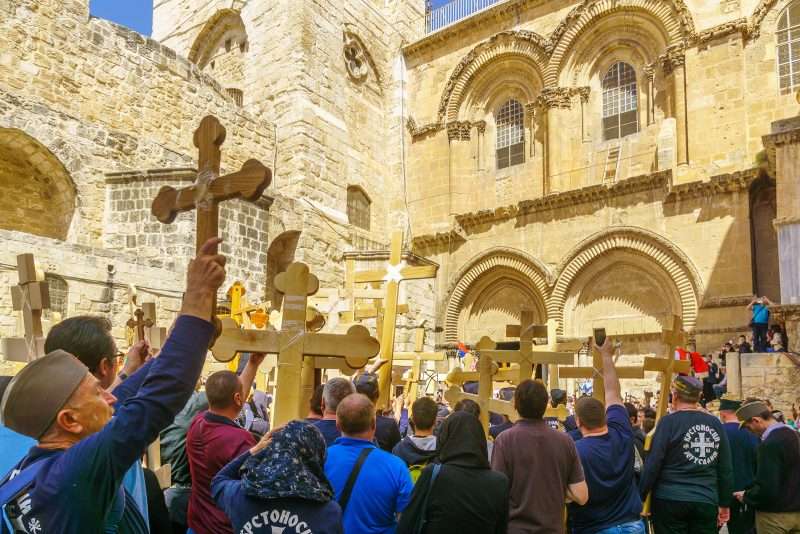
Before the war, throngs of worshippers, the largest contingent from Cyprus, and a fair number from Egypt, would descend upon the Old City, the cradle of Christianity, to express their faith and seek spiritual rejuvenation.
The city would bounce to life, like the legendary Brigadoon, long before the church bells started ringing, heralding the onset of Passion Week.
There are over a dozen Christian denominations on the map of the Old City, their adherents all agog with excitement, as they would prepare to commemorate the resurrection of Jesus, with pageant and psalm, peaking up to a euphoric culmination at the Cathedral of the Holy Sepulcher.
This is the traditional site of the tomb of Jesus, and this is where the most emotionally charged ceremony is staged, one in which I would play a key role as the bearer of the Sacred Torch.
In the narrow alleys of the city, pilgrims are hounded by hawkers and peddlers plying their wares, clamoring for custom, as they push their wares into the faces of potential buyers.
Many of the pilgrims come carrying lanterns where they will capture a flame from the Sacred Torch, and carry it back home where it will illuminate their lives and fill them with hope, until relit and replenished the following year.
The intensity of religious fever is so palpable, one wonders if this is a manifestation of the eschatological longings that drive the throngs: it is as if they expect the Messiah to make his entrance this year.
Among the Orthodox Christian fold – Greeks, Armenians, Assyrians/Syriacs, Copts, and Ethiopians – it is mainly the first two who go for the pageant and stage and present a visually and spiritually uplifting reconstruction of the agony and ecstasy of the Christ.
Passion Week festivities get off the ground with a procession from the village of Bethany on the outskirts of Jerusalem, led by the Catholic Church in memory of the triumphant entry of Jesus into the city.
The Armenians follow with the Washing of the Feet ceremony, attended by local political figures and members of the various diplomatic corps.
Outside, in the open Cathedral plaza, the Greeks put on an elaborate spectacle full of color and drama, atop a portable stage.
A day later, on Good Friday, the row of lanterns slung across the width of the nave of the St James Armenian Cathedral, are extinguished, the wicks limp and lifeless.
No candles will be lit during the 3 to 4 hour “Khavaroom” (descent of darkness) ceremony, except for 12, in commemoration of the Disciples of Jesus.
But it is Holy Fire Saturday, “Sabt-el-nour,” that brings the celebrations to a climax, with a dramatic re-enactment of the resurrection of Jesus, It is a unique event in the annals of Jerusalem, and the day I am to carry the flaming torch signifying the rise of Jesus from the dead in a blaze of incandescent fire.
The Cathedral of the Holy Sepulcher is packed to the rafters with pilgrims, many of whom will have planted themselves as close as possible to the Aedicule, or Tomb of Christ. (Some will even spend the night before to secure a vantage point).
It is through an oval opening in the wall of the Aedicule that the miraculous flame will emerge in glorious triumph, and make its way around the world.
(Historical sources believe the Holy Fire phenomenon was first recorded by a Christian pilgrim, the monk Bernard (Bernardus Monachus) the Wise in 876, but there is also reference to a holy fire miracle in Eusebus’ Vita Constantini, circa 328).
I had inherited the privilege from my godfather who had in turn inherited it from his father.
The suspense builds up to a crescendo as the Greek Patriarch and an Armenian priest enter the tomb.
I am standing next to the opening, the excitement and anticipation palpable all around me.
When the hand of the clock creeps towards the magical 1 o’clock in the afternoon, the whole edifice crumbles into an instantaneous silence of expectation.
Eyes are riveted towards me. And then the clock strikes 1 and the flame of the Holy Fire erupts from the Aedicule – and launches a tsunami of ecstatic ululations and cries of joy that engulf every living soul in the church.
My torch captures the flame.
I snatch it and hurtle towards a staircase, looking neither right nor left, unmindful of the colossal pressure of people around me, the jostling and grasping, until I reach the spot high above the tomb, where the Armenian Patriarch is seated, and thrust the torch into his hands.
With an elaborate sweep of his arms, he leans over, makes the sign of the cross over the heads of the multitude below, as bells scream their joy drowning out the ululations and cries, and candles wave triumphantly over the heads of worshippers., the undulating dance of their lights taking the appearance of a river of fiery lava cascading down the side of a broiling volcano.
It takes only a few minutes for every nook and cranny in the cathedral to become a feast of lights as pilgrims and tourists share their light.
The next day, Easter Sunday, the climax over, pilgrims prepare for their return home, and for children to launch their egg-cracking contests.