Erdogan aide who said Turkey is at war with ‘Crusaders’ named ambassador to Vatican
Levent Kenez/Stockholm
Nordicmonitor.com
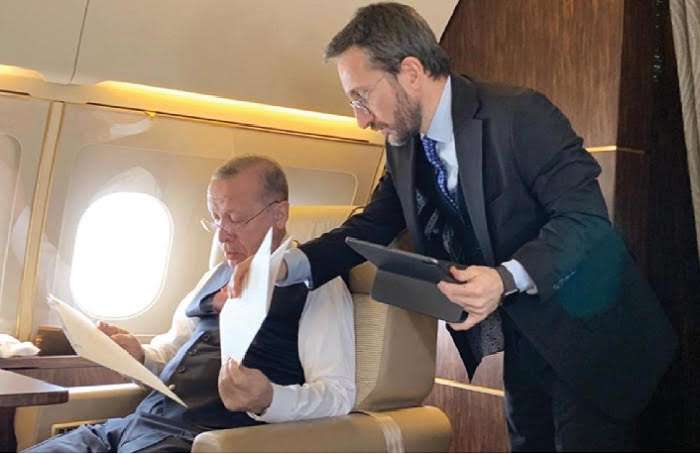
Turkish President Recep Tayyip Erdogan has appointed his former communications chief Fahrettin Altun, as Turkey’s ambassador to the Holy See, a move that puts one of Ankara’s most combative government propagandists in the diplomatic post representing a Muslim-majority country to the center of the Catholic world.
The appointment comes months after Altun was removed from his powerful role as head of the Presidency’s Directorate of Communications, a position he had held since 2018. During his tenure Altun oversaw government messaging, media coordination and the administration’s international public relations campaigns.
His reassignment to the Vatican follows a rapid series of position changes. After being dismissed from the communications post in July, Altun was named head of the Human Rights and Equality Institution of Turkey, a largely symbolic state body. The Vatican ambassadorship marks his second reassignment in a short period of time.
The posting carries a notable irony: Altun built his public profile partly through speeches and writings accusing Western countries of reviving a “Crusader mentality” against Turkey and the Muslim world.
In historical terms the Crusades were a series of religious wars launched by European Christian powers between the 11th and 13th centuries to capture or defend territories in the Middle East considered sacred to Christianity. Participants in these campaigns were known as Crusaders. In modern political rhetoric, the term “Crusader mentality” is sometimes used by political figures to describe what they portray as Western hostility toward Muslim-majority countries.
In a February 2018 article published in the pro-government magazine Kriter, Altun described global politics as a confrontation between Turkey and what he called a revived Western crusading mindset. “The new Crusader mentality’s primary ‘other’ is the Muslim world and its authentic representative, Turkey,” he wrote. “For the Crusaders, whoever was the ‘other’ yesterday remains the ‘other’ today.”
The same article argued that Turkey had entered a broad historic struggle against Western powers. Referring to a coup attempt in 2016, Altun wrote that “the project belonged to the new Crusaders and was implemented through the Gülen movement,” a group critical of Erdogan that promotes inter-religious and cultural dialogue.
Altun’s article in the pro-government Kriter magazine claiming Turks are at war with the “new Crusaders”:

Altun also framed regional conflicts in similar terms. Writing about the Syrian war, he asserted that the crisis was engineered to block Turkey’s rise and destabilize the country internally. “The Syrian crisis was created to stop Turkey,” he wrote. “This project has also collapsed.”
Those themes appeared again in later speeches. In March 2021, speaking at a symposium in Bishkek organized by Kyrgyzstan-Turkey Manas University and the Parliamentary Assembly of Turkic States, Altun said Turkey was confronting a revival of the same mindset in the eastern Mediterranean.
“We are breaking the intrusive hand reaching toward the chest of our sacred homeland and neutralizing this Crusader mentality that has resurfaced after 100 years,” he said during the opening address, referring to the occupation of Anatolia by Western countries after World War I.
Altun also used similar language in newspaper columns. In a July 2017 opinion piece in the pro-government Sabah daily, he described critical coverage of Turkey in Western newspapers as part of a coordinated campaign against the country. Listing outlets including The New York Times, The Guardian and The Wall Street Journal, Altun wrote that Western actors were supporting what he called a broader confrontation. “I wrote ‘cultural war,’” he said in the column. “You should read it as ‘Crusade.’”

The Vatican appointment puts Altun in charge of relations with the Holy See, the governing body of the Catholic Church led by Pope Leo XIV. Diplomatic ties between Turkey and the Holy See date back to 1960 and have often focused on interfaith dialogue, migration issues and Middle East diplomacy.
Altun’s previous role gave him extraordinary influence over Turkey’s media environment. As communications director, he controlled a large government budget and coordinated messaging across ministries, pro-government media outlets and international lobbying networks.
Officials and journalists working in Ankara frequently described the communications office as the central node of the government’s information strategy. The office oversaw press accreditation, organized international media campaigns and coordinated messaging for Erdogan’s foreign policy initiatives.
Altun’s authority extended beyond public relations. He was widely known in Turkish media circles as the official who determined which commentators would appear on television and which outlets would receive government advertising revenue.
 A part of Altun’s speech where he claimed Turkey was neutralizing a “Crusader mentality” in the eastern Mediterranean.
During his tenure the communications directorate also became a hub for social-media messaging campaigns defending the government and attacking critics. Opposition politicians accused the office of organizing networks of pro-government accounts to shape online discourse.
Despite that influence, Altun’s position became increasingly precarious amid internal power struggles inside Erdogan’s circle. His removal in July coincided with the appointment of political scientist Burhanettin Duran as the new communications chief.
Duran previously served as deputy foreign minister and as director general of the pro-government think tank SETA Foundation, which has long been closely aligned with Erdogan’s political agenda.
The leadership change strengthened the role of Turkey’s intelligence apparatus in government communications. Duran maintains close ties with İbrahim Kalın, who became head of the National Intelligence Organization (MIT) in 2023.
Altun’s dismissal followed growing tensions between the communications director and the intelligence leadership. Disagreements reportedly intensified after a 2024 terrorist attack targeting Turkish Aerospace Industries, when leaked internal security footage fueled criticism of the intelligence response.
The Vatican appointment effectively removes Altun from the center of Turkey’s domestic political apparatus.
Diplomatic posts have historically served as a way for Turkish governments to relocate senior political figures away from Ankara while keeping them within the state hierarchy. The ambassador to the Holy See holds a respected position but wields limited influence over Turkey’s internal politics.
Altun’s new role also contrasts sharply with the position he briefly held after leaving the communications office. The Human Rights and Equality Institution of Turkey, where he was initially assigned, has little visibility in public life and rarely plays a direct role in policymaking.
His rapid reassignment from that institution to a diplomatic mission has raised questions among Turkish political circles about the real motive behind the move.
What is clear is that the former communications chief, once one of the most powerful figures in Erdogan’s media apparatus, will now represent Turkey in a city-state at the heart of global Catholicism after years spent publicly describing Western political forces as heirs to a “Crusader mentality.”