Erdogan’s son emerges as new key figure overseeing Turkey’s pro-government diaspora
Levent Kenez/Stockholm
Nordcmonitor.com
The Union of International Democrats (UID), the main overseas political network aligned with Turkey’s ruling Justice and Development Party (AKP), is undergoing a notable shift in political signaling, with President Recep Tayyip Erdogan’s son, Necmettin Bilal Erdogan, emerging as the central figure responsible for diaspora affairs.
The UID, founded in 2004 and active primarily across Europe, functions as the AKP’s most important proxy organization abroad. It mobilizes voters, organizes gatherings and shapes political opinion within expatriate Turkish and Muslim communities. Its importance has increased steadily as overseas votes have become decisive in Turkish elections.
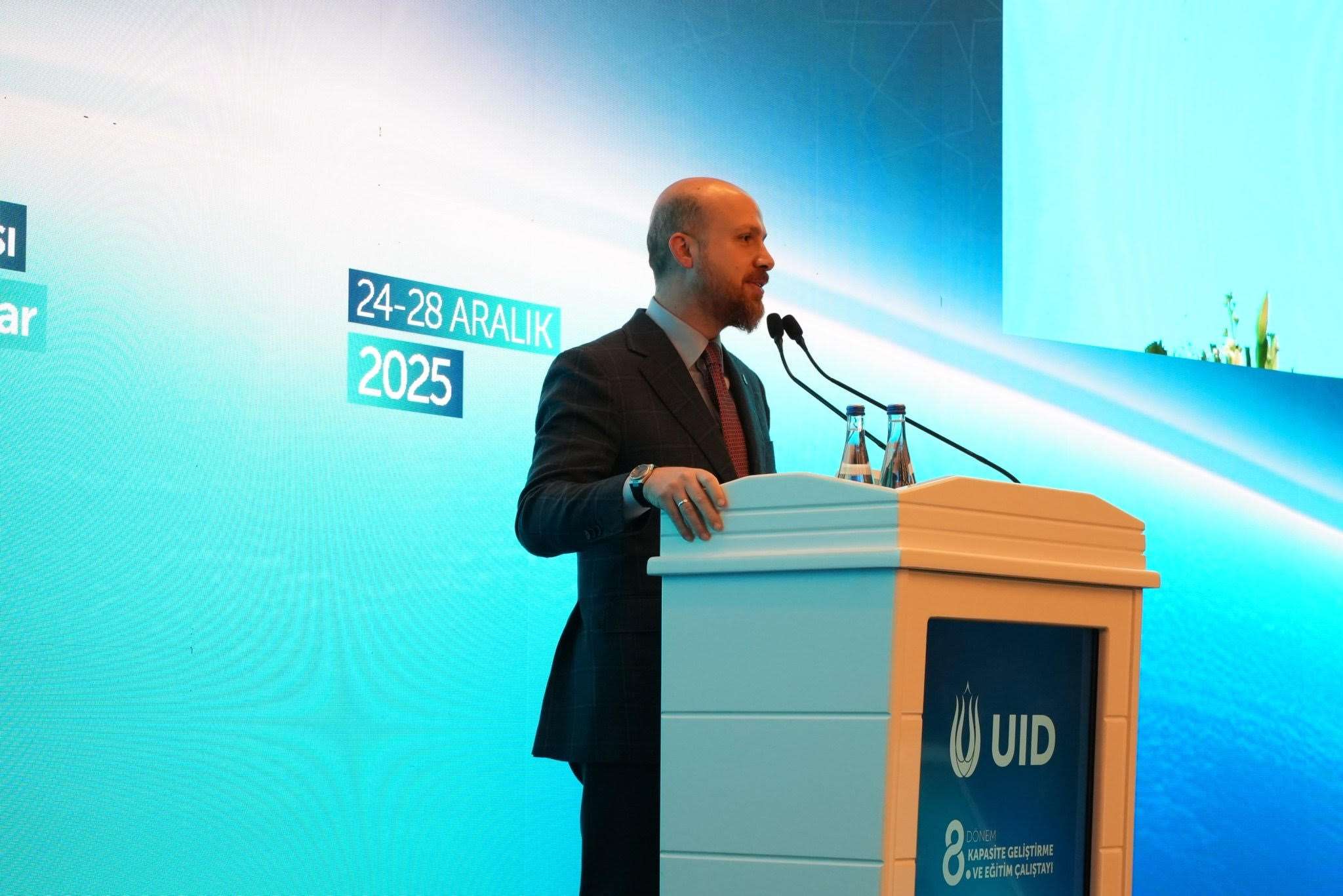
Last week Bilal Erdogan assumed a highly visible and elevated role within the UID, despite holding no formal position in the AKP or the Turkish government. On December 25 he attended the UID’s annual education meeting as the main guest, delivered a speech and answered questions in a closed-door session, according to participants familiar with the gathering. Senior AKP officials present treated him with the deference normally accorded top party leadership, reinforcing perceptions that he has been informally assigned responsibility for overseas political organization.
This development followed an unusual and striking break with protocol. Several hours before Bilal took the stage, President Erdogan hosted UID delegations from dozens of countries at the presidential palace for a formal luncheon. Such events have historically been widely publicized by the UID and its leadership. This time, however, neither the UID nor its president shared any images, statements or acknowledgments of the meeting on social media.
Observers described the silence as extraordinary and deliberate. The UID routinely publicizes even minor encounters with President Erdogan. The decision to ignore a palace invitation, an event considered a major honor among pro-government circles, pointed to a clear shift in focus. According to sources close to the organization, attention was intentionally redirected toward Bilal Erdogan’s appearance days later, signaling a recentering of diaspora leadership around him.
 UID President Kenan Hasan Aslan (L) presenting a gift to Bilal Erdoğan.
The UID’s strategic importance lies in its ability to mobilize overseas voters. Under Turkey’s election system, ballots cast abroad are added after domestic votes are counted. In the 2023 presidential election, Erdogan won 59.57 percent of nearly 2 million votes cast abroad, securing a margin of more than 360,000 votes over opposition candidate Kemal Kilicdaroglu. In Germany, home to the largest Turkish diaspora in Europe, Erdogan received about 65 percent of expatriate votes. Similar margins were recorded in the 2018 election.
Germany’s domestic intelligence agency, the Federal Office for the Protection of the Constitution (BfV), identified the UID in its 2024 annual report as the most prominent pro-Erdogan organization operating in Europe. The report also cited the UID’s close ties to Islamist and nationalist circles in the Turkish diaspora.
 UID members, along with top AKP officials and former ministers, posed for a commemorative photo with Bilal Erdoğan after his speech.
TÜGVA is widely described by critics and investigators as a jihadist organization operating under the cover of a nongovernmental organization. TÜGVA serves as an extension of Turkish intelligence, with a secret mandate to recruit young people in Turkey and in diaspora communities abroad to support President Erdogan’s Islamist regime. Under Bilal Erdogan’s patronage, the foundation runs dozens of dormitories across Turkey, has access to public schools through cultural cooperation agreements and actively promotes political Islam in line with the ideology of the Muslim Brotherhood.
The foundation has been accused of helping place loyalists in state institutions, contributing to the creation of an ideologically aligned bureaucracy. In previous years documents disclosed by whistleblowers showed that individuals whose names appeared on lists prepared by TÜGVA were later hired by state institutions
 Leaked picture shows young men at a TÜGVA summer camp circling a campfire with their fingers pointing up in the air, a gesture used by many violent jihadists around the globe.
Wiretaps released at the time allegedly captured conversations between Bilal Erdogan and his father discussing large sums of money. The investigations were halted within weeks. Police officers, prosecutors and judges involved in the cases were dismissed, arrested or later sentenced to lengthy prison terms, including life sentences on charges of attempting to overthrow the government. The Erdogan government described the probes as a coup attempt.
Bilal Erdogan has denied wrongdoing, and no charges were ultimately pursued against him.
Since then, his public role has steadily expanded. He frequently appears at events organized by pro-government civil society groups and delivers speeches on domestic and global politics. Earlier this month he appeared alongside representatives of Turkey’s four largest football clubs to promote a pro-Palestinian demonstration planned for January 1, a rare show of coordination between sports institutions and political activism in Turkey.
Bilal Erdogan’s positioning at the center of the UID’s activities is politically significant. While President Erdogan remains firmly in control, discussions about succession have intensified due to his age and health. Within pro-government circles, Bilal Erdogan is increasingly mentioned along with other family members, including Erdogan’s son-in-law and drone manufacturer Selcuk Bayraktar as well as another son-in-law, former finance minister Berat Albayrak. Foreign Minister Hakan Fidan, the former intelligence chief widely described as President Erdogan’s “black box,” and former interior minister Suleyman Soylu, who has a tarnished reputation due to alleged ties to organized crime but is backed by nationalist circles, are also among the other names mentioned as potential contenders.
 Former UID president and curent AKP Deputy Chairman Zafer Sırakaya also presented a gift to Bilal Erdoğan. While UID President Aslan was presenting an award on behalf of the UID, Sırakaya’s role as an AKP official added a symbolic note of allegiance.
For the AKP, control of the diaspora remains a crucial political asset. For Bilal Erdogan, the UID now appears to function as a network that takes its political direction from him, providing a platform to consolidate influence, loyalty and visibility abroad and marking his emergence as a central figure in Turkey’s political future.