Faith and Renewal
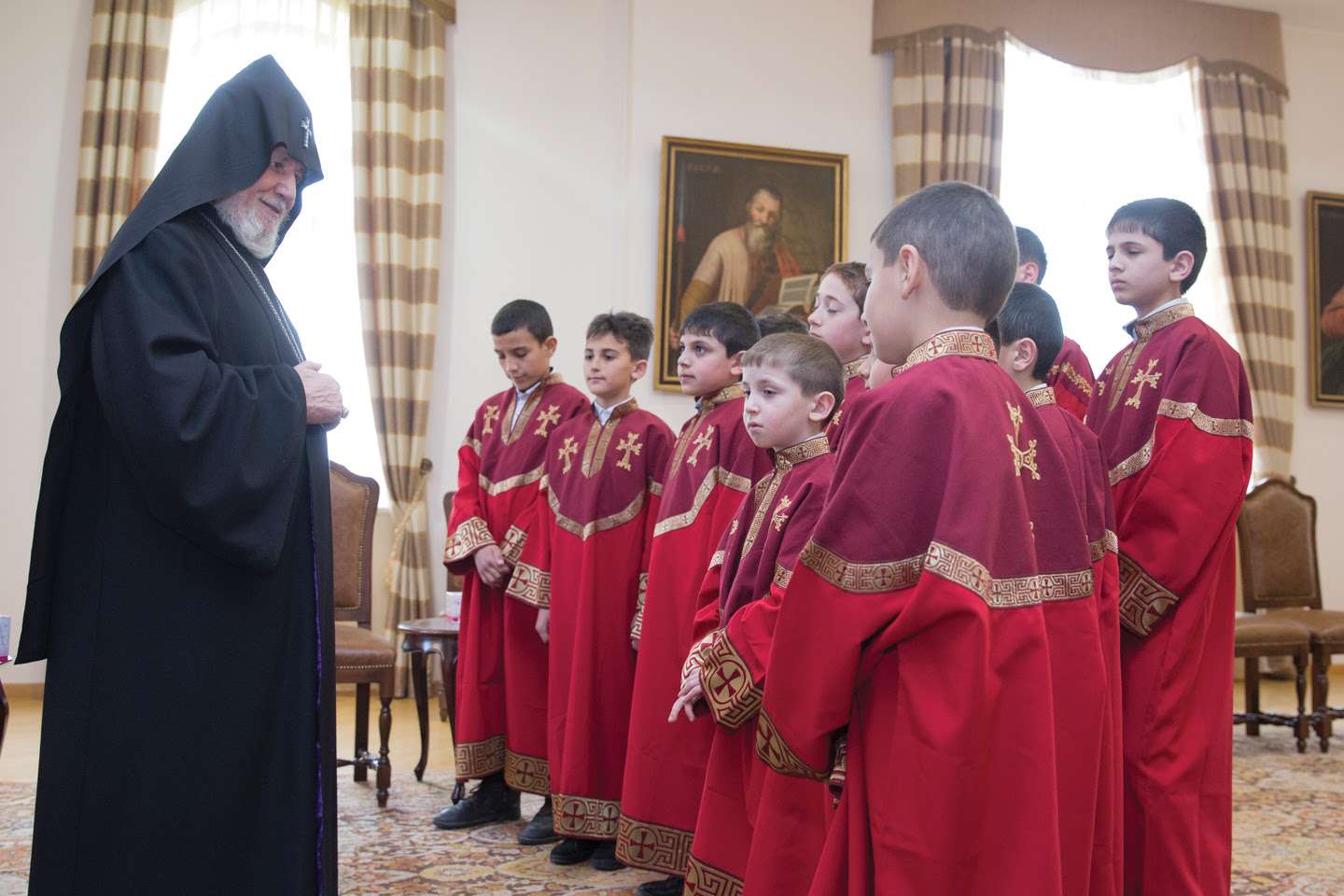
A quarter century of achievement under His Holiness Catholicos Karekin II
AGBU Magazine
His Holiness Karekin II has led the Armenian Church since October 1999 as its Supreme Patriarch and 132nd Catholicos of All Armenians, the highest-ranking official in the global Armenian Apostolic Church. For over 25 years, he has guided the Mother See of Holy Etchmiadzin through restoration, reform, and the pressures of a turbulent new century. In these endeavors, His Holiness earned the trust and confidence of, not only the Armenian faithful worldwide, but also numerous benefactors, donors and partner organizations in the Diaspora and Armenia. This resulted in an array of major achievements in a relatively short time.
Born on August 21, 1951, in the village of Voskehat in Armenia’s Armavir Province, Ktrij Grigori Nersisyan grew up in a deeply spiritual environment that shaped his early devotion to the Church. At just 14, he entered the Gevorkian Theological Seminary of the Mother See of Holy Etchmiadzin, where his path to the priesthood began in earnest.
Ordained as a deacon in 1970 and as a priest two years later—taking the name Karekin—he pursued advanced theological studies in Vienna, Bonn, and later at the Moscow Theological Academy. This international education broadened his outlook, instilling in him a global perspective that would later mark his approach to both faith and leadership. His breadth of training, multilingual ability, and diplomatic composure would later define his leadership style—balancing tradition with global engagement.
His Holiness earned the trust and confidence of, not only the Armenian faithful worldwide, but also numerous benefactors, donors and partner organizations in the Diaspora and Armenia, resulting in an array of major achievements in a relatively short time.
Returning to Etchmiadzin in 1980, he was consecrated a bishop in 1983 and named deputy primate in that same year. In 1992, he was elevated to the rank of Archbishop. As a highly trusted leader in the Armenian Church, he became the Primate of the Araratian Pontifical Diocese, the largest and most active diocese of the Armenian Church in a now independent Armenia. He was entrusted by His Holiness Catholicos Vasken I of Blessed Memory—and later His Holiness Catholicos Karekin I of Blessed Memory—with broad pastoral and administrative authority over Yerevan and its surrounding districts.
Rising to the Challenges of Change
In the difficult years following the collapse of the Soviet system, and in the years following independence and the first Nagorno Karabagh War, the people of Armenia faced dire conditions with a lack of access to education, heat and even food.
In 1992, Archbishop Karekin ensured that as many as 1,000 pensioners, who once benefited from socialist-era entitlements, would be provided with nutritious warm meals and gathering spaces at what were then called soup kitchens. His ability to mobilize resources on the ground as well as gain the trust of philanthropists from the Diaspora ensured that these early projects could run with efficiency and impact. Such initiatives set the stage for the first large-scale, Church-run humanitarian efforts in newly independent Armenia and an expanded social ministry in the years ahead.
He also used his position to prioritize and address urgent social needs of the youth, for whom conditions were harsh and many were abandoned to life on the streets. Archbishop Karekin moved quickly to reclaim Soviet-era youth centers and converted these buildings into after-school centers where youth could study, gather safely, and reconnect with Armenian cultural and spiritual life, as well as receive healthful meals on a daily basis. 3,000 students were enrolled each year starting in 1993.
His Holiness’s guiding philosophy has shaped two decades of initiatives that strengthen the bond between the Church, the homeland, and the global Armenian Diaspora. It is a vision that places the Armenian Apostolic Church at the center of national life—not as a relic of history, but as an active force for faith, education, and community.
During this critical period, he saw the value in investing in digital media to reach the masses and, in 1995, he launched Shoghakat TV Company from the offices of Araratian Patriarchal Diocese with a staff of three people. Programming was aimed at instilling Christian values, while covering public and current events. Along with the youth centers and soup kitchens, the Shoghakat broadcast platform would remain a priority in the years to come.
Physical Imprints
As critical humanitarian and socio-economic projects continued throughout the 1990s, Archbishop Karekin understood that to bring a post-Soviet society back to the Armenian traditions and religion meant improving access. Among the first projects entrusted to him by His Holiness Vasken I of Blessed Memory, followed by His Holiness Karekin I of Blessed Memory, was the establishment of the St. Gregory the Illuminator Cathedral in Yerevan, which began construction in 1997. The cathedral would be the largest Armenian Apostolic Cathedral in the world and made possible through ongoing donor investment from the Diaspora.
After his election to Catholicos in 1999, His Holiness Karekin II’s early years were marked by an unprecedented expansion of church infrastructure. The property of the Mother See of Holy Etchmiadzin quadrupled, with roughly 40 new or renovated buildings transforming the historic complex in addition to countless churches, cathedrals and seminary buildings throughout Armenia and Artsakh.
Among the most significant projects were the creation of the St. Trdat Open Sanctuary—built to accommodate 1,500 worshippers during the 1,700th anniversary of Armenia’s conversion to Christianity—and the renovation of the Holy Etchmiadzin Cathedral. The seven-year renovation of this Cathedral, a UNESCO World Heritage Site, involved structural reinforcement, replacement of the dome’s cross, and the restoration of murals and frescoes which had been damaged due to age or obscured with multiple coats of paint applied during the Soviet-era. The project, carried out under the supervision of UNESCO, was an internationally coordinated effort unifying donors and supporters of all backgrounds.

New monastic residences, libraries, and educational centers, including the Vatche and Tamar Manoukian Library and the Karekin I Educational Center, further enriched the spiritual and intellectual life of Etchmiadzin. Through the generosity of benefactors, major renovations transformed key institutions: the Alex and Marie Manoukian Treasury, the Khrimian Museum, the Old Veharan, the Ruben Sevak Museum, and modern dormitories for seminarians. Together, these projects, among others, would ensure that Etchmiadzin would remain both a sacred sanctuary and a vibrant hub for learning and service, as well as positively impact education and managerial capabilities.
Fortifying Internal Foundations
Beyond physical expansion, His Holiness worked to strengthen the internal structures of church governance. Holding regular sessions of the Supreme Spiritual Council both in Etchmiadzin and in dioceses abroad reinforced unity and accountability. Other specialized councils and committees, such as the Monastic Council, the Review and Disciplinary Committees, and the Architectural and Publishing Councils, were created to professionalize church administration. The re-establishment of the Episcopal and Ecclesiastical-Representative Assemblies after a long hiatus marked a renewed era of institutional participation and transparency.
Upon his ascension as Supreme Patriarch and Catholicos of All Armenians, Karekin II pledged to rebuild the Church’s educational and pastoral foundation, restructuring seminaries, introducing accelerated training programs for priests, and creating new departments of youth ministry and Christian education. With the goal to attract a new generation of priests, His Holiness looked at clergy education through the lens of the modern world. Under his watch, two major seminaries—the Gevorkian and Vazkenian—were revitalized and a new investment in scholarships for higher education degrees in international universities was launched.
Under His Holiness’s leadership, the Gevorkian Theological Seminary achieved state accreditation in 2002, full recognition as a higher education institution in 2005, and alignment with European higher education standards in 2007. In 2016, the seminary gained the right to conduct postgraduate and doctoral education, a milestone in theological scholarship.

The Vazkenian Theological School of Sevan was similarly fortified, offering graduate-level programs and producing new generations of clergy and scholars. New educational centers like Turpanjian Theological College of Harich monastery, established in 2012, and the Karekin I Educational Center, opened in 2018, became vital spaces for priestly retraining and intellectual exchange. In addition, His Holiness would ensure that young clergy with high academic potential had the opportunity to study in highly respected institutions like Oxford University, the Pontifical Grigorian University in Rome or the University of Louvain in Belgium, not only gaining quality educations but also exposure to different cultures. With placements in secular settings, they could better see the world through a layperson’s prism. Over 300 young clergy have benefited from this training and 41 of the 54 Bishops currently serving in the Armenian Apostolic Church were educated and ordained since 1999.
In addition to a thriving Shoghakat TV, investments were made to expand accessibility to Armenian Church’s historic resources, publications and digital programing. The Publishing Department of the Mother See, launched in 2006, became an important institution for issuing translations from foreign languages and Classical Armenian, as well as ecclesiology, Armenian studies, biblical commentary, Christian ethics and instructional booklets. In 2012, for the first time, the Mother See published both the modern Armenian and the Classical Armenian editions of Saint Gregory of Narek’s Book of Lamentations. More than 30,000 copies were reprinted over seven years.
Spiritual Command of Army and Prisons
As codified in the Armenian Constitution of 1995, the spiritual service of the Armed Forces was entrusted to the Armenian Church in 1997. Starting in 1999, the libraries of numerous military units were enriched with spiritual literature, including copies of the Holy Bible, the Etchmiadzin Journal, the Christian Armeniabiweekly newspaper of the Mother See, as well as various spiritual booklets and prayer books. The number of military chaplains continued to grow, and a cohort of clergymen serve within the spiritual service structures of Armenia’s military, included married and celibate priests and deacons. For Armenia’s correctional institutions, the Catholicos established the Spiritual Inspectorate of Prisons. Today, those in penitentiary institutions receive regular spiritual ministry from the Armenian clergy.
Humanitarian Relief
Through the Mother See’s “Building with Faith” initiative launched in 2008, more than 100 apartments have been built for families in need across Armenia, including those affected by war and natural disasters. The Mother See has also supported free medical care through its Izmirlian Medical Center, a fully operational hospital, and extended aid to wounded soldiers and clergy, including allocating substantial funds for prosthetic limb fittings for those sent to hospitals abroad. Pastoral and material assistance to prisoners and their families were also provided.

His Holiness also spearheaded the founding of educational institutions such as the Eduard Eurnekian School in Etchmiadzin (2009) and the Yerevan G. Emin High School (2014), both promoting academic excellence infused with moral and spiritual values. The Mother See also operates numerous boarding schools and youth homes in cities like Ashtarak, Gyumri, Vanadzor, and Yerevan, where more than 60,000 needy children have received education and care.
In 2014, His Holiness established the Social Services Office at the Mother See, launching wide-ranging humanitarian programs that assist refugees, veterans, displaced families, people with disabilities, and children in need.
The last decade has been marked by successive and historic crises that have tested the leadership of the Armenian Church to play an essential role in humanitarian relief. Ever since the COVID-19 pandemic in Armenia and the 2020 Artsakh War, the Social Services Office of the Mother See has carried out a significantly greater number of in-kind assistance programs than its usual financial