Former Armenian captive recounts sham trials and years without legal defense in Azerbaijan
By Siranush Adamyan, Civilnet
Gevorg Sujyan, one of four Armenians released from Azerbaijani custody earlier this month, has described what he says were years of unlawful detention, fabricated trials, and complete denial of legal rights while imprisoned in Baku.
Sujyan returned to Armenia on January 14 together with Davit Davtyan, Vigen Euljekjyan and Vagif Khachatryan, following a prisoner exchange in which Armenia transferred two Syrian nationals convicted of fighting as mercenaries for Azerbaijan during the 2020 Nagorno-Karabakh war. The Syrians had been serving life sentences in Armenia.
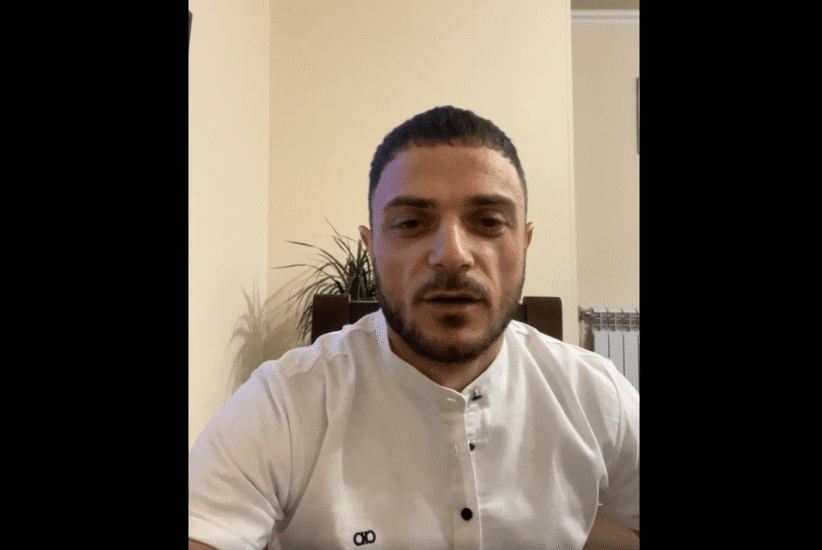
Speaking in a livestream after his return on Facebook, Sujyan said Azerbaijani officials made clear from the outset that his imprisonment had little to do with any alleged crime.
“They told me directly: you have no guilt,” Sujyan said. “But you must stay here because we have issues to resolve with your state. We need to give you a sentence so you sit until those issues are settled.”
Sujyan said he repeatedly asked the Azerbaijani authorities to present evidence against him and insisted that he would accept punishment if any wrongdoing were proven. Instead, he said, he was told that his continued detention was a matter of political leverage rather than justice.
‘No lawyer, no charges, no hearing’
According to Sujyan, court proceedings in Baku were conducted with what he described as systematic and severe violations of basic legal standards.
“I went to court without ever seeing a lawyer beforehand,” he said. “I was never familiarized with the charges against me. I was taken to court blindfolded, they spoke among themselves, completely ignored anything we said, and then sent me back to my cell.”
He said lawyers appeared only symbolically, during hearings, and played no meaningful role in his defense. Requests for legal representation or access to case materials were ignored.
“There is no judicial system, at least in cases like ours,” Sujyan said. “I was tried not as a person, but as an Armenian, as an enemy whose rights were not protected at all.”
He said prosecutors relied on fabricated testimony and openly admitted they could produce witnesses at will. “They told me: if you want, I can step outside and bring you 60 witnesses in 10 minutes,” Sujyan said. “People I had never seen in my life were presented as witnesses.”
Detained after ceasefire, sentenced to 15 years
Sujyan and Davtyan were captured on November 11, 2020, one day after the ceasefire that ended the six-week war between Armenia and Azerbaijan. At the time, they were transporting humanitarian aid to Nagorno-Karabakh. Sujyan said he was traveling as the founding head of a charitable organization.
Both men were later sentenced by an Azerbaijani court to 15 years in prison.
Sujyan said the psychological pressure in detention was severe and constant, compounded by what he described as intense anti-Armenian propaganda.
“We were in an extremely heavy psychological state,” he said. “The local propaganda and anti-Armenian messaging were overwhelming. They talk about peace, but at the same time they conduct relentless hostility toward us, and that has a serious psychological impact.”
He said prison guards varied in their behavior, describing some as abusive while others tried to offer quiet support. “There were people who tried to give us strength, who showed human decency,” he said. “There are very good people in Azerbaijan – and very bad ones.”
‘No reconciliation without prisoners’
Sujyan said Azerbaijan’s continued detention of Armenians contradicts its public rhetoric about peace and reconciliation. “If Azerbaijan speaks of reconciliation, then reconciliation cannot exist while people are still held hostage,” he said, drawing an analogy to a kidnapped child whose return is a prerequisite for peace.
He expressed gratitude to the International Committee of the Red Cross, which he said provided books, clothing, food and hygiene supplies during his imprisonment. Sujyan also said a manuscript he wrote in prison was confiscated after being submitted for review through the Red Cross and never returned.
“I will write it again,” he said. “There will be a book, and there will be a film.”
According to official Armenian figures, 19 Armenians remain in Azerbaijani custody, including eight former political and military leaders of Nagorno-Karabakh. Some have been convicted, while others are still facing trial.