From Musa Dagh to Anjar: “We live as one family,” Says Mayor Setrag Havatian
Marine Martirosyan
Vahe Sarukhanyan
The Armenian-populated town of Anjar in Lebanon today has about 3,000 inhabitants. Not counting the Arab minority, the Armenians of Anjar are represented by three communities: Apostolic, Catholic, and Evangelical.
The latter are Musa Dagh residents, who were resettled here in September 1939 with the support of the French authorities. Initially, the number of Armenians was 5,125 (1,205 families). Until houses were built in Anjar, people lived in tents for several months. Life was not easy in these conditions; there was a shortage of drinking water and food. Part of the refugees dispersed to neighboring settlements because of all this. Out of 1,205 families, 1,050 remained (803 Apostolic, 165 Catholic, 82 Evangelical). However, even in tent conditions, the Musa Dagh residents educated their children and performed church services.
Later, each community in Anjar established its own church and school.
3 Communities, 3 Churches, 3 Schools
With an eagle-shaped plan, Anjar has the St. Paul the Apostolic Church at its headquarters, and the Catholic (Our Lady of the Holy Rosary) and Evangelical churches on its wings.
In 1941, the Evangelical Church was built, in 1954 the Holy Rosary was consecrated, and in 1960 St. Paul was consecrated. Moreover, after leaving the tents, for some time the Apostolic community performed its church services in the school building, and the Catholics in the wooden church.
Anjar Mayor Setrag Havatian says that today 90% of the community’s Armenians are Apostolic, but they, the Catholics, and the Evangelicals, trace their roots to Musa Dagh.
“We don’t make any distinctions at all,” says Havatian. “When we celebrate our heroic battle of Musa Dagh, all three communities and all three clergy are present, sitting side by side when we prepare harissa. We respect each other in all our events. When the Catholic community celebrates Christmas on December 25, we go with the others to congratulate them, and on January 6, they come to congratulate us. We always have close and warm relations. We live like one family here.”
Before building churches, the Armenian Apostolics, Catholics, and Evangelicals established schools in their new settlement.
The Apostolics, in 1939, shortly after arriving in Anjar, had connected several large Arab tents together and were educating children there. The school was called the ‘tent-school’. In 1940, on the initiative of Chavarche Missakian, editor of the Paris daily newspaper Haratch (Forward), French Armenians raised money build the Haratch elementary school. It opened in 1941, with 755 students. It was here that the Apostolic clergy temporarily performed ceremonies. It is no coincidence that the bust of Chavarche Missakian, considered its founder, is placed in the courtyard of the school.
The repatriation that began to Soviet Armenia after World War II affected both the residents of Anjar and the number of students at the Haratch school. In the 1954-1955 school year, there were only 135 students here. Until 1959, education was six years, and from 1959, it was twelve. (the first graduates with this education left the school in 1965). Thus, since 1959, Haratch has been a secondary school.
The extension of the school year also meant an increase in the number of students. In addition, the kindergarten was also located in the school. In the mid-1960s, due to the increase in the number of students, it was moved to the maternity hospital (mayranots) building. In 1969, the construction of a new two-story building of the school began, where students from grades 7 to 12 were to be accommodated. The building was built with the support of the Calouste Gulbenkian Foundation. Today, the educational institution, consisting of two buildings, is called Haratch-C. Gulbenkian National Secondary School.
Armen Tashchian, the school’s principal since 2005, tells Hetq that the number of students used to fluctuate between 200-230, but against the backdrop of the ongoing economic crisis in the country (the Lebanese lira has rapidly depreciated since 2019), there is a trend of emigration, and in the 2025-2026 school year there was a significant decrease in the number of students. For the first time in the last twenty years, their number dropped from 200 to 185.
The kindergarten, which is located next to the school, has been headed by Lena Ashkarian-Stamboulian for sixteen years, having worked here since 2000. Currently, the kindergarten has 37 students, and the staff consists of eight. Mrs. Lena confirms Armen Tashchian’s idea that the birth rate in Anjar has decreased. She says the reason is the emigration of families from the country or the move from Anjar to Beirut. She remembers that twenty years ago the kindergarten had more than 130 students, but the number gradually decreased.
As mentioned, previously a maternity hospital operated on the site of the kindergarten. Over time, the site of the educational institution has expanded. Today, children aged 2-6 attend. There are four groups or classes: Dzil (2-3 years old), Poghpoch (3-4), Gogon (
“The number of children is decreasing with the total population, I don’t know the solution, the leaders should decide, but in my opinion, one kindergarten in Anjar is enough, there are 34 children in the other (evangelical – ed.) kindergarten,” says Lena Ashkarian-Stamboulian. “The majority there are Armenians, but there are also foreigners. In our case, we don’t have any foreign students.”
The Armenian Catholic community of Anjar had its own school for many years. It was opened in 1940, thanks to Catholic sisters Lorentsia Alexandrian, Madeleine Chrnazian and Perjuhi Avetisian, and was called the Armenian Catholic Sisters’ School. As in the Haratch school, education here was originally six years long, and there were separate male and female departments, which were merged in 1954 due to the decrease in students. In the 1970s, the school building was expanded, and it became a secondary (9-year) educational institution.
Anjar Mayor Setrag Havatian says the Catholic school has not been operating for several years. The reason is the economic crisis in Lebanon.
In 1973, an orphanage was opened next to the Catholic church, which bears the name of Cardinal Aghajanian (“Cardinal Aghajanian Sanuts Dun”, see below). A prominent representative of not only Armenian, but also the world Catholic Church, Cardinal Krikor Bedros Agaghanian (Gregorio Pietro XV Agagianian) was the Catholicos Patriarch of Armenian Catholics from 1937-1962, and in 1958 and 1963 he was a candidate for the Pope. He was born in 1895 (Akhaltsikhe, Russian Empire) and died in Rome, 1971. In 2017, the orphanage was renovated, and in 2018 a playground was opened here.
As for the Evangelical Community School, its foundations were laid in 1940. In the 1950s, it expanded to include a kindergarten, a primary school (grades 1-6), a secondary school (grades 7-9), and a secondary school (grades 10-12). The Armenian Evangelical Secondary School also has a boarding school, and Mayor Havatian says that this is precisely what helps the school continue its activities. Thanks to the boarding school, the school, according to Havatian, also has students from Beirut, Syria, and Arab countries (in contrast, only Armenians from Anjar study at the Haratch-K. Gulbenkian National Secondary School.
Anjar – a tourist destination
Anjar is a place worth visiting for lovers of both ecotourism and historical-cultural tourism.
In Hetq’s previous article, we wrote that the Anjar spring (ag) has formed a rich flora and fauna in the surrounding area. The Ghzayel River originates from here, which in the Bekaa Valley joins the Litani, Lebanon’s main river. The Ghzayel basin is a habitat for species such as the otter (lutra lutra) and the Syrian serin bird (serinus syriacus), a species listed as vulnerable by the International Union for Conservation of Nature’s Red List.
Anjar is best known for its historical and cultural heritage. In the previous article, we mentioned that this is a historical settlement where people lived as early as the 8th century A.D.
We are talking about a city-fortress built in the 8th century during the Umayyad Caliphate, which the locals also call a ‘fortress’. In particular, the ruins of large and small palaces, a mosque, a bathhouse, residential quarters, some 600 shops and their arches built along two intersecting major streets, the walls and defensive towers surrounding the city have been preserved.
When the people of Musa Ler (Musa Dagh) settled in the Anjar area in 1939, it was a semi-desert with uncultivated lands and swamps. Even then, some ruins of the ancient city were visible, which, however, were extremely poor compared to other historical and archaeological sites in Lebanon: Baalbek, Byblos, Sidon, Tyre. Archaeological work in Anjar began in the 1940s. The new Armenian transplants also participated in the digs.
Scientists have revealed that this is a city built during the reign of Caliph Walid I (705-715) of the Umayyad Caliphate (a 7th-8th century state in the Arabian Peninsula, the Middle East, the Armenian Highlands, Iran, Central Asia, North Africa and the Iberian Peninsula. The capital was Damascus). This is evidenced by the inscriptions found throughout the fortress. However, archaeologists have also found traces of an earlier civilization, the Greeks, and Romans, as evidenced by early Christian buildings dating back to 395 A.D.
Thus, the ruins of the Anjar city-fortress are a unique example of urban development in the early Islamic period of the 8th century. The nature of the ruins shows the early transition from a protobyzantine culture to the development of Islamic art, as evidenced by the various construction techniques recorded in Anjar and the architectural and decorative elements of the monuments.
The location where the city was built is also no coincidence. It is located at the intersection of two historically busy routes. The west-east direction is the Beirut-Damascus road, and the north-south direction is the Homs-Tiberias road, which runs along the Bekaa Valley. This circumstance, along with the ruins of more than 600 shops, suggest that ancient Anjar flourished as a trading city.
But the ‘golden age’ of ancient Anjar lasted only 20-30 years, until 744, and the city was never fully built. In the fall of that year, the army of Caliph Ibrahim (son of Walid I) suffered a heavy defeat near Anjar from another representative of the Umayyads, Marwan, who had rebelled against the caliph. After the victory at Anjar, Marwan’s army quickly reached the capital Damascus, where he was proclaimed the new caliph, and Ibrahim accepted defeat. Partially destroyed because of the battle, Anjar was then abandoned. The Armenians of Musa Ler settled in Anjar 1,195 years later, in 1939.
The ancient city-fortress of Anjar was included in the UNESCO World Heritage List in 1984.
Anjar tour guide Assadour Andekian says that due to financial constraints, the city-fortress has not been fully excavated and studied to this day. That is, excavations have been ongoing here for more than seventy years. Naturally, this historical and cultural monument is the main tourist attraction of Anjar, but Andekian says that because of the economic crisis in Lebanon, the flow of tourists here has decreased by about ten times.
Armenian museums
In addition to the old city-city-fortress, there are other historical and cultural attractions in Anjar. One of them is the Musa Ler-Anjar Ethnographic Museum.
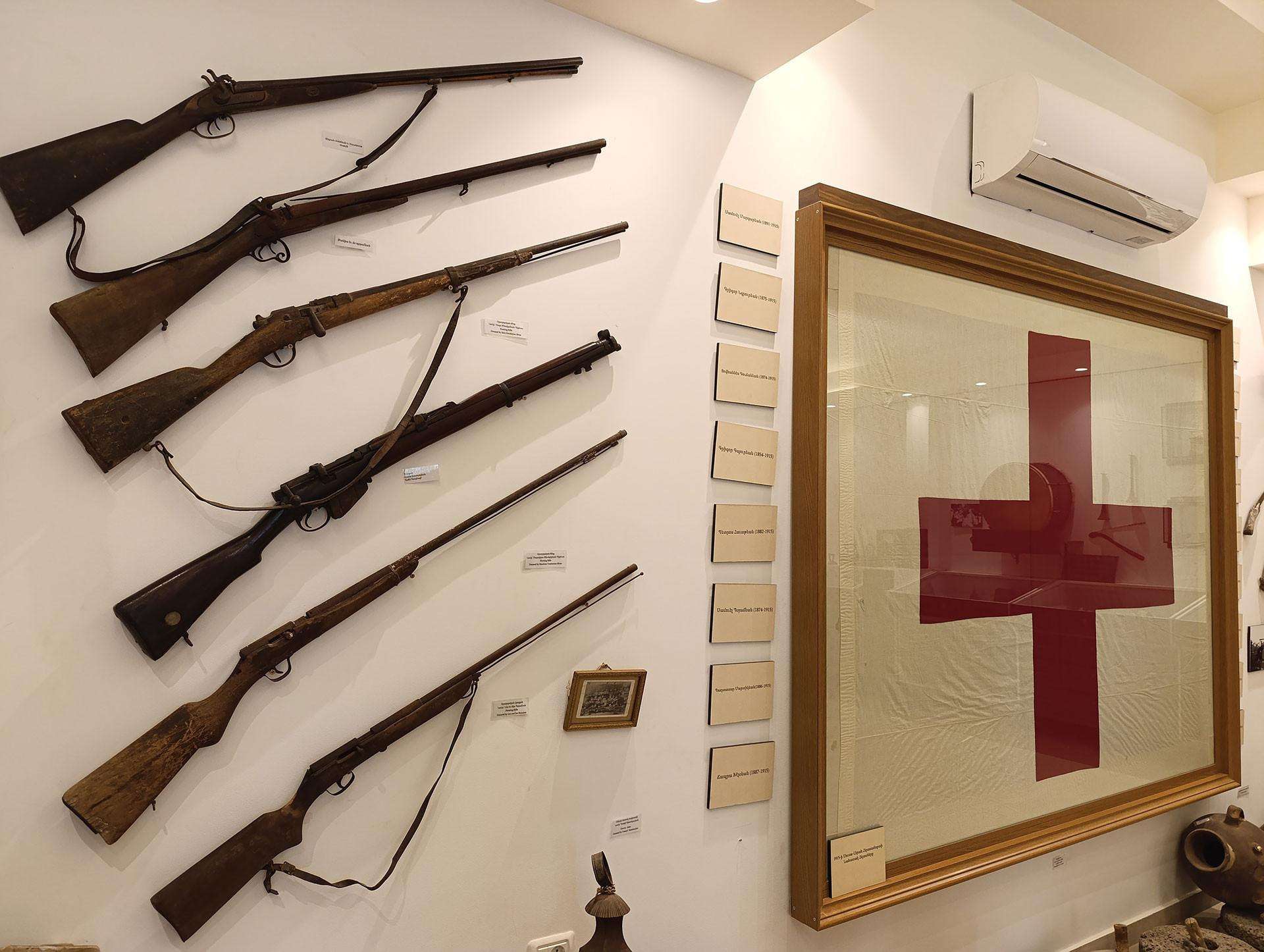
When the Musa Dagh Armenians left their homeland for the second time in 1939, this time moving to Lebanon, they also took with them small but valuable items, including religious books (the most valuable example is a Bible from 1771), weapons, household items, and a white flag with a red cross, which was of great value to them. This is one of the two flags Armenians displayed to signal for help to passing Allied ships. The other was inscribed with “CHRISTIANS IN DISTRESS: RESCUE”. These flags were crucial in attracting French vessels to rescue over 4,000 people.
Museum manager Hilda Doumanian says that the sample hanging in the museum’s exhibition hall is a copy of the first flag, and the original is preserved in the museum. Doumanian says schoolchildren’s uniforms were used for the red cross. On September 5, 1915, it was thanks to these flags that the crew of the French cruiser Guichen noticed the Armenians, and then French and English warships evacuated them to the Egyptian city of Port Said.
Doumanian says when the Musa Dagh Armenians were evacuated to Egypt, they deposited the two flags with the Armenian Church Diocese there. After the end of World War I and the defeat of Ottoman Turkey, the Armenians returned to their villages near Musa Dagh in 1919, where they lived for twenty years.
Musa Dagh remained under French Mandate until 1939. Armenians left their villages for a second and final time when the area (Sanjak of Alexandretta) was given to Turkey following an agreement between France and Turkey.
Doumanian says that when moving to Anjar, the Musa Dagh Armenians handed the flag with the red cross to the Catholicosate of the Great House of Cilicia, which had been established in the city of Antelias, Lebanon in 1930.
She says that the other flag with English writing was lost. In the 1970s, on the 40th anniversary of the founding of Anjar, the Musa Ler residents turned to the then Catholicos of the Great House of Cilicia, Khoren I, asking for their flag. The Catholicos handed over the flag, which had become a relic for them.
The creation of the Musa Ler-Aynjar Ethnographic Museum was initiated by Father Ashod Karakashian, the spiritual shepherd of the Apostolic community, in 1976 to collect and preserve old and valuable objects. In 1999, a committee was formed to open a museum on Anjar’s 60th anniversary and to house the items collected by Karakashian there, but this did not happen due to financial reasons.
Nevertheless, on September 14, 2019, on the Feast of the Holy Cross and the 80th anniversary of the founding of Anjar, the ethnographic museum was opened. It is dedicated to the memory of the eighteen martyrs of the heroic battle of Musa Dagh. Their names are posted next to the flag of salvation hanging in the exhibition hall. The heroic defense involved some 600 fighters protecting about 4,000 civilians.
Among the museum’s exhibits are holy books brought from the villages of Musa Dagh. Doumanian says that since the Turks had forbidden non-Turkish peoples, including Armenians, to speak their language, the latter were forced to compile Bibles that were in Turkish, but in Armenian script. Church rituals were performed in these, that is, in Turkish.
The exhibits displayed in the museum represent not only the struggle of the Armenians of Musa Dagh against the Ottoman Empire, but also their lifestyle and culture in the villages of Musa Dagh and in Anjar.
Doumanian says that many visit the museum, both ordinary tourists and official high-ranking guests.
Another destination for cultural tourism in Anjar is the house-museum of sculptor and painter Varujan Mardirian (1937-2023).
Museum manager Garine Shannakian says that Mardirian had Musa Dagh ancestry but was born and lived mainly in Beirut, studied in Armenia, and occasionally in Anjar. He was an engineer by profession, but since 1985 he dealt mainly in woodworking like his grandfather.
He had solo exhibitions in Lebanon, Austria, and Italy, and participated in group exhibitions in Lebanon, Armenia, and the United States.
Mardirian’s Anjar House-Museum was opened after the artist’s death, in 2024, by his wife and daughters.
Shannakian says the number of visitors to the house-museum increases in September, when Musa Dagh Armenians, guests, and tourists from various places gather in Anjar to attend the annual celebration marking the heroic battle of Musa Dagh.
Anjar-Yerevan