Georgia’s Ethnic Armenians Have a Long History from Medieval Times to Current Political Unrest
Larry Luxner, Universul.net
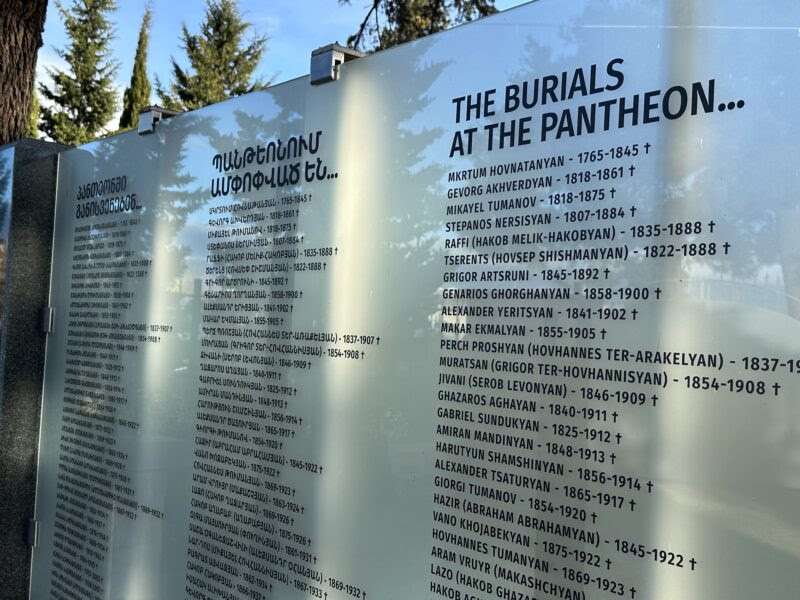
 An informational panel at the Khojavank Pantheon of Armenian Public Figures lists all 48 people buried at this cemetery in Tbilisi, Georgia (photo Larry Luxner)
The Khojavank Pantheon of Prominent Armenian Public Figures sits next to Tbilisi’s Holy Trinity Cathedral, which at 87 meters ranks among the world’s tallest Eastern Orthodox churches. Here, preserved above the ruins of a cemetery that once held more than 90,000 graves, are the remains of 48 important Armenians including playwright Hakob Melik Hakobyan (known by his pen name, Raffi) and poet Serob Stepani Levonyan, known as Kousan Jivani.
 Elaborate marble tombstone in Armenian and Russian script at the Echmiadzin Church in Tbilisi, Georgia (photo Larry Luxner)
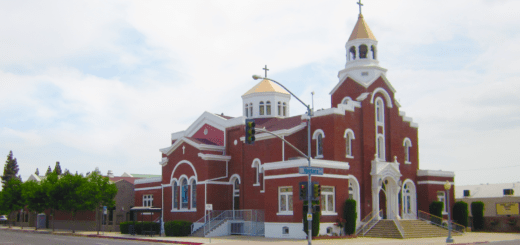
Ten minutes’ walk from this solemn place — just off Ketevan Tsamebuli Square — is St. George [Gevorg] of Echmiadzin Church, built between 1806 and 1808. Renovated numerous times since then, most recently from 2006 to 2010, the cathedral belongs to the Armenian Apostolic Church and is one of only two remaining Armenian houses of worship in Tbilisi (at one time there were 29).
The other is St. George’s Church, a 13th-century Armenian cathedral located at the southwestern corner of Vakhtang Gorgasali Square, under the shadow of the ruins of Narikala fortress. Its most recent renovation — financed by Russian-Armenian businessman Ruben Vardanyan and former Georgian Prime Minister Bidzina Ivanishvili, among others — was completed in 2015.
Given its location in the heart of the Caucasus, it’s no surprise that the Republic of Georgia is home to some 220,000 people of Armenian origin. That includes 50,000 in Abkhazia, a Georgian territory bordering the Black Sea that’s been under Russian military occupation since 2008.
That gives Georgia the world’s fourth-largest Armenian diaspora community after Russia itself (1.9 million), the United States (1,500,000) and France (500,000) — and way larger than Armenian communities in Ukraine, Canada, Argentina, Lebanon, Turkey and Syria.
At the time of the Soviet collapse in 1990, an estimated 400,000 Armenians lived in Georgia. But with the rise in Georgian nationalism, most of them emigrated to Russia, France and Armenia itself. Yet even today, ethnic Armenians represent at least 5% of Georgia’s population.
Unlike the case with nearly every other Armenian diaspora, those in Tbilisi did not come as a result of the 1915 genocide. Rather, they’ve been living in the Georgian capital since medieval times. For much of the city’s history, Armenians comprised the majority of Tbilisi’s inhabitants; in fact, most of its mayors have historically been ethnic Armenians.
“Tbilisi was the main cultural center of the eastern Armenians,” said historian Levon Chidilyan. “As such, it was here in Tbilisi that the idea of an independent state of Armenia was born.”
Chidilyan, 38, traces his roots to Khach Gyugh (“village of the cross”). His ancestors immigrated to Georgia in 1828, and his family moved to Tbilisi when he was 4 years old. Interviewed at a café in the old city’s Meidan bazaar, Chidilyan is the former director of Tbilisi’s Hayartun cultural center, and the co-founder of several NGOs dealing with Armenian affairs.
“During the reign of the Georgian kingdom, the majority of Tbilisi’s residents were Armenians. And when Tbilisi became the administrative center of the Caucasus, even more Armenians came,” he said. The first non-religious Armenian school opened in Tbilisi in 1824, and the first newspaper in Armenian was established in the 1840s.
In the southern region of Samtskhe-Javakheti — which borders both Turkey and Armenia — ethnic Armenians represent 50.5% of the population, according to the 2014 census. And in Abkhazia, Armenians are the third-largest ethnic group after Georgians and the Abkhazians themselves.
Although differences exist between the Armenian Apostolic Church and Georgia’s Orthodox Church, the two countries have similar histories and unique alphabets (the Armenian alphabet has 39 letters, the Georgian alphabet 33). They were among the first countries in the world to adopt Christianity, and although they fought a month-long war in 1921, Armenians today see Georgia as the closest nation in the world to Armenia itself in terms of culture and mentality.
According to the Armenian Embassy in Tbilisi, annual bilateral trade comes to around $850 million and consists mainly of agricultural products, metal ore, food, beverages and vehicles.
Giorgi Tumasyan, a political activist of Armenian origin, said that back in the 19th century, Armenians were the wealthiest citizens of Tbilisi.
“We were the bankers, and we owned businesses and properties. But capitalism ended with the Soviet Union, and then everyone became part of the communist system,” he said. “Antisemitism never had a place in Georgia, but when the Armenians were really powerful, there was anti-Armenian sentiment.”
He added: “Armenians, especially in Tbilisi, are very well integrated. But unlike Georgian Jews, whose surnames are usually the same as Georgian surnames, ours are very easy to identify. If I never introduced myself by name, nobody would guess that I’m not Georgian.”
Tumasyan, 30, has a bachelor’s degree in international relations and international law from the Free University of Tbilisi, and a master’s in government from a German university. For 10 years, he chaired the Armenian Community Platform of Georgia.
“But right now, we’re completely shut down because of these new anti-NGO regulations, which are actually very undemocratic. So we got rid of the name, and I continue to work on issues relating to the Armenian community,” he said.
Those anti-NGO regulations were first approved in late 2023, requiring any civic organization accepting donations from abroad to register as foreign agents. Following huge street protests, the law was rescinded but was later adopted following the victory of the pro-Russia Georgian Dream party in October 2024 parliamentary elections.
One month later, mass protests again erupted after Prime Minister Irakli Kobakhidze announced the suspension of Georgia’s efforts to join the European Union. Thousands of people gathered on Rustaveli Avenue in central Tbilisi and were attacked by riot police armed with water cannons, tear gas and pepper spray. The protests continue to this day, though with less intensity as before.
“The rights of every citizen are undermined. That’s why I participate in protests against this government’s anti-democratic actions,” Tumasyan said. “I do that as a Georgian civic leader.”
Tumasyan said he was fined 4,000 laris (the equivalent of $1,500) for a Facebook post that accused a prominent lawmaker — Mariam Lashkhi from the ruling Georgian Dream coalition — of being a “traitor to the homeland” for blocking Georgia’s accession to the EU.
“They oppress those who don’t like Russia,” he said, adding that he was fined twice for participating in anti-government protests in front of the parliament building. “Of course, I understand that such statements can result in fines, and not only fine. They can imprison you for up to 60 days.”
The Council of Europe has warned that Georgia’s Foreign Agents Registration Act will cause “grave and unjustified damage to civil society.”
Despite their government’s stance, a recent poll showed that 74% of Georgian citizens support EU membership, with only 5% opposed. Joining the 27-member bloc would eventually open the door for Armenia to do the same, Tumasyan said, since Armenia is landlocked. Ironically, as the Georgian government drifts closer to Russia, Armenia — a traditional ally of Russia — is moving in the opposite direction.
On December 2, Brussels and Yerevan adopted a new Strategic Agenda for the EU-Armenia Partnership, “marking a significant step forward in the deepening of political, economic and sectoral cooperation between the two partners,” according to an EU press release.
Asked about prospects for regional stability following the August 8 signing of a peace treaty between the leaders of Armenia and Azerbaijan, Tumasyan expressed cautious optimism.
“I believe there’s a possibility to build relations [with Azerbaijan], but only when Armenia is strong enough to defend itself,” he said. “We should become like Israel — an ally of the United States, a self-sufficient military and economic power in order to secure our country’s borders.”
On that subject, Chidilyan the historian is clearly not as optimistic.
“I don’t believe in peace between Armenians and Turks. If a murderer is proud that he has murdered you, and has no remorse, you can’t have peace with him. History has shown that we should rely only on ourselves, and that other powers will use us for their own benefit,” he said.
“We all pray for peace, but we think peace should be just. Our Armenian compatriots have been forcibly displaced from Nagorno-Karabakh, and we still have prisoners of war and hostages in Baku,” Chidilyan added. “Under such circumstances, I don’t think a dignified peace is possible.