International Backlash Intensifies as Armenian Authorities Escalate Repression Against the Armenian Apostolic Church
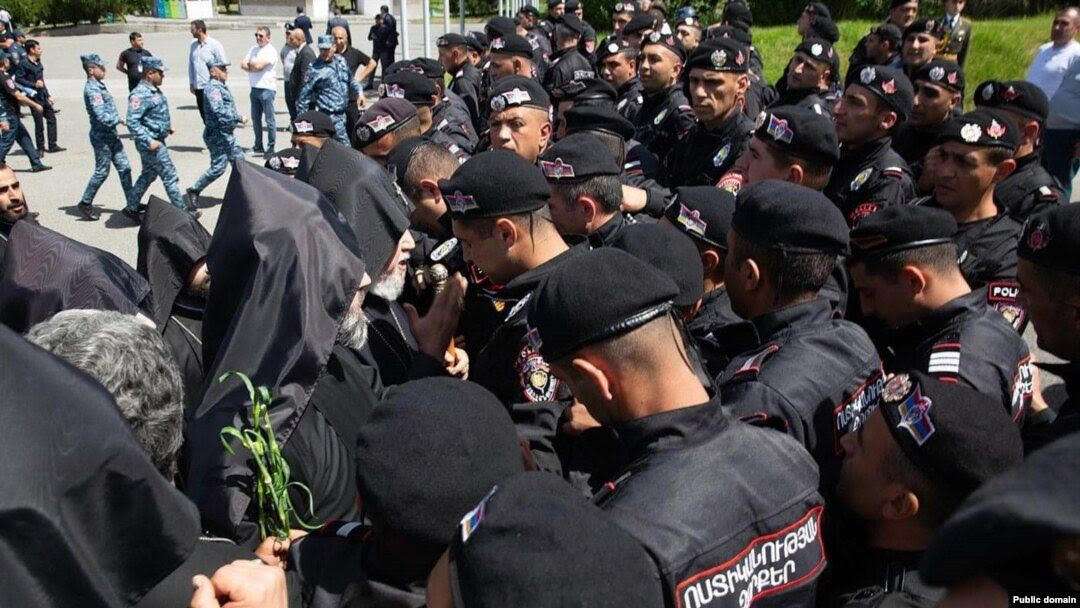
The Armenian government’s confrontation with the Armenian Apostolic Church has entered a
new phase marked by judicial and extra-judicial actions, travel restrictions on senior clergy, and
allegations of coercion inside the military chaplaincy, prompting warnings from international
human‑rights advocates, legal experts, and diaspora institutions that the Armenian state is
crossing constitutional and democratic red lines [1,5,6,12,19].
What began as political criticism of Catholicos Karekin II has, according to critics, evolved into a
coordinated campaign using courts, investigators, and administrative pressure to influence the
Church’s internal governance, restrict its leadership’s movement, and weaken its institutional
independence [1,6,15,16].
Travel Bans Attempt to Derail International Church
Governance
The most concrete, recent escalation occurred from late January to February 2026, when
Armenian authorities imposed travel bans on senior clerics days before a scheduled Bishops’
Assembly in Austria.
According to CivilNet, investigators barred six bishops from the Mother See of Holy Etchmiadzin
and the Secretary of the Supreme Spiritual Council from leaving the country, citing charges
related to the alleged obstruction of a court ruling tied to the defrocking of Gevorg Saroyan, a
former Bishop aligned with the government’s reform agenda [19]. On February 14, the
Prosecutor’s office also imposed a travel ban on Catholicos Karekin II and opened a criminal
case against him. Lawyers and Church representatives say the case intrudes directly into
canonical matters traditionally handled within ecclesiastical structures [15,17, 22].
Diaspora and Church sources link the move to earlier disruptions of episcopal governance. A
planned December 2025 assembly in Armenia was postponed, they say, after a majority of
Bishops from global dioceses reported feeling unsafe amid ongoing pressure and detentions
[1,2,12]. Subsequent assemblies were relocated abroad due to what Church officials describe
as the absence of credible immunity guarantees for participants [2].
Military Chaplaincy Drawn into Political Dispute
At the same time, the Armenian government’s intrusions into church matters have reached into
the Armenian Armed Forces, where the Military Chaplaincy had been entrusted to the Church
since the late 1990s.
In January 2026, OC Media reported that Armenian Army Chaplains said commanders had
pressured them to sign statements supporting the Prime Minister’s repressive Church agenda,
including calls for the Catholicos’s resignation [5]. The Defense Ministry denied wrongdoing,
while the Mother See confirmed that complaints had been received.
Additional accounts cited by diaspora commentators noted that some chaplains were offered
inducements or subjected to threats, raising concerns that state administrative resources were
being used to mobilize clergy against their own spiritual leadership [4,9,11]. Church officials
responded that the army should remain neutral and outside political or ecclesiastical struggles
[5].
As of February 1, Defense Minister Suren Papikyan decreed the Chaplaincy system dissolved
and Chaplaincy appointments terminated. [20]
International Watchdogs Frame a “Religious‑Freedom
Crisis”
International advocacy organizations have increasingly framed these confrontations as part of
larger and more worrisome religious‑freedom and rule‑of‑law issues in Armenia.
In a Nov. 22, 2025 briefing on Capitol Hill, Christian Solidarity International (CSI) warned that
Armenia was witnessing a “systematic state‑led campaign to undermine, divide, and
persecute” its national church, calling demands for the Catholicos’s resignation a “flagrant
assault on religious freedom” [6]. A subsequent CSI analysis of the imprisonment of Archbishop
Bagrat Galstanyan argued that criminal prosecutions were being used to silence dissenting
clergy [7].
The Lemkin Institute for Genocide Prevention, in a Dec. 28, 2025 statement, expressed
“deep concern” over arrests, intimidation, and, what it described as, the selective targeting of
Church institutions. The Institute warned that attacks on the Church risk eroding a core pillar of
Armenian identity and highlighted the removal of the Church‑linked Shoghakat TV channel
from the national digital package by the Armenian government as part of that pattern [16].
Legal Experts and Journalists Warn of Constitutional
Overreach
Legal analysts argue that the Armenian government’s actions violate both Armenian
constitutional law and international human‑rights obligations.
International law specialist Kevork Hagopjian has described the repression and ensuing
confrontations as “rule‑of‑law tests,” arguing that executive pressure on Etchmiadzin crosses
a legal boundary by interfering in matters beyond state authority [13–15]. Philippe Raffi
Kalfayan, writing in The Armenian Mirror‑Spectator, similarly contends that selective
recognition and suppression of Church factions breach the Armenian state’s duty of neutrality
under the European Convention on Human Rights [17].
Journalist Hoory Minoyan has characterized the unfolding dispute as a constitutional crisis,
noting that the Armenian Constitution grants no role to the executive branch in appointing or
removing the Catholicos [12].
Diaspora Institutions and Commentators Mobilize
Major diaspora organizations have issued unusually direct warnings.
The Armenian General Benevolent Union (AGBU) urged the government to respect Church
self‑governance and called for reconciliation rather than coercion [2]. In a separate publication,
the AGBU highlighted a quarter century of institutional growth under Catholicos Karekin II, citing
expanded infrastructure, accredited seminaries, social‑service programs, and unprecedented
Vatican engagement [3].
The Armenian Democratic Liberal Party (ADLP) Coordinated Press condemned what it called
“stubbornly unconstitutional, undemocratic, and dictatorial practices,” denouncing the detention
of clergy without standard judicial safeguards [1].
Leading voices from the Los Angeles community have warned of internal destabilization.
Commentator Harut Sassounian has repeatedly argued that state pressures on the Church risk
provoking civil conflict [9–11], while Glendale City-councilman Ardashes “Ardy” Kassakhian
has written that undermining the Church amounts to dismantling the very institution that
preserved Armenian identity through historical catastrophes [4].
On February 12, several prominent Armenian diaspora representatives published an open
letter warning the Armenian government about the potential consequences of its actions toward
the Church. The signatories include Noubar Afeyan, co-founder of Moderna; Anthony
Barsamian, former chairman of the Armenian Assembly of America; Lord Ara Darzi of
Denham, British Armenian surgeon and member of the U.K. House of Lords; UCLA
physician and philanthropist Eric Esrailian; businessman Vatche Manoukian; French
financier Joseph Oughourlian; and Berge Setrakian, former president of the Armenian
General Benevolent Union.
The letter cautioned that, “even if unintentional, the Armenian government’s approach is risking
severing its relationship with the diaspora.”
The authors further declared their obligation as Diaspora Armenians in the US and other
countries, to seek legal action/intervention from their respective governments. “Diasporan
Armenians are obliged to seek the assistance of our own governments — including political
remedies and legal actions if necessary — in protecting our religious rights,” the letter stated,
including the Armenian Apostolic Church’s right to self-governance. [21]
The Coordinating Council of Armenian Organizations of France (CCAF) has also issued a
sharply worded statement condemning what it described as “the repression committed against
the Armenian Apostolic Church in Armenia.”
The organization said the situation had reached a critical point following what it called “illegal
prosecutions initiated against His Holiness Karékin II, Catholicos of all Armenians,” arguing that
the allegations concern matters “that clearly fall within the exclusive competence of the clergy.”
According to the CCAF, the actions represent “a campaign, of a political nature, directed against
the Supreme Leader of the Armenian Church,” which it said constitutes “an inadmissible
violation of one of the essential pillars of the Armenian national identity.” [23]
A Defining Test for Church–State Boundaries
Supporters of the Armenian government maintain that law enforcement actions are purportedly
legitimate and that Church leaders are not above the law. Critics counter that timing, selectivity,
and institutional targeting point to a campaign designed to fracture Church unity, restrict
international engagement, and subordinate an autonomous religious institution to executive
authority [6,15,16,19].
As David A. Grigorian wrote in a full‑page Financial Times advertisement, Armenia’s most
enduring institution now appears to be on a “collision course with its own government”—a
confrontation whose outcome may define the country’s democratic and constitutional future [8].
1. ADLP Coordinated Press — The Armenian Mirror‑Spectator, Dec. 10, 2025
→ Claims of unconstitutional state interference; condemnation of clergy detentions without due
process.
2. Armenian General Benevolent Union (AGBU) — The Armenian Mirror‑Spectator, Dec. 24,
2025
→ Call for Church autonomy, reconciliation, and respect for canonical self‑governance.
3. AGBU Magazine — Dec. 2025
→ Factual record of institutional, educational, social, and diplomatic achievements under
Catholicos Karekin II.
4. Ardashes “Ardy” Kassakhian — The Armenian Mirror‑Spectator, Nov. 13, 2025
→ Argument that weakening the Church threatens Armenian national survival.
5. Arshaluys Barseghyan — OC Media, Jan. 2026
→ Reporting on allegations of pressure on military chaplains; ministry denial and Church
confirmation.
6. Christian Solidarity International (CSI) — Nov. 22, 2025
→ Framing of events as a “systematic state‑led campaign” against religious freedom.
7. Christian Solidarity International — Dec. 27, 2025
→ Analysis of Archbishop Bagrat Galstanyan’s imprisonment as political/religious repression.
8. David A. Grigorian — Financial Times advertisement, 2025
→ Argument that Armenia is facing a historic church–state collision.
9. Harut Sassounian — Horizon Weekly, Dec. 2, 2025
→ Warning of destabilization from confrontation with Church leadership.
10. Harut Sassounian — The California Courier, Dec. 15, 2025
→ Critique of executive ambitions over Church authority.
11. Harut Sassounian — Aravot, June 18, 2025
→ Warning that attacks on the Church risk civil conflict.
12. Hoory Minoyan — The Armenian Weekly, Jan. 8, 2026
→ Description of the dispute as a constitutional crisis.
13. Kevork Hagopjian — The California Courier, June 30, 2025
→ Rule‑of‑law analysis; national‑survival framing.
14. Kevork Hagopjian — Groong Podcast, Jan. 13, 2026
→ Detailed legal critique of executive overreach.
15. Kevork Hagopjian — Dec. 3, 2025
→ Argument that judicial actions against clergy breach constitutional limits.
16. Lemkin Institute for Genocide Prevention — Dec. 28, 2025
→ Warning of identity erosion; concern over repression and media restrictions.
17. Philippe Raffi Kalfayan — The Armenian Mirror‑Spectator, Nov. 13, 2025
→ European human‑rights law analysis; duty of state neutrality.
18. Sergio Nahabetian — The Armenian Mirror‑Spectator, Jan. 6, 2026
→ Diaspora perspective on the Church as non‑negotiable national pillar.
19. CivilNet — Jan. 31, 2026
→ Factual reporting on travel bans imposed on bishops ahead of the Austria meeting.
20. CivilNet — Feb. 06, 2026
→ Armenia DM terminates military chaplaincy system.
21. MediaMax — Feb. 12, 2026
→ Warning from Prominent Armenians.
22. CivilNet — Feb. 14, 2026
→ Prosecutor’s office opens criminal case on Catholicos Karekin II and imposes travel ban.
23. 301.am, CCAF Facebook Page — Feb. 14, 2026
→ Coordinating Council of Armenian Organizations in France (CCAF) issues statement
condemning Pashinyan government’s repressions
*This article was produced, in part, utilizing data research and drafting assistance from
generative artificial intelligence. Sources, quotations, and factual claims were reviewed and
verified by author prior to publication.
Khachig Joukhajian is a historian, researcher, and educator. He earned his degree in
Philosophy and Armenian Studies from UCLA and holds a Master’s degree in History Education
from Mikayel Nalbandian State University of Gyumri.