
JD Vance on deal-making spree in Azerbaijan, Armenia
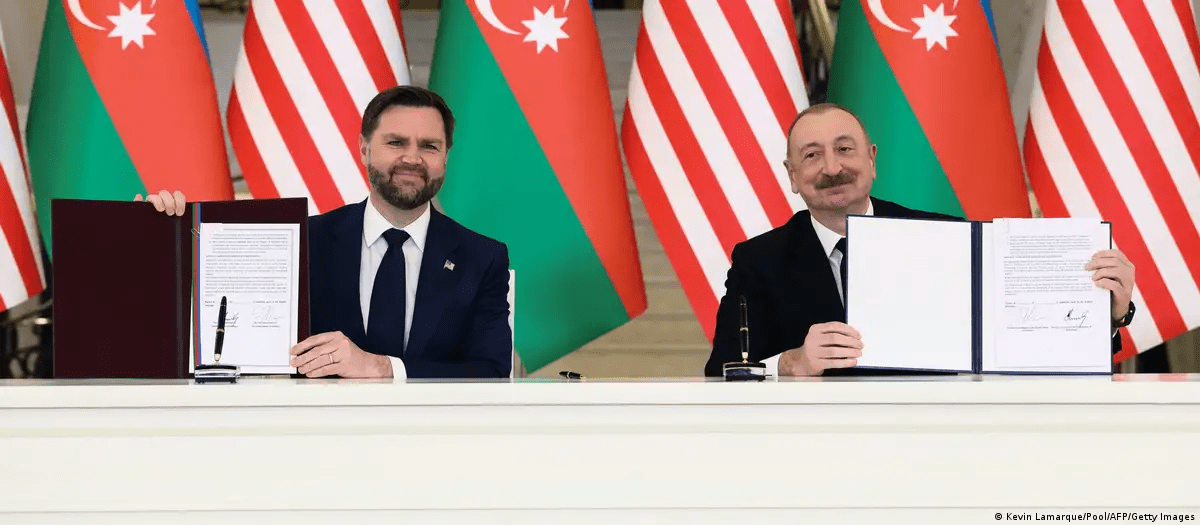
US Vice President JD Vance is on a trip to Armenia and Azerbaijan this week to back up a US-brokered peace process in the South Caucasus region with energy, defense and trade deals.
US Vice President JD Vance met with Azerbaijani President Ilham Aliyev in Baku on Tuesday and signed a strategic partnership agreement encompassing economic and security cooperation that Aliyev said would open new opportunities to work with the United States.
Vance said the US would be sending an undisclosed number of “new boats” to Azerbaijan to help with “territorial waters protection” in the Caspian Sea.
President Aliyev said that ties with the US were entering an “entirely new phase,” including with cooperating on defense sales, artificial intelligence and continued collaboration on security and counterterrorism.
Vance said the agreement “will formalize that partnership and make it very clear that the United States-Azerbaijan relationship is one that will stick.”
US expands influence in Caucasus
The US vice president is visiting Azerbaijan and Armenia as Washington seeks to expand its influence in the South Caucasus, a region where Russia has traditionally been the main power broker, but has seen its influence wane since it launched the war in Ukraine.
Part of Vance’s trip is consolidating a US-brokered peace process that was seen as a major step towards ending decades of war between Azerbaijan and Armenia over the Nagorno-Karabakh region, which for years had been an ethnic Armenian enclave. Azerbaijan consolidated control of the region after a 2023 offensive, ending three decades of by Armenian separatist rule.
US President Donald Trump brokered an agreement at the White House in August 2025, calling for both countries to renounce claims on each other’s territory and cease military action in Nagorno-Karabakh.
Before the meeting with Aliyev on Tuesday, Vance said the issue of Armenian separatist leaders imprisoned in Azerbaijan on war crimes charges was “certainly going to come up” during talks with Azerbaijani leaders.
Vance deleted Armenian ‘genocide’ post
Vance also drew controversy after he deleted a post on X stating that he and his wife Usha Vance were “at the Armenian Genocide memorial to honor the victims of the 1915 Armenian genocide.”
Armenia has long pushed for international recognition that the killing of 1.5 million Armenians in the Ottoman Empire during the World War I era was a genocide. In April 2021, then-Democratic President Joe Biden formally recognized the Armenian genocide.
Turkey, the heir to the Ottoman Empire, rejects the genocide label and bristles at its use. Turkey is a NATO ally of the US and home to the Incirlik Air Base used by the US Air Force.
Vance had visited the Tsitsernakaberd Armenian Genocide Memorial while in Yerevan. Vance’s office said the post was published in error by staff who were not part of the delegation.
Nuclear power deals in Armenia
On Monday, Vance held talks with Armenian Prime Minister Nikol Pashinyan in Yerevan, and agreed to cooperate on civilian nuclear power, including a deal allowing $5 billion (€4.2 billion) in initial US exports to Armenia, plus an additional $4 billion in longer-term fuel and maintenance contracts, the US vice president said.
Armenia is reviewing proposals from several countries, including the US, Russia, France and China, on building a new nuclear reactor to replace its old Russian-built power plant. Armenia has yet to choose a partner, but Monday’s deal is seen as increasing the chances for a US project to be selected, which would be a blow for Russia.
Trump’s ‘route for prospierity’
Vance’s Caucasus trip is also expected to advance a transport communications project integrating Armenia and Azerbaijan into a planned east-west trade route dubbed the “Trump Route for International Peace and Prosperity” (TRIPP).
The proposal calls for a road-and-rail corridor that links Azerbaijan with its Nakhchivan exclave, which cut off from the mainland by Armenian territory. It envisions integrating the region into a wider east-west trade route connecting Central Asia and the Caspian basin to Europe.
Washington is presenting TRIPP as a confidence-building measure for regional peace, and Azerbaijan has said the opening of regional communications is an important precondition for signing a comprehensive peace treaty with Armenia.
Aliyev said on Tuesday that TRIPP “will make another contribution to peace, development and cooperation in the region.”.