
Pashinyan attacks the Church to prevent exposure of agents within the government
Armenia has rapidly transitioned from a semi-democratic system to an authoritarian regime and now stands one step away from dictatorship, Tigran Khzmalyan, Chairman of the European Party of Armenia, said in an interview with Aysor.am.
“And this definition was given by Pashinyan himself,” Khzmalyan noted. “In 2018, he declared, ‘You are all prime ministers; the government, the state is you.’ By 2025, he was saying, ‘The government is me; whoever disagrees can leave.’ This means we have already become an authoritarian state and are one step closer to dictatorship.”
Khzmalyan stated that after each visit to European countries, Pashinyan reports to “Moscow, or Altai, or another center within the Russian-Turkish alliance.”
“He views Armenia through the prism of a Russian-Turkish regionalist agenda. In reality, this region is not ‘3+3’ but five against one, and he cannot fail to understand that,” Khzmalyan said.
According to the party chairman, these policies serve Pashinyan’s personal and party interests.
“He has been promised support for re-election by Aliyev, Putin, and Erdogan. Azerbaijan will demonstrate this support through temporary silence on the issue of enclaves until the elections, while Turkey, I assume, will do so by opening the border on April 24, allowing him to say, ‘Look, I brought you peace,’” Khzmalyan stated.
Khzmalyan recalled the 1938 Munich Agreement signed by British Prime Minister Neville Chamberlain with Adolf Hitler, which was presented as a peace deal but was followed by war a year later. “For us, this will result in mass emigration,” he warned.
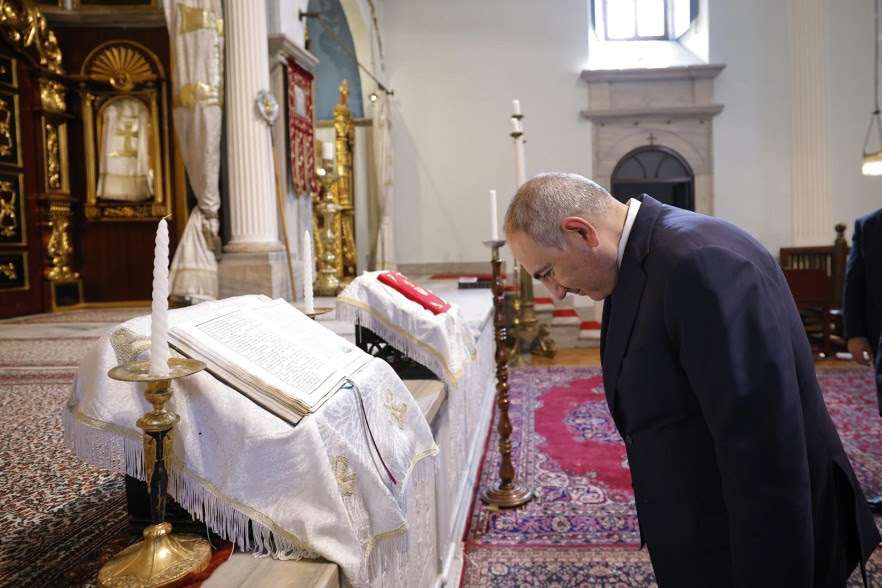
Khzmalyan also described domestic policies – particularly pressure on the Armenian Apostolic Church –as part of a broader regional strategy.
“In normal countries, national leaders seek to unite society. From day one, Pashinyan’s policy has been aimed at division and the cultivation of hatred,” he said.
He reminded that under the Constitution, the church is separate from the state and acknowledged that foreign agents may exist within church structures.
“However, KGB agents should first be sought within the government, the National Assembly, the media, the economy, ministries, the National Security Service, and the armed forces. Only after society undergoes lustration and frees itself from foreign influence will the church be cleansed naturally,” Khzmalyan emphasized.
“Pashinyan is targeting the church because it is the only institution that does not belong to him. He is doing this to avoid addressing the same issues within the spheres of governance that are under his control,” he concluded.