The ancient ‘Pink City’ with elegant boulevards, vast markets and public art Armenia’s compact capital is full of history, architectural wonders and a lively vibe
A piece of music by Handel floats across the neo-classical plaza, cueing the floodlit water to prance and pirouette in synchronised harmony with the lilting beat. The crowd cheers as a dozen jets arc skywards and camera flashes light up the buildings around the square.
This over-the-top musical fountain show is a daily occurrence that brings locals and tourists together in the gargantuan Republic Square, in the heart of Yerevan, the compact capital of Armenia.

Romans, Persians, Ottomans and the Soviets all left their mark on the country during centuries of volatility. Today, most Armenians live outside the country’s borders in diaspora communities around the world, while Armenia itself has a population of about three million.
Still, Yerevan, founded in 782 BC, is one of the world’s oldest continually inhabited cities, and today it has an intense energy to it. In summer, people stroll along its lush tree-lined streets, sit at al fresco cafes enjoying gelato and smoothies, and congregate around the much-loved musical fountain.
For visitors, it offers an intriguing alternative to the well-trodden European city break path, without coach parties or tour groups. And it’s also good value, with boutique hotel rooms widely available for less than £100 in spring and a meal at an inexpensive restaurant costing around £10. Wizz Air will launch no-frills flights to the city from Luton this June.

South-east of the centre is the Blue Mosque, covered in colourful tiles; quiet and serene, it’s the only mosque in this predominantly Christian city.
As I wander the streets, much of what I see was shaped by Alexander Tamanyan, the visionary architect who imagined Yerevan filled with green spaces, gardens and stately buildings. While there are drab Soviet-era structures, there are also verdant parks, European-style boulevards and neo-classical architecture built from striking pink tuff, a local type of volcanic stone that gives Yerevan its nickname, the Pink City.

Looming large from atop a hill is Mother Armenia, a 240ft tall copper statue of a female warrior with an eternal flame at its base. The circular Armenian National Opera and Ballet Theatre has another statue in front – this time of the Armenian composer Aram Khachaturian – and is surrounded by parks, nightclubs, cafes and shops.
My favourite part of the city is just across from the opera house. The quirky Cascade complex centres on a colossal flight of 572 stone steps built into a hillside and flanked by multi-level garden terraces dotted with fountains, art and escalators connecting the different levels.
While the concept was part of Tamanyan’s master plan in the 1920s, the bulk of what can be seen today was constructed in the 21st century – funded in part by a $128m (£95m) donation by Armenian-American philanthropist Gerard Cafesjian.

The Cascade’s design combines elements of art deco and Soviet style, while the open-air artworks by Armenian and international artists range from obese cat sculptures and giant metallic teacups to abstract paintings. There are indoor galleries, too, and a cultural centre due to be completed in the next few years.
To get a sense of Armenia’s cultural identity, I head across town to the vast Vernissage market, where walls, stalls and parked cars are used to display an odd mix of goods. Handicrafts, chess sets, backgammon boards, jewellery, books and paintings can be found alongside Soviet memorabilia, carpets, lace tablecloths and nesting dolls.
At the nearby GUM Market, vendors beam proudly over pyramids of pomegranates, stacks of thin lavash bread, strands of sujukh – walnuts dipped in thickened grape syrup – and rolled sheets of plum fruit leather.

These are just some of the flavours to be found in the Armenian capital’s food scene, which ranges from atmospheric traditional establishments to fine-dining spots like Sherep and Barev Arev. Deciding to stick with the classics, I head to Old Yerevan restaurant, where women swing lavash flatbread around their heads – both to stretch out the dough and to add a touch of drama to proceedings – before putting it in the oven. The mezze-like spread includes salads, pickled vegetables and local cheeses, as well as dolma (meat-and-rice-stuffed vine leaves) and lamadjo – Armenia’s answer to pizza.
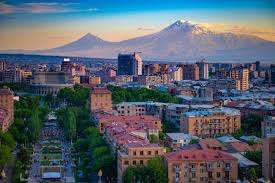
Everywhere in the city, the image I see gracing everything from wine bottles and t-shirts to the city’s coat of arms is Mount Ararat, where Noah’s Ark is supposed to have landed. While the mountain was ceded to Turkey in 1923, it continues to be the symbol of Armenia and dominates the capital’s skyline on clear days.
It also gives its name to Ararat Brandy, whose factory is housed in an imposing brick building on a hill overlooking the city. On a guided tour – ending with a tasting – the guide tells us that in 1945, Stalin introduced Churchill to Ararat Brandy at the Yalta Conference. The prime minister was so taken with the stuff that he immediately ordered 400 bottles to be delivered to him annually, for the rest of his life.
Beneath the charm and cheer of the city, the shadows of history remain. The hilltop Armenian Genocide Museum complex commemorates the death of 1.5 million Armenians who were killed under the Ottoman Empire between 1915 and 1917. It’s a sobering and deeply moving experience, with books, photographs and eyewitness accounts bringing the tragic events to life.
On my last day in Yerevan, the clouds part, and I finally catch a glimpse of Mount Ararat beyond the rooftops. Glowing in the evening sun, it’s every bit as mighty as its Biblical status would suggest, and finally seeing it is the perfect farewell to a city that surprised me, moved me and completely won me over.
Getting there
There are no direct flights from the UK to Yerevan, but one-stop services are available with airlines including Pegasus and Lufthansa. Wizz Air will launch a direct service from Luton in June. Prices will start from £36 one-way, without checked-in luggage.
Where to stay
Armenia Marriott Hotel Yerevan has doubles from $150 (£111), including breakfast.
More info