The Perils and Possibilities of the Diaspora’s New Capital
B
y Levon Baronian
Oragark
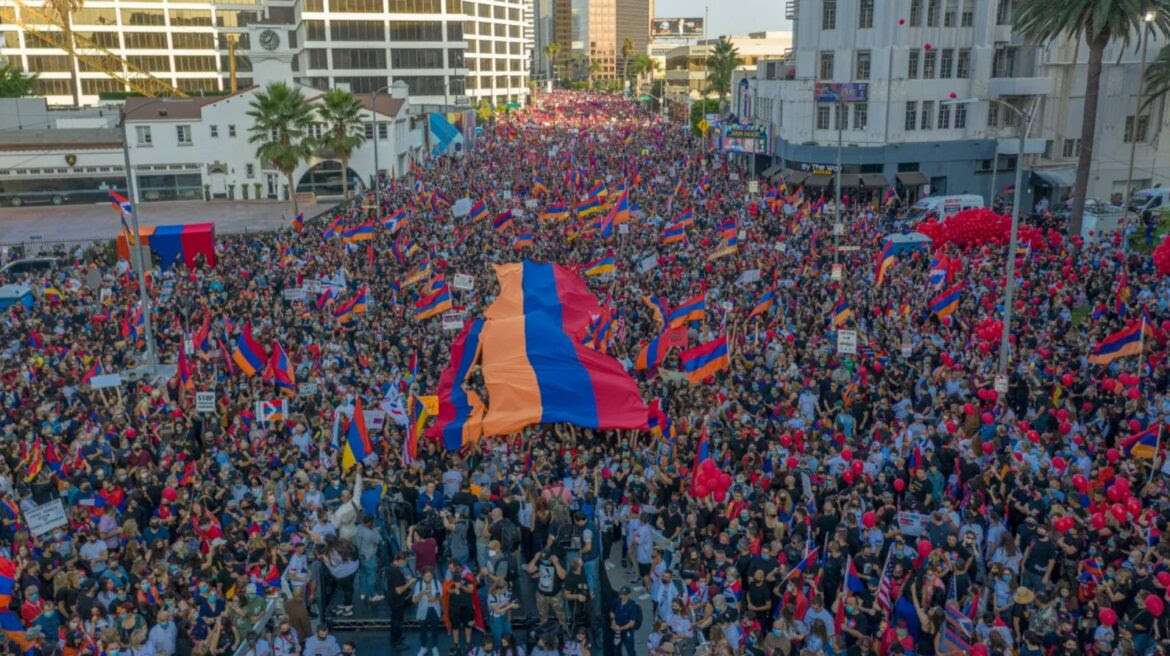
For more than a century, when Armenians spoke of the Diaspora, they usually imagined a map whose principal centers lay in the eastern Mediterranean: Beirut, Aleppo, Tehran, Cairo, Jerusalem, Istanbul. Those communities were not merely concentrations of people. They were civilizational outposts. They sustained Armenian schools, presses, churches, parties, beneficent unions, youth organizations and communal patterns of life in which Armenian identity was not an occasional performance, but a living social environment. That world, though diminished, still exists. But it no longer constitutes the demographic center of gravity of Armenian life outside the Republic of Armenia. In the twenty-first century, that center has moved decisively westward, and above all to Los Angeles. Scholarly work has explicitly described Los Angeles as the capital or informal “second capital” of the contemporary Armenian immigrant community, while studies of Glendale and the surrounding region underscore Southern California’s singular importance in the modern Armenian Diaspora.
That fact carries profound implications. Los Angeles is not simply a city with many Armenians. It is a representation of the real, new Diaspora: a Diaspora increasingly shaped not by the old post-Genocide centers of Lebanon, Syria and Iran, but by migrants from the Republic of Armenia and the broader post-Soviet Armenian world. Research on Armenian Los Angeles notes that the major immigration waves after the 1965 reforms, and especially after the collapse of the Soviet Union, transformed the social composition of Armenian America. Glendale in particular has come to embody this shift: an Armenian hub where older Diasporan streams and Armenia-born immigrants meet, overlap and reshape one another.
This demographic transformation is not a footnote. It is the central fact of Diasporan Armenian life in our time. Yet much of our institutional thinking still operates as though the paradigmatic Diasporan Armenian remains the child of Beirut, Aleppo, Anjar or Tehran. The result is a dangerous mismatch between reality and leadership. We often speak in the language of an old Diaspora while inhabiting the sociology of a new one.
The westward movement of the Diaspora is not merely geographic
For decades, the Armenian national body has been living through a westward displacement of its demographic fulcrum. This is usually described in practical terms: where Armenians find security, employment, education and stability. But the phenomenon must also be understood politically and civilizationally. Every major westward shift has moved large segments of our people farther from the Armenian homeland, farther from the daily urgency of Armenian statehood, and farther from the instinctive national reflexes that arise when a people remains regionally anchored.
The old Middle Eastern Diaspora, for all its hardships, existed in a geography emotionally and historically proximate to the homeland. Beirut was not Yerevan, but neither was it civilizationally alien to Armenian memory. Aleppo was not Echmiadzin, but it belonged to a Near Eastern world in which Armenian Christianity, Armenian communal structures and Armenian historical consciousness were legible realities. Even where Armenians were minorities, they were minorities in societies that understood durable communal difference.
The United States, by contrast, offers freedom and prosperity but also an environment of immense absorptive power. It is not merely that America is far away. It is that America is a machine for dissolving old solidarities into private success, symbolic ethnicity and eventually memory without structure.
This is why the westward movement of the Diaspora should be seen not only as a sociological process but as a national risk. A nation whose extraterritorial population becomes more numerous, more prosperous and more institutionally influential while also becoming more distant from its homeland faces a strategic contradiction: it gains resources but risks losing cohesion; it gains comfort but risks losing seriousness; it gains visibility but risks losing continuity.
The Diaspora cannot be understood as permanent
At this point, a more fundamental question must be asked: what is the Diaspora for?
Too often, Armenians speak of the Diaspora as though it were a permanent national arrangement, as though dispersion itself were a stable civilizational destiny. That is a profound error. The Diaspora is not a homeland. It is not a replacement for the homeland. It is not even, in the deepest sense, a normal condition for a healthy nation. It is an emergency historical condition—a condition born of dispossession, massacre, exile, state loss and repeated waves of forced or semi-forced migration.
A Diaspora may survive for generations, but it cannot be accepted as a permanent strategic horizon. Left to itself, it withers. Its outer shells may remain impressive—churches, organizations, banquets, schools, commemorations, respectable donors, proud rhetoric—but its internal vitality gradually drains away. Language erodes. Marriage patterns loosen. Memory becomes ceremonial. Institutions become custodial rather than generative. The people remain ethnically named, but less and less nationally formed.
The Diaspora, therefore, must be viewed as temporary national scaffolding. It is like a branch or seed of a tree placed in foreign soil in order to keep it alive until it can be rooted again in its own ground. It may survive for a time elsewhere. It may even grow leaves. But if the branch forgets the tree, or if the seed begins to imagine the pot as its permanent earth, decline becomes only a matter of time.
That is why the central orienting principle of Diasporan Armenian life must be back to Armenia.
This does not mean that every Armenian must immediately sell his home, pack a suitcase and move to Armenia tomorrow morning. Such slogans are unserious. But it does mean that every Diasporan institution, every Armenian school, every church, every political organization, every media platform and every family should be cultivating a steady, incremental, structured deepening of ties to Armenia.
The Armenian who has never visited Armenia should visit Armenia. The Armenian who visits only occasionally should visit more often. The Armenian who visits often should establish personal, professional, educational or economic ties. The Armenian who already has such ties should deepen them. The Armenian family that sends its child to Armenian school but has no lived relationship with the Republic should begin building one. The businessman should invest. The student should study there for a period. The professional should build networks. The family should create routines of travel, property, philanthropy, partnership or service.
In short, Diasporan Armenians must not merely “care about” Armenia in the abstract. They must progressively bind their lives to it.
If the Diaspora has no strategic arc toward Armenia, then it is not preserving the nation—it is merely prolonging dispersion.
Los Angeles is the new center because it has inherited both strength and fragility
Los Angeles has become the new capital of the Armenian Diaspora precisely because it combines several features no other center now possesses at comparable scale. It has numbers. It has density. It has institutional legacy. It has new immigration. It has wealth. It has media. It has educational and organizational infrastructure. And, crucially, it has become a meeting ground between old Diasporan Armenians and immigrants from Armenia itself. Glendale has been described in scholarship as an ethnoburb with substantial Armenian demographic and civic presence, and one study notes that Armenian Americans make up a very large share of Glendale’s population.
But Los Angeles also embodies the fragility of the new Diaspora. It is the place where Armenian life is most visible, yet also the place where its long-term survival will be most severely tested. We should not mistake numerical mass for national durability. A community can grow in size while shrinking in depth. It can accumulate businesses, churches, schools and nonprofit entities while still failing in intergenerational transmission. It can become loud without becoming rooted.
This is the paradox of Armenian Los Angeles: it is powerful enough to lead the Diaspora, yet not disciplined enough to do so automatically.
The American setting is more dangerous for assimilation than many Armenians admit
There remains a sentimental tendency among some Armenians to think that because the United States permits open ethnic association, Armenian continuity here is secure. That confidence is unwarranted. In reality, the American environment is more dangerous for assimilation than the environments our communities historically faced in Lebanon, Syria or Iran.
Why? Because assimilation is not only a question of tolerance or oppression. It is a question of whether a host society leaves room for thick communal continuity. In Lebanon, Syria and Iran, Armenians often lived as clearly bounded communities with their own schools, churches, parties, endowments, marriage circles and dense forms of daily collective life. Religious difference, linguistic difference and communal boundaries helped slow down dissolution. Those societies did not necessarily make life easy, but they often made full absorption difficult. Difference itself could function as a bulwark.
America works differently. It celebrates ethnicity rhetorically while dissolving it structurally. The “melting pot” does not usually demand immediate surrender; rather, it rewards gradual dilution. The first generation works. The second generation translates. The third generation remembers selectively. The fourth generation often inherits cuisine, surnames and nostalgia, but not language, institutional loyalty or civilizational discipline.
The historical record of major European-origin groups in the United States is instructive. Census data show that in 2022 about 41.1 million Americans reported German ancestry, 30.7 million Irish ancestry and 16 million Italian ancestry. Yet the broader language data tell the deeper story: English overwhelmingly dominates life in the United States, and Census reporting shows that most Americans speak only English at home. That is precisely how assimilation works in America. Ancestry survives long after thick ethnicity, communal separateness and inherited language have largely dissolved.
That is the real warning for Armenians in America. The danger is not that our children will hate being Armenian. The danger is that they will regard Armenianness as one optional adjective among many: emotionally pleasant, occasionally performative, but socially nonbinding. That form of assimilation is more lethal than open hostility, because it feels harmless while it empties a people of substance.
The Armenian problem in Los Angeles is not lack of culture, but lack of cohesion and national direction
It would be incorrect to say that the Armenian challenge in Los Angeles is a lack of cultural activity. Quite the opposite. There is no shortage of Armenian “culture” in Southern California. There are dozens, indeed hundreds, of institutions, programs and initiatives devoted to some aspect of Armenian communal life: dance groups, choirs, language classes, Saturday schools, athletic programs, church activities, scouts, student associations, cultural centers, commemorative events, media platforms and artistic programs. Armenian culture, in the narrow sense of visible and organized cultural expression, is not absent.
But culture by itself is not enough.
A nation does not endure merely because it produces dance performances, language classes and commemorative gatherings. It endures when those activities are woven into a larger national framework—when they form not a scattered collection of well-meaning efforts, but a coherent system of transmission, discipline and mobilization. That is where Armenian Los Angeles remains deficient.
The problem is not that Armenians in Los Angeles have failed to preserve cultural forms. The problem is that these forms too often exist in a fragmented and uncoordinated manner, detached from a unifying national agenda and narrative. One institution teaches Armenian language. Another teaches dance. Another organizes youth sports. Another hosts lectures. Another raises funds. Another conducts church life. Yet too often these efforts do not converge into a single civilizational project. They coexist, but they do not always function as parts of a single national organism.
As a result, the community often generates activity without generating sufficient national coherence. It produces participation without necessarily producing formation. It produces events without always producing direction. It preserves symbols without reliably transmitting a disciplined understanding of what Armenian life is for, where it must lead, and what obligations it imposes.
That is why even a large, active and visibly cultural Armenian population can remain strategically weak. A people may have abundant institutions and yet still lack the internal coordination necessary to turn numbers into organized power. It may have many cultural expressions and yet fail to produce a common national narrative strong enough to shape the next generation. In such a setting, “culture” risks becoming a collection of separate performances rather than a unified mechanism of national continuity.
Los Angeles does not suffer from a shortage of Armenian cultural life. It suffers from the absence of sufficient cohesion among the forces that sustain that life, and from the lack of a clear, organizing national purpose capable of binding them together. The real challenge is therefore not simply to preserve Armenian culture, but to bring Armenian institutions, programs and energies into a common Armenia-centered national framework. Only then can culture become not merely an expression of identity, but an instrument of continuity.
The debate over Western Armenian and Eastern Armenian is being mishandled
One of the most self-defeating habits in present Armenian discourse is the way language is too often framed as an arena of factional preservation rather than national consolidation. Concern over Western Armenian’s decline is real and understandable. But from that correct concern, some circles draw the wrong strategic conclusion. They behave as though the central linguistic question before the Diaspora is the preservation of Western Armenian as distinct from Armenian as a whole.
That approach may arise from understandable historical sentiment, but under present demographic conditions it is strategically misguided.
The first obligation of a threatened nation is to keep its children Armenian, not to turn dialectal differentiation into a battlefield of prestige. In Los Angeles especially, where the community has been transformed by immigrants from the Republic of Armenia and the post-Soviet Armenian world, any posture that implicitly treats Eastern Armenian as secondary or less authentically national is not merely parochial; it is nationally dangerous. It alienates those very Armenians whose arrival has made Los Angeles the demographic center of Diasporan life. It trains children to associate Armenian language with internal dispute. And it mistakes a part for the whole.
More than that, once the question is placed in the broader strategic framework of return and reconnection to Armenia, the current way the issue is often framed becomes even more indefensible. If the national future requires progressively strengthening the relationship between Diasporan Armenians and the Republic of Armenia, then it follows that the common linguistic bridge to Armenia must be strengthened, not weakened.
That means something simple but politically uncomfortable: our children should be taught standardized Eastern Armenian, as spoken and written in the Republic of Armenia, first. First not because Western Armenian has no value, and not because its literary and historical inheritance is unimportant, but because the primary national need is to ensure that future Diasporan Armenians can function linguistically in direct relation to the Armenian state, Armenian society, Armenian institutions and Armenian reality as it actually exists.
Only after that foundation is laid should the preservation of Western Armenian be pursued as a secondary and enriching task.
That is the rational national sequence: Armenian first, Armenia-connected Armenian first, then dialectal preservation. Reversing that order in present conditions is strategically absurd. The tragedy of our moment is that many Armenian children in Los Angeles are moving rapidly toward English dominance while adults debate which Armenian they should feel guilty about not speaking.
The real task is broader: produce Armenian-speaking children, Armenian-literate homes, Armenian-capable institutions and an Armenian public culture in which both major modern standards of the language are treated as national assets, but where the language of actual state continuity—standardized Eastern Armenian—holds priority because it is the living linguistic bridge to the Republic. A nation on the edge of language erosion cannot afford luxury quarrels.
The older Diaspora model cannot simply be imported, but neither can it be discarded
Some will argue that the old Middle Eastern Diaspora cannot be our model because its social conditions no longer exist. That is partly true. Los Angeles is not Beirut. American suburbia is not Bourj Hammoud. The state, class structure, urban geography and cultural pressures are all different.
Yet it would be foolish to discard the central lesson of the old Diaspora: Armenian life survives where institutions are thick enough to organize everyday existence. The success of historical Diasporan communities did not come from rhetoric alone. It came from schools that formed children daily, churches that were not merely ceremonial, newspapers that shaped opinion, political organizations that demanded discipline and neighborhoods in which being Armenian was not an extracurricular identity.
Los Angeles has many Armenian institutions, but too many of them still operate at a scale and mentality suited to an older, smaller community. The city and its surrounding Armenian population have grown dramatically, but the organizational imagination of the community has not kept pace. We have more Armenians than before, yet not proportionally more schools, not proportionally stronger youth pipelines, not proportionally greater Armenian-language competence, not proportionally stronger media and not proportionally more serious civic coordination. In many cases, we have inherited organizations but not expanded them to match the demographic reality before us.
That is one of the most under-discussed failures of Armenian Los Angeles: growth without corresponding institutional modernization.
Our institutions have stagnated while the population has expanded
If Los Angeles is indeed the capital of the Armenian Diaspora, then one must ask a sobering question: why does the infrastructure of that capital so often appear underscaled? Why do so many organizations still behave like custodians of legacy constituencies rather than architects of a mass national community? Why is there still so much duplication, so much complacency, so little coordination and so little data-driven planning?
This is not merely a managerial criticism. It is a civilizational one. Institutions are how a people converts population into power. If our schools cannot absorb enough children, if our churches do not command enough lived loyalty, if our organizations cannot integrate Armenia-born newcomers into common structures, if our media cannot shape a unified public conversation, if our youth institutions do not scale with urgency, then Los Angeles will remain a symbolic capital rather than an effective one.
A true capital does not merely host a population. It organizes it.
And here another problem emerges: many Armenian institutions in Los Angeles still imagine their role primarily as preserving inherited sub-communities rather than forging a new Diasporan synthesis. But the new Armenian Los Angeles cannot be built as a museum of separate memories. It must become a political, linguistic, educational and cultural framework capacious enough to integrate descendants of genocide survivors from the old Diaspora, immigrants from Soviet and post-Soviet Armenia, newcomers from Russia and Ukraine, Armenian-speaking professionals, working-class families, mixed-background households and increasingly American-born youth. The old institutions often know how to preserve circles; they have been less successful at organizing a total community.
If Los Angeles is the capital, its institutions must become Armenia-centric
Once one accepts that the Diaspora is not an end in itself, but a temporary national condition whose legitimacy rests on strengthening Armenia, a further conclusion follows. Diasporan institutions should no longer define success merely by local attendance, fundraising totals, banquet culture or symbolic ethnic preservation. They should be judged by the extent to which they increase the real, lived, cumulative connection of Armenians to Armenia.
This means Armenia-centric programming must cease to be peripheral and become central.
Armenian schools should not merely “teach about Armenia”; they should produce graduates who can function in Armenian, travel in Armenia, study there, work there and imagine a serious future relationship with the Republic. Churches should not speak of Armenia only in moments of catastrophe, but as an ongoing axis of communal life. Youth organizations should build repeated, structured and escalating Armenia engagement, not one-off sentimental trips. Professional networks should create pathways for internships, business formation, investment, consulting, relocation options and long-term partnerships. Media should normalize Armenia-oriented life choices rather than treat them as exceptional.
The institutional question is no longer whether Diasporan Armenians love Armenia. Most do, at least emotionally. The question is whether our institutions are converting that emotion into structure.
Too often, they are not.
The current regime in Armenia is widening the rupture, not healing it
This institutional failure becomes even more dangerous in light of the ideology now being advanced by Nikol Pashinyan’s government. Pashinyan has publicly promoted what he calls the doctrine of “Real Armenia,” including in official remarks in late 2025 and again in public messaging in 2026. Official coverage presents this doctrine as rooted in history and centered on the present Republic and its current state framework. Whatever one calls it, the effect has been to narrow the national imagination and to deepen, in the eyes of many Armenians, the conceptual separation between the Republic and the Diaspora.
His defenders present this as realism. But whatever label is applied, the political outcome is the same: Diasporan Armenian attachments, historical claims and national instincts are increasingly treated not as strategic assets to be integrated, but as energies to be managed, domesticated or sidelined. A government that teaches Armenians to shrink their national horizon to a regime-approved formula does not heal dispersion; it normalizes it.
That is why Diasporan institutions must not respond to this ideological drift by becoming quieter, more cautious or more detached. They must do the opposite. If the current government in Armenia advances frameworks that separate the Republic from the Diaspora, then Diasporan institutions have an even greater duty to counter with amplified Armenia-centric programs, deeper people-to-people integration, stronger educational ties, greater student exchanges, more investment, more visits, more partnerships, more Armenian-language competence and more insistence on one indivisible Armenian national body.
The answer to a regime-centered narrowing of the national idea must be a broader, deeper and more unapologetic Armenia-centeredness from below.
Los Angeles has the capacity to become more than a refuge
There is another mistake Armenians sometimes make when speaking about Los Angeles: we describe it as though its significance were merely demographic. But a community of this size, density and visibility can do much more than preserve remnants. It can produce power.
Los Angeles can shape Armenian media narratives globally. It can influence philanthropic priorities. It can produce scholarship, literature, entertainment and policy networks. It can train clergy, teachers, organizers and intellectuals. It can anchor durable Armenia-Diaspora exchange. It can help define the terms on which the Diaspora relates to the Republic of Armenia. It can also serve as the principal site where a unified modern Armenian identity is renegotiated under new historical conditions.
But none of that happens automatically. Armenians in Los Angeles must stop thinking of themselves merely as a successful immigrant cluster and start thinking of themselves as bearers of national responsibility. That means acting less like a prosperous ethnicity and more like a dispersed nation.
A prosperous ethnicity asks how to preserve customs.
A dispersed nation asks how to secure continuity, sovereignty and organized collective life across generations.
The difference is everything.
The relationship with the Republic of Armenia must be re-centered
Because Los Angeles now reflects the new Diaspora, it must also rethink its relationship with the Republic of Armenia. The old Diaspora often understood itself as guardian, benefactor and moral witness. Those roles still matter. But the demographic rise of Armenia-born Armenians in Los Angeles changes the equation. The Diaspora is no longer dealing only with a distant homeland populated by others. More and more, the homeland has arrived inside the Diaspora itself.
This is one reason the internal opposition between “Diasporan Armenian” and “Hayastantsi” has become so destructive. It is an outdated distinction masquerading as cultural sophistication. In demographic, political and civilizational terms, the future Armenian Diaspora cannot survive if it treats Armenians from the Republic as culturally useful but institutionally secondary. Nor can it survive if Armenia-born Armenians remain detached from Diasporan institutions. Los Angeles must become the place where these two historical streams are fused into one national body.
That fusion will not occur through slogans about unity. It will require concrete adaptation: language instruction aligned with Armenia while preserving broader Armenian literacy; institutional leadership that reflects new demographics; media that speaks across internal Armenian divides; and communal standards that privilege national continuity over old-status reflexes.
The choice before Los Angeles is historic
Los Angeles is already the new capital of the Armenian Diaspora in demographic and symbolic terms. The question is whether it will become such in strategic and civilizational terms as well.
If current trends continue without correction, the likely outcome is clear enough: a large, visible, prosperous Armenian-descended population with partial memory, weakened language, attenuated institutions and increasingly symbolic ties to Armenia. In other words, Los Angeles could become the site of the greatest Armenian Diasporan success in numbers and the greatest Armenian Diasporan failure in transmission.
But that outcome is not inevitable.
The same city that magnifies assimilation also makes possible scale. The same American openness that dilutes identity also permits institution-building. The same demographic transformation that has unsettled older communal assumptions also offers the raw material for a renewed Armenian national life, broader than before and more closely tied to Armenia itself.
That will happen only if we abandon comforting illusions.
We must stop confusing population growth with national strength.
We must stop treating the Diaspora as a permanent national condition.
We must stop treating language debates as inheritance disputes while our children drift into English.
We must stop organizing twentieth-century institutions for a twenty-first-century demographic reality.
We must stop speaking as though the Armenian Diaspora still revolves around old centers that no longer carry the same demographic weight.
And above all, we must stop assuming that Armenian continuity in America will take care of itself.
It will not.
Los Angeles is the new capital of the Armenian Diaspora. But a capital is not simply a place where many Armenians live. A capital is the place where a nation organizes its future. If Los Angeles is to deserve that title, then its institutions must understand that the purpose of Diasporan life is not to perfect dispersion, but to overcome it. Not by fantasy. Not by slogans. Not by demanding that every Armenian uproot himself overnight. But by systematically orienting Armenian life, generation by generation, back toward Armenia.
If we meet that challenge seriously, Los Angeles can become not the cemetery of Armenian depth beneath the glitter of ethnic success, but the place where a new and more unified Armenian national life is forged—one that understands the Diaspora as temporary stewardship and Armenia as the permanent center.
If we fail, history may record that the Armenian nation built its largest Diasporan center precisely where it forgot what the Diaspora was for.
A capital is not defined by numbers alone. It is defined by whether it can turn numbers into destiny—and whether it knows where that destiny belongs.